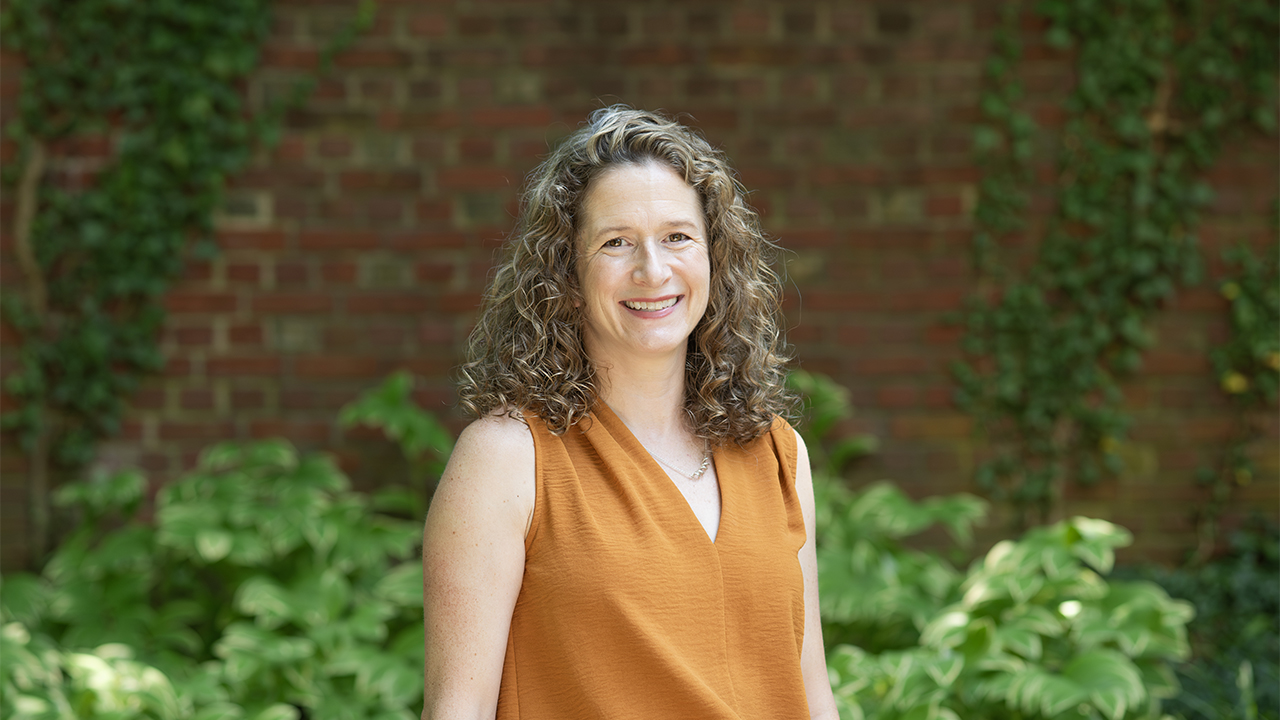
Biotechnologist Sarah Glaven joins Andlinger Center as Gerhard R. Andlinger Visiting Fellow to scale sustainable biomanufacturing
Bringing over 16 years of experience as a researcher and White House top scientist for the bioeconomy, Sarah Glaven has joined the Andlinger Center as a Gerhard R. Andlinger Visiting Fellow to chart a sustainable future for the biomanufacturing industry.
As a fellow, Glaven will work with Z. Jason Ren, a professor of civil and environmental engineering and the Andlinger Center for Energy and the Environment, to apply a net-zero emissions framework originally developed for the water and wastewater sector to the emerging biomanufacturing industry.
“Biomanufacturing is an industry of the future,” Glaven said. “Almost anything that we make today with petrochemicals, we’ll be able to make with biological systems. But as the industry scales, we need to make sure that it actually backs its claims about sustainability.”
As a visiting fellow at the Andlinger Center, Glaven brings considerable experience in the biotechnology sector that spans research, policy, and innovation.
For over a decade, Glaven was a research scientist at the United States Naval Research Laboratory, where she studied the underlying biological processes by which some marine bacteria can reduce carbon dioxide without sunlight.
In 2023, she joined the White House Office of Science and Technology Policy as a Principal Assistant Director to lead the implementation of the Biden administration’s executive order on biotechnology and biomanufacturing. In the role, she coordinated across all federal departments and agencies to align a $15 billion budget in biotechnology and biomanufacturing.
She also previously worked at the Pentagon to establish and lead the $300 million Tri-Service Biotechnology for a Resilient Supply Chain program, building public-private partnerships to scale defense-related biomanufacturing.
“I have both the scientific and the policy background to not just contribute to our basic understanding of biotechnology, but also to have conversations with stakeholders about what the biomanufacturing industry needs to scale sustainably,” Glaven said. “That sweet spot — where technology, energy and the environment, and policy overlap — is where my experience and the Andlinger Center’s mission intersect.”
In addition to working with Ren, Glaven plans to work more broadly to grow Princeton’s involvement in biomanufacturing by uniting faculty across the Andlinger Center, Omenn-Darling Bioengineering Institute, and School of Public and International Affairs to build a more robust program around biotechnology. She is also collaborating with Joshua Atkinson, an assistant professor of civil and environmental engineering and the Omenn-Darling Bioengineering Institute, on a research project to engineer bacteria with improved electron transfer capabilities.
“Outside of the healthcare realm, biotechnology and biomanufacturing aren’t often included in conversations about the technologies we need to decarbonize our industrial sectors,” Glaven said. “One of my goals during my fellowship is to act as a bridge between researchers, innovators, and policy experts to advance the role of biomanufacturing in achieving a net-zero chemicals sector.”
The Gerhard R. Andlinger Visiting Fellows program is designed to attract distinguished visitors who will collaborate with Andlinger Center faculty, researchers, and students, and enrich the research and teaching at the Andlinger Center.
Funding is provided by The Gerhard R. Andlinger Visiting Professorships in Energy and the Environment Fund.