Date: February 26, 2026
Time: 12:30 p.m. - 1:30 p.m.
Location: Maeder Hall Auditorium
Highlight Seminar Series
Projected impacts of data centers and cryptocurrency mining on U.S. electricity costs and emissions
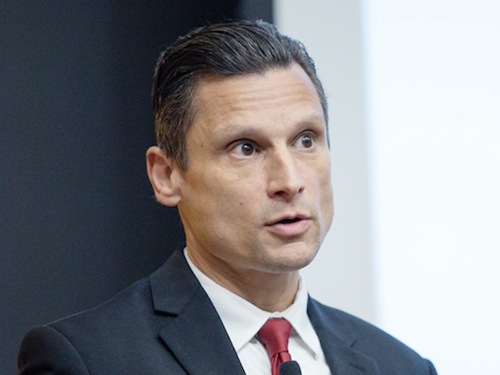
Joseph DeCarolis
Department Head and Professor, Engineering and Public Policy, Carnegie Mellon University
Abstract
Rapid growth in electricity demand from data centers and cryptocurrency mining has already begun to affect the U.S. electricity grid, with impacts likely to grow over the next five years. We use a detailed energy system optimization model to evaluate how projected demand through 2030 may influence electricity generation, infrastructure investment, emissions, and costs across a range of scenarios. Our approach models power sector capacity expansion, retirements, and dispatch decisions across 26 interconnected U.S. power regions, while accounting for policy constraints and spatial variation in renewable resources and transmission infrastructure. Results suggest that growth in data center and cryptocurrency demand could increase U.S. power sector CO₂ emissions in 2030 relative to a no-growth baseline. Regional effects vary substantially, with the largest demand increases concentrated in Northern Virginia and Texas. Energy costs, measured using demand-weighted marginal locational prices, could rise significantly in some regions. However, early model results also suggest that complementarities in load profiles between winter-peaking heat pump demand and summer-peaking data center cooling loads can improve infrastructure utilization, potentially mitigating or even offsetting regional price increases.
Bio
Joseph DeCarolis is a Professor and Head of the Department of Engineering and Public Policy at Carnegie Mellon University. His research focuses on conducting rigorous, impartial energy systems analysis to inform sustainable energy system development. From 2022 to 2025, he served in a Senate-confirmed role as Administrator of the U.S. Energy Information Administration, one of the thirteen principal statistical agencies within the U.S. federal government. Under his leadership, EIA prioritized transparency and accessibility of its products and embarked on a bold new effort to revamp its long-term modeling program. From 2008 to 2025, he served as a professor in the Department of Civil, Construction, and Environmental Engineering at NC State University.
All seminars are held from 12:30 p.m. to 1:30 p.m. Lunch is provided at 12:00 noon.
Contributions to and/or sponsorship of any event does not constitute departmental or institutional endorsement of the specific program, speakers or views presented.
Visit our Main Highlight Seminar Series page at acee.princeton.edu/highlight-seminar-series for more info.