A key to 3D-printing tougher concrete lies deep in the ocean
3D-printed concrete has promised to cut construction costs, boost speed, and help engineers and architects execute intricate designs. But one major limitation has held the technology back: cement-based materials are mostly brittle. They can carry large loads, but once cracks form, those cracks can spread suddenly and catastrophically.
Now, engineers at Princeton have developed a multi-material 3D-printing approach that helps overcome this limitation. Taking inspiration from a deep-sea creature called a glass sponge, a team led by Reza Moini has developed a technique to print cement-based composites that are far more resistant to cracking and deformation while retaining load-bearing capacity.
In an April 9 article in Advanced Materials, the research team described how they programmed a custom, multi-material 3D printer to place thin polymer layers within printed mortar. The result is a concrete-polymer composite that achieves up to 187-fold higher fracture toughness and 22.6-fold greater ductility than conventional cement-based materials like concrete, while recovering strength to statistically comparable levels. Aimane Najmeddine, an associate research scholar at Princeton Engineering and the paper’s lead author, said the technique brings together material design, engineering mechanics and manufacturing control.
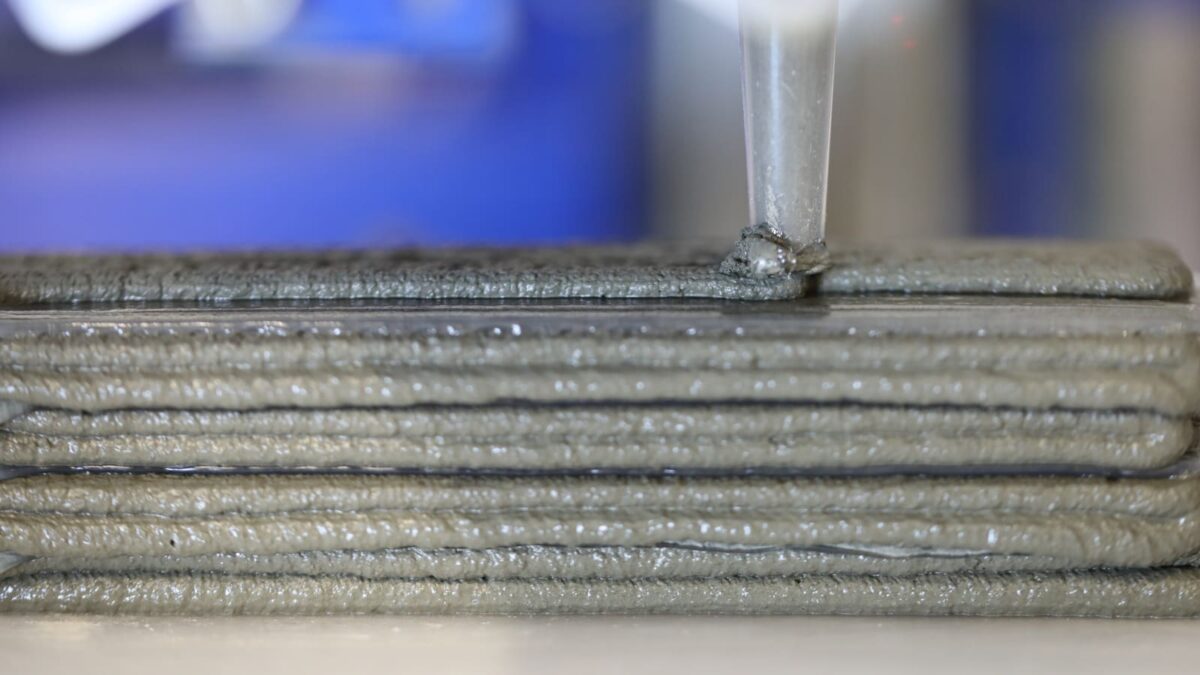
“The key idea is not just to print mortar and polymer together, but to design how they work together,” Najmeddine said. “By controlling the material combination and turning the layered geometry into a design framework, we can activate toughening mechanisms that ordinary concrete does not have.”
Multi-Material Additive Manufacturing could be a game changer for construction
Moini, an assistant professor of civil and environmental engineering and associated faculty at the Andlinger Center for Energy and the Environment, said the work is a possible breakthrough for additive manufacturing in construction. That’s because most concrete structures are not made with concrete alone – instead builders use reinforced concrete, which incorporates steel bars as reinforcement. The concrete is strong in compression but brittle in tension. The steel counters this by carrying tensile forces, controlling cracking, and improving ductility.
“By incorporating secondary materials into concrete 3D-printing, we open a new degree of freedom that can help rethink both how we define concrete as a composite material and how we design reinforced concrete,” Moini said.
The Princeton approach explores a different path than conventional single-material 3D-printing with concrete: using multi-material printing to engineer how concrete cracks. This results in a new class of concrete, Architected Cementitious Composites (ACC), which can serve as the basis for new composite structures or work alongside existing material like reinforced concrete.
Absorbing energy to prevent failure
In ACC structures, the polymer layers do not act like steel rebar. Instead, they function as thin, soft interlayers that interrupt, redirect, and redistribute the cracks. As cracks move through the hard concrete, the soft layers can arrest or deflect them, bridge the damaged regions like a band aid, and force cracks to re-form in subsequent concrete layers. These mechanisms allow the composite to absorb far more (fracture) energy before complete failure and improve its ultimate load bearing capacity.
“Single materials only take you so far. Composites, on the other hand, usually provide better mechanical properties than a single material if they can be made and engineered properly,” Moini said. “We have a new framework to put materials together in an additive fashion and tailor the overall capability.”
Moini said the printer offers designers new ways to combine dissimilar materials, control the geometric arrangements of layers and beads, and make composite structures. By controlling the geometry of how the materials are arranged, as well as the properties of each material, he said users can create new composites with improved mechanical performance at large scales, building upon existing large-scale development in additive construction. Building construction is one possible application.
“For instance, 3D-printed walls are fabricated using concrete boundaries and later filled with insulating materials,” he said. “The proposed technique can easily be adopted by current gantry and robotic systems, by adding the secondary print head, that can allow co-printing polymers alongside concrete that can serve as insulation as well as a load-bearing composite.”
Inspired by nature, the work combines soft layers with hard ones
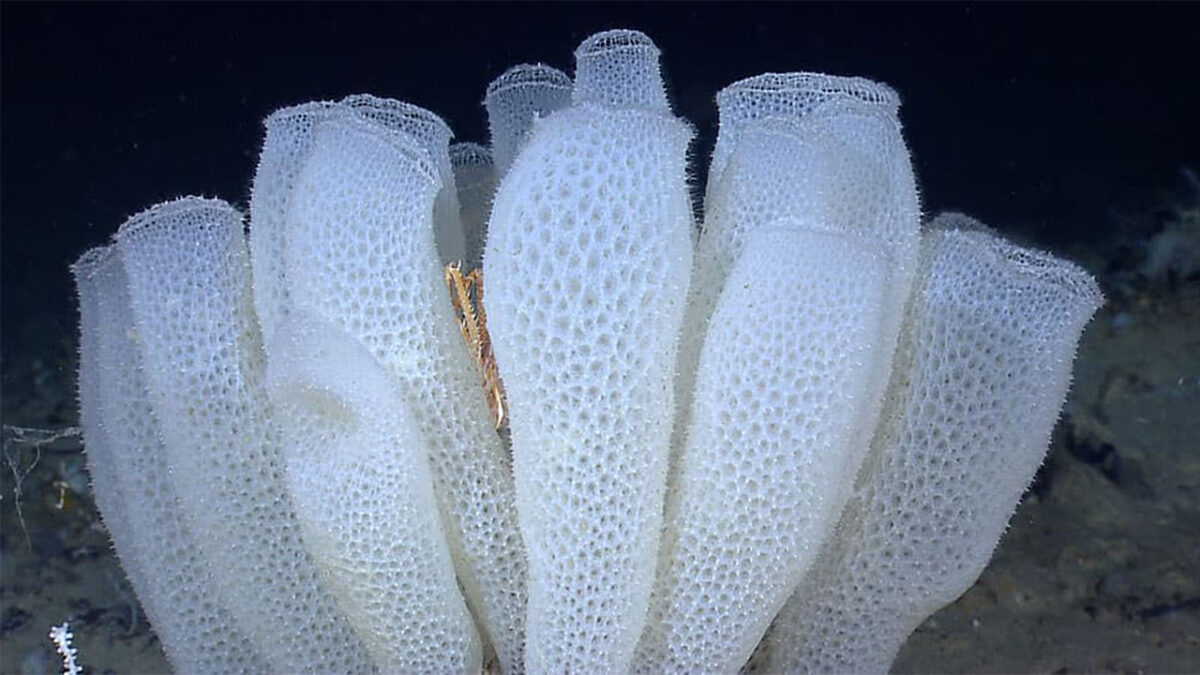
The work was inspired by Euplectella aspergillum, a deep-sea glass sponge whose skeleton contains alternating hard and soft layers. Commonly called Venus’s flower basket, the sponge lives deep in the ocean and builds its skeleton into a lattice of silica (the main component of glass.) The sponge’s soft layers arrest and deflect cracks that occur in the skeleton before they spread and shatter the glassy structure. The result: a complex and delicate structure that is both strong and extremely tough. One of the features that interested the Princeton team was its layered hard-soft architecture.
“We were inspired by the layered architecture of the deep-sea glass sponge,” Najmeddine said. “Its skeleton contains hard and soft phases arranged in a way that helps prevent cracks from spreading catastrophically.”
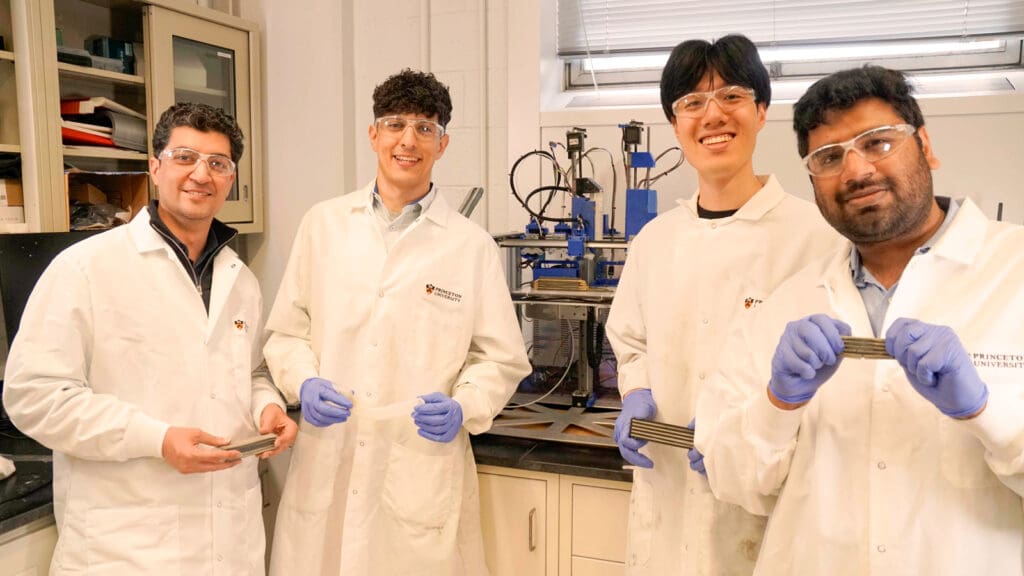
Moini’s lab frequently draws inspiration from natural materials. In previous work, the research team took inspiration from the mother-of-pearl that lines seashells to develop a technique improving the crack resistance of ceramics like cement and porcelain. Similar work has derived architected design themes from fish scales for 3D-printing tougher concrete.
“Through evolution, nature has developed really intricate ways to optimize performance using modest materials,” Moini said.
Polymer additive manufacturing required careful planning and calibration
The Princeton research team designed a computer-guided 3D printing system and a digital workflow that can alternate extrusion between concrete and polymer layers. The researchers first worked with silicone interlayers and found that layered mortar-silicone composites achieved major improvements in fracture toughness and ductility compared with monolithic 3D-printed and cast mortars. They then used computational modeling to study how the thickness and stiffness of the soft layers affected mechanical performance. The simulations suggested that thinner and stiffer interlayers could preserve load-bearing capacity while dramatically increasing fracture resistance.
Guided by those results, the team printed composites with thin polyurethane interlayers. These mortar-polyurethane composites achieved the largest improvements in fracture resistance (up to 187 times) and ductility (up to 22 times) while recovering flexural strength to levels statistically comparable to monolithic mortar references.
“The soft polymer layer cannot simply be added arbitrarily,” Najmeddine said. “Its thickness and stiffness have to be designed together. If it is too thick or too soft, the composite loses load-bearing capacity. But if it is sufficiently thin and mechanically tuned with the properties of the hard concrete and the interfaces, it can redirect cracks, bridge damaged regions, and greatly increase fracture resistance without sacrificing strength.”
Najmeddine said in many ways the increased stiffness led to better performance because the stiffer polymer improved the stress transfer across concrete-polymer interfaces, which in turn contributed to the substantial increase in load-bearing capacity while simultaneously resulting in two orders-of-magnitude higher resistance against cracking compared to conventional concrete.
“The cementitious formulation used in this project is no special concrete. The innovation is in combining it with various polymers. One of the important findings was that the soft phase must be carefully minimized and mechanically tuned,” said Shashank Gupta, a graduate student at Princeton and one of the article’s co-authors. “Thinner, stiffer interlayers helped recover load-bearing capacity while still preserving the crack-arrest, bridging, and crack-deflection mechanisms responsible for toughening.”
The work began with an undergraduate thesis
Moini said the work on the project began in May 2021, with a key contribution from William Makinen, an undergraduate working in the lab. Makinen, who graduated in 2022, championed early work and chose the topic of multi-material concrete 3D-printing for his senior thesis project. The team continued with the work for the next several years, perfecting the printing controls and workflow.
The team intends to continue research into the technique. Moini said the approach could open new possibilities for printed infrastructure materials that need both load-bearing capacity and high resistance to damage or can absorb heat and insulate concrete. Future applications may include structural walls, facades and protective elements. The technique could also be used for infrastructure components exposed to impact, vibration, wind, waves or seismic loading. Further work is needed to scale the approach and evaluate performance under full structural and environmental conditions.
“This work broadens the design space for concrete 3D-printing technology as well,” Moini said. “It shows that multi-material additive manufacturing can be used not only to shape better cementitious materials and how they fracture, deform, and resist damage, but also to engineer new functions such as thermal regulation and insulation that we could not easily attain otherwise.”
This article was originally published on the Princeton Engineering website.