Industry, academic, government experts convene to work toward biomanufacturing strategy
Experts from academia, industry, finance, government, and NGOs gathered on the Princeton University campus in April to build a strategy framework that reflects the interconnectedness between current challenges in biomanufacturing scale-up and a future industry that’s highly efficient, competitive, and enduring.
The workshop’s talks and discussions focused on three critical domains: feedstocks, process technology, and energy and power. Over the course of the day, attendees explored how industrial innovation across these domains might be leveraged to realize the full potential of biomanufacturing in terms of product costs, waste reduction, and economic growth.
“The U.S. has traditionally been very good at innovation research,” said Sarah Glaven, the Gerhard R. Andlinger Visiting Fellow who led the event, in her opening remarks. “But when it comes to scaling up and or scaling out and actually building at a production level that’s going to result in commercialization, that’s not something that the government has traditionally supported through financial incentives.”
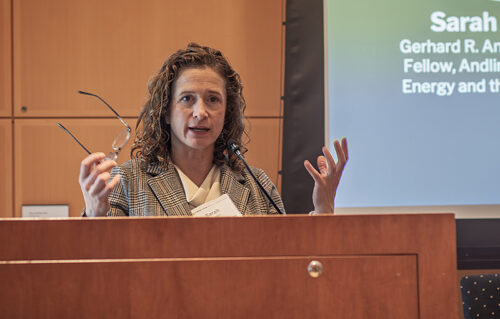
In her remarks, Glaven painted a picture of a world in which materials and molecules are available for everyday life thanks to an on-demand manufacturing approach which taps into renewables to increase efficiency while reducing pollution. She said the goal of the workshop was to have conversations that would not only probe potential solutions to current manufacturing challenges, but also envision how future biomanufacturing systems could leverage early-stage technologies.
During the first half of the day, speakers and discussions concentrated on unpacking the obstacles confronting the biomanufacturing industry, where cost, available infrastructure, and product-market match often constrain commercialization.
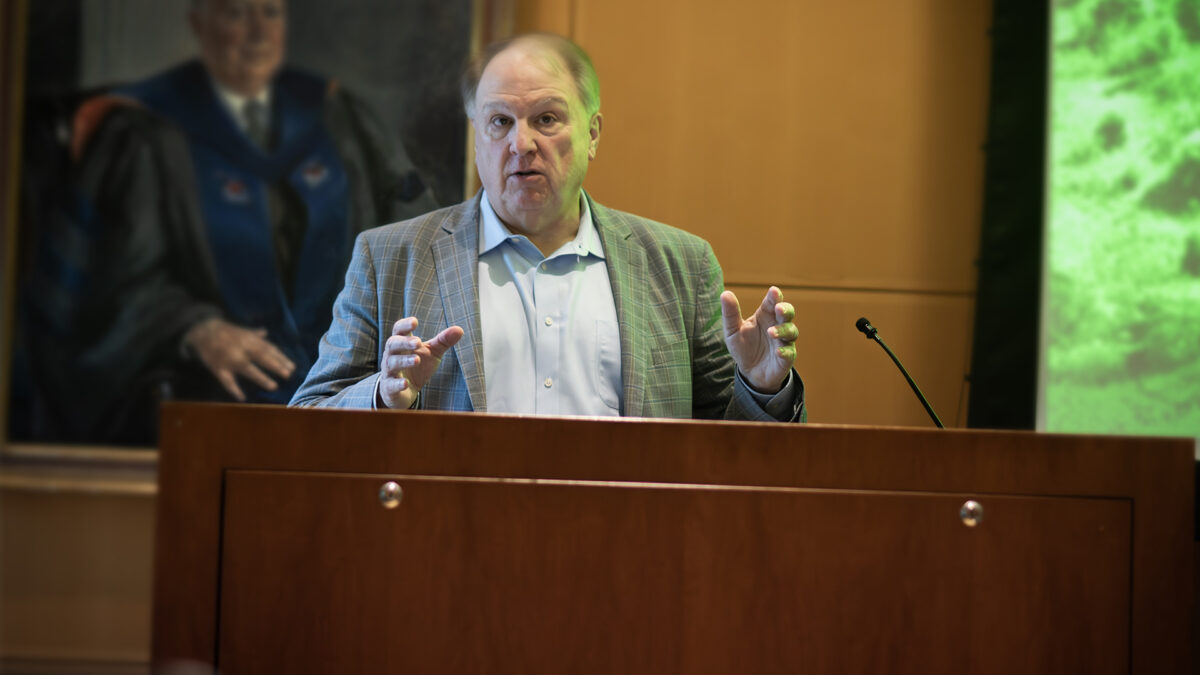
“Our core bottleneck is not technology,” said Mark Warner, chief technology officer for the contract manufacturer Liberation Bioindustries, during his morning keynote presentation. “It’s manufacturing capacity.”
As a cautionary tale, Warner discussed the case of semiconductors. Although semiconductor chips were invented by Bell Labs in the 1940s, during the 1980s, chip manufacturing began to move overseas. “Where manufacturing goes, the research and development follows,” said Warner. “If all we’re going to do is put money in the R&D, we’re going to lose that leadership if we don’t have commitment to manufacture the products.”
A series of lightning talks following Warner’s keynote further expanded on other considerable bottlenecks including supply chain management, cost management as production scales, and commercial development of products for market adoption.
“Supply chain and value chain management are infinitely complicated in their composition,” said Terry Yosie, the former president and CEO of the non-profit World Environment Center, during his talk. “Some individual companies literally have tens of thousands of suppliers.”
Using local feedstock to simplify biomanufacturing supply chains reduces the risks of unethical labor practices along the line and prevents loss of product availability due to geopolitical tensions from war or tariffs.
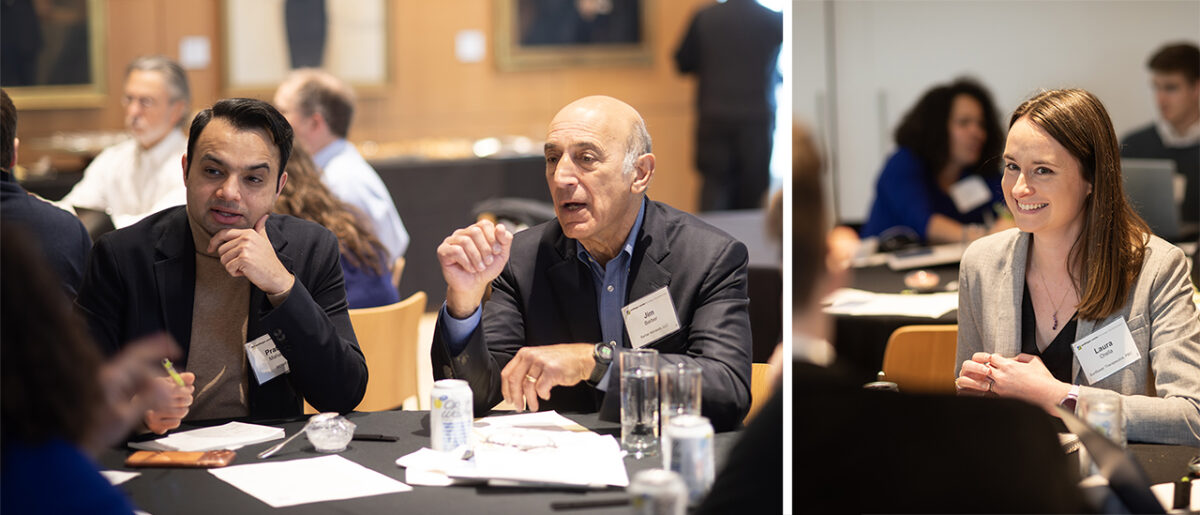
In the roundtable discussion groups, the workshop attendees worked together to identify key challenges in biomanufacturing today, specifically within the pillars of process technology, feedstocks and energy and power. Discussions centered around the effects of power availability and operational costs, growing biomanufacturing capacity in the U.S. while navigating a lack of funding for first-of-a-kind facilities, and how to take advantage of biomass feedstock while protecting natural resources.
During a lunch session focused on feedstocks, Andlinger Center for Energy and the Environment Director Iain McCulloch addressed the attendees. “If biomanufacturing is going to realize its full potential in the U.S., feedstocks can’t be a footnote, but rather the starting point,” said McCulloch. “Where they are, what they are, what they cost, how they move, and what tradeoffs that all implies will constrain what’s technically feasible, economically viable, and politically durable.”
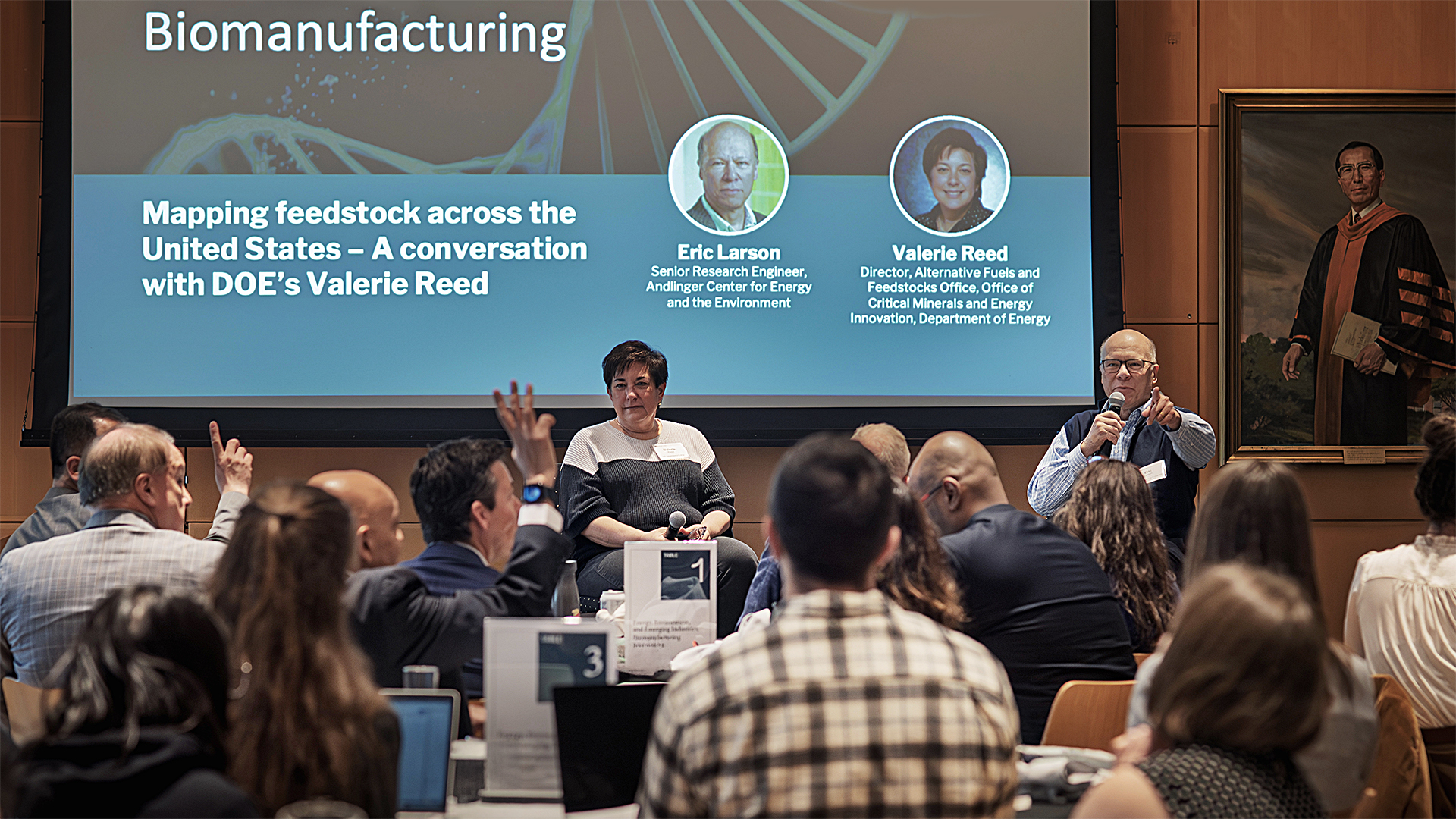
Director for the Alternative Fuels and Feedstocks Office at U.S. Department of Energy (DOE) Valerie Reed then sat down in conversation with Eric Larson, senior research engineer at the Andlinger Center, to talk about the government’s role in scaling and funding biotechnology.
Reed invoked the imagery of a laboratory scientist making a potentially massive discovery in the bioenergy space, but being unable to scale it without the market agreeing the discovery is bankable. “In order to move up the technology readiness level, you have to have somebody on the other end saying, ‘I’m going to buy it,’” said Reed. “And so for us, public-private partnerships are essential.”
Discussions in the second half of the day focused on new innovations in biomanufacturing that can help overcome the earlier identified challenges.
“We should think about how we can, out of the box, concentrate and create hubs and synergies for biomanufacturing like has been done for the fossil fuel industry,” said Prateek Mahalwar, CEO of Bioweg, in his afternoon keynote. “If we think from that angle, it will make biomanufacturing cheaper, more adaptable and scalable in the future.”
Headquartered in Germany, Bioweg produces bio-based alternatives to fossil-fuel-based microplastics – which are now banned in Europe – for use in cosmetic products, agriculture, and more. Mahalwar discussed how the company has planned to reduce costs through industrial symbiosis with a sugar producer, using waste streams as feedstock and waste heat to cut energy costs. He also emphasized China’s example of rapidly developing faster and cheaper manufacturing plants as a motivation for Bioweg to use the same approach.
Microfactories – flexible, highly automated small-to-medium scale manufacturing facilities – were highlighted in an afternoon lightning talk from Laura Orella, director of R&D for Sunflower Therapeutics.
“We’re able to do full end-to-end automation and make the process smaller and simpler,” said Orella, who pointed out biopharma processes are typically expensive, highly manual, and slow.
The CEO of Capra Biosciences, Liz Onderko, shared how her company’s full-stack biomanufacturing process was designed to be modular and allow on-demand processing while maintaining a fully domestic supply chain. Having these factors “allows you to scale up your production capacity much more quickly and more cost effectively,” said Onderko.
At the second set of roundtable discussions, attendees explored promising innovations in the three critical domains that would advance biomanufacturing to the future laid out in the opening remarks: feedstocks, process technology, and energy and power.
The solutions to biomanufacturing challenges and other insights proposed by the workshop attendees over the course of the day will be used to create a set of principles which will serve as the foundation of a biomanufacturing strategy framework put together by Glaven. The framework will identify a set of recommendations for consideration by policymakers, investors and government sponsors.
“There is a role for all stakeholders to achieve a future vision for biomanufacturing that is efficient, reduces waste, and ensures technological competitiveness,” said Glaven.
Related articles: