Accelerating progress in clean energy technologies and water management: rethinking ion separations
Technologies that filter dissolved minerals—often present as charged particles or ions—are already an indispensable part of industries from water treatment to food, beverage, and chemical production, but it is easy to overlook their increasingly critical role for the global transition to a more sustainable energy and resource economy. Effective ion filtration materials and processes are also essential to emerging technologies for energy conversion and storage, critical resource recovery, and environmental protection, but many emerging separation problems exceed the capabilities of currently available materials. Unfortunately, however, developments in ion separation technology too often occur application-by-application, preventing growth in one area from benefiting others.
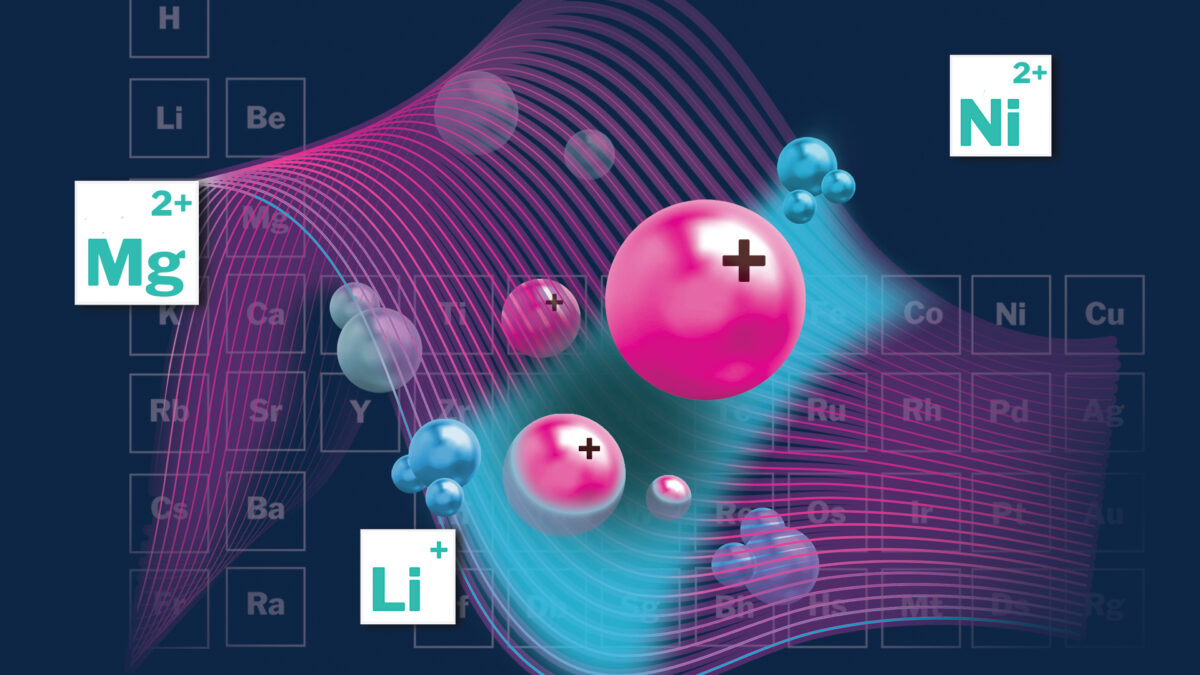
 Ryan Kingsbury, an assistant professor of civil and environmental engineering and the Andlinger Center for Energy and the Environment, hopes to change that. In a recently published perspective article in the journal Joule, he proposed a holistic approach to organizing the diverse physical and chemical factors influencing ion separations into a “periodic table of ions.” The perspective lays out a guide to help researchers navigate the complex landscape of processes, materials and mechanisms associated with emerging ion separation challenges and aims to enable research that will play an essential role in new energy technologies, environmental adaptation, and the evolution of a more circular economy. We spoke to Kingsbury to ask about his vision for the field and his group’s efforts to think differently about improving selectivity in ion separations.
Ion separations have been used in many industries for a long time, from water desalination to wastewater treatment. Why do you think it’s important to accelerate and advance the field now?
Ion separations are very relevant to energy and the environment. Everything from water supply to critical minerals for energy technology to dealing with pollution: that’s all ion separations. Ion-selective materials like membranes and electrodes are also ubiquitous components of electrochemical devices such as electrolyzers for hydrogen fuel production, redox flow batteries for energy storage, catalytic carbon dioxide reduction cells, and technologies for electrified chemical manufacturing and even agriculture. Nearly all electrochemical devices require ion-selective filters – also called membranes – to separate the anode and cathode compartments.
With all these applications, it’s clear that if progress in the ion separation field is slow and disjointed it will limit how quickly we can expect advances in new energy technologies, resource recovery and environmental protection: all areas that we need to accelerate now.
What is it about the current research approach that you feel needs to be rethought?
Historically ion separation technology has not needed to be very specific to individual ions. Take water desalination for example. We have well-developed technology for water desalination, and for that, you just want to filter everything out of the water. But when you consider a more circular economy where you want to harvest certain valuable resources in the process, I would say that the paradigm that we’ve used for the last several decades to make these filtration technologies just isn’t appropriate anymore.
Part of the problem is that all the classical models we use to understand filtration are based on oversimplified models of ions. In the current paradigm, if we were going to have a conversation about dissolved ions, we would draw circles on a piece of paper with a plus or minus in them and say those are the ions. They have some charge and some size, and that’s it.
There’s a figure in the perspective that sums this up well, where I compared a sodium ion and a silver ion dissolved in water. Those two ions have almost the same size and they both have a plus one charge, but when you actually examine how their electrons interact with water, they look very different. You can see that the silver ion has a much more deformable cloud of electrons around it – it is more like a water balloon while the sodium is more like a baseball – and that gives rise to different interactions with membranes for the two ions.
What is different about the approach of your research group?
I believe we have to start thinking about the electronic structure of the ions, the specific chemistry, that lets us see more detail inside those circles on the page. Today, nothing that we do in environmental engineering really incorporates any insights from quantum mechanics or all the things we’ve learned about chemistry in the last century. I’m oversimplifying a little bit, but I think there is a much richer, more detailed knowledge of chemistry that we could be using.
That’s where my group’s synergy of experiment and quantum chemistry simulations comes into play. My group uses molecular simulations to understand some of those nuanced chemical differences between ions like the silver and the sodium that we talked about before. When we do that, it gives us different ways of interpreting experimental characterization data. We do a lot of fundamental materials characterization on the experimental side of the lab, where we take a membrane, we expose it to different types of ion solutions, and we measure different properties about how strongly those ions absorb or how easily they transport through. By combining those kinds of systematic characterization studies with more of the physical chemistry insight and the quantum chemistry insight from simulations, we can develop new theories and new understanding of what’s happening with these materials.
How would you like the perspective to impact the field?
I think about it as comparable to engineering a car. Nowadays, if we wanted to turn a minivan into a Formula One car, we would have a pretty good idea of what to do, because we understand the basic relationships: if it’s heavy, it goes slower; if the displacement of the engine is big compared to the weight, then it’s going to go faster; or the tire radius does certain things. I don’t think we have those kinds of principles yet for solving a challenging specific ion filtration problem, and so as a result, we’re just taking guesses, hoping things work. I’d like to get to a more rational approach to these better materials, rather than using trial and error.
Can you give us an example of how increased selectivity could make ion separations more useful?
Industrial waste, with its accompanying recycling, is a big example. Wastewater from different kinds of manufacturing, such as semiconductor manufacturing or metal finishing or even ore mining is hazardous, toxic, and costly to dispose of, but also contains some valuable metals. If we can develop technology that efficiently filters that wastewater to recapture those metals, that’s a way of generating a new value stream while reducing the toxicity of the waste and lowering the demand for freshly mined minerals, making that supply chain more circular.
What do you hope the future holds for the ion separation field?
Right now, I see us as trying to write a new rule book, if you will, to help understand what the guiding principles are and which principles apply in which situations. If we can understand the rules, we can approach a scenario where we could very rapidly tailor a membrane to any number of very specific applications.
In the longer term, when we get to the point of having some solid principles I look forward to being able to make some of these high-performance materials through collaboration with a lot of material specialists with deep expertise in different kinds of materials.
By adopting a more coherent framework grounded in a rigorous understanding of hydrated ion properties and behavior, we aim to identify platform separation strategies that can be readily translated from one problem to another, ultimately accelerating progress toward a new generation of ion separation technologies.
The perspective article, “A guide to ion separations for the global energy transition”, was published in October 15, 2025 in Joule. This research is supported through Princeton University, with partial funding from the de Carvalho—Heineken Family Fund for Environmental Studies.