Elie Bou-Zeid named American Geophysical Union Fellow
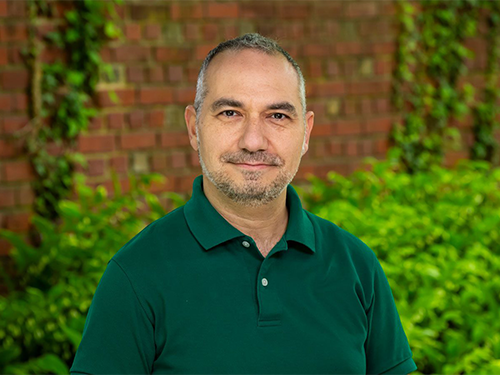
Elie Bou-Zeid has been elected a Fellow of the American Geophysical Union (AGU) for his work on modeling and measurement of flow and turbulence in the lower atmosphere, with applications to mass and energy transport, urban environmental quality, building energy efficiency, and renewable energy production.
Bou-Zeid, a professor of civil and environmental engineering and associated faculty at the Andlinger Center, joins 52 others in the 2026 Class of Fellows. AGU, the largest Earth and space science association, bestows this honor to researchers who have made exceptional scientific contributions, a group that has included less than 0.1% of AGU members each year since the program’s inception in 1962.
Bou-Zeid leads the Thermofluids of Urban and Natural Environments (TUNE) Lab, which examines how lower atmospheric dynamics shape systems ranging from polar ice zones and rainforests to lakes and vineyards. The lab also focuses on built surfaces and urban environments, where 70% of the world’s population will reside by 2050. Bou-Zeid’s group designs and investigates solutions that modulate air flow and heat transfer in urban terrain to make cities more sustainable, resilient, livable and equitable. These efforts combine modeling, in-situ and remote sensing, and fundamental thermofluidic theory.
Bou-Zeid holds a bachelor’s degree in mechanical engineering and a master’s degree in environmental and water resources engineering from the American University of Beirut, and a master’s in mechanical engineering and a Ph.D. in environmental engineering from Johns Hopkins University. He joined Princeton in 2008 and served as the founding director of the Metropolis Initiative until 2022.
He is the recipient of the 2026 Helmut E. Landsberg Award from the American Meteorological Society (AMS), the 2025 Atmospheric Sciences Ascent Award from the AGU, and the 2024 Distinguished Scientific/Technological Accomplishment Award by the Board on Urban Environment of the AMS. His research was also recognized with a ‘Beyond Bauhaus – Prototyping the Future Award’ for the Cityreader project on mobile urban sensing. He is the current chair of the American Meteorological Society’s Committee on Boundary Layer and Turbulence and served as editor of the Journal of the Atmospheric Sciences from 2020 to 2025.
Founded in 1919 as an affiliate of the National Academy of Sciences, the American Geophysical Union incorporated independently in 1972 as an organization of Earth and space scientists working to discover solutions to societal issues. Entering Fellows will be honored at the Union’s annual conference in San Francisco in December.
This article originally appeared on the Princeton Engineering website.