Former Princetonian returns as visiting fellow to study energy efficiency in historic buildings
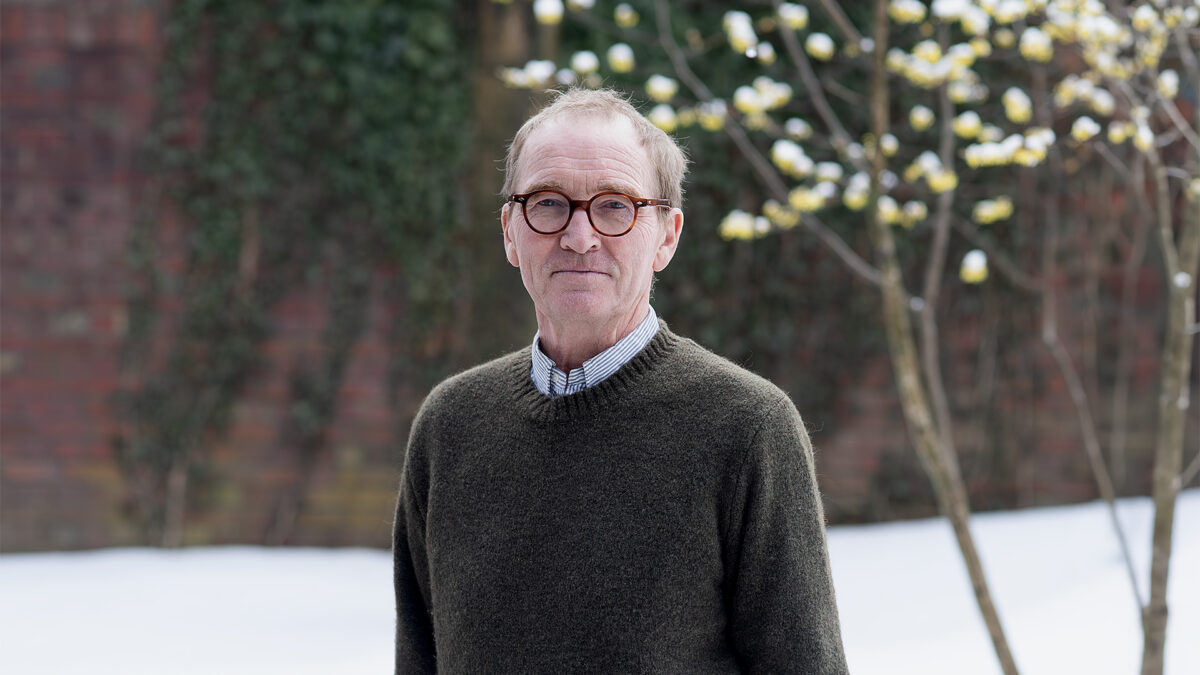
Tor Brostrom, a 1980 Princeton alumnus, has joined the Andlinger Center for Energy and the Environment as a Gerhard R. Andlinger Visiting Fellow, aiming to examine the Princeton campus as a case study in reducing the carbon footprint of historic buildings whilst preserving their unique attributes.
“Princeton campus has changed a lot from when I was here, but the impression it makes has stayed the same, which is really the best thing you can say about the development of the campus,” he says. “They’ve retained the original character and feeling of the campus.”
Brostrom, professor in building conservation at Uppsala University, Sweden, began his education at Princeton. He graduated with a Bachelor of Science in engineering and went on to complete a Ph.D. at KTH Royal Institute of Technology in Sweden.
Brostrom’s work grapples with the difficult question of how to sympathetically adapt culturally important buildings to increase their energy efficiency. For instance, much of the concern about methods to increase energy efficiency in historic buildings is around disrupting the exterior, such as when using external insulation and window replacements. Instead, solutions such as heat pumps and district heating can be considered, which can reduce the carbon footprint with little effect on the historic values of the buildings.
Throughout his career Brostrom has applied his engineering education to a mixture of research, advising on policy and approach at the national and European levels, and teaching. On this last point, he was part of the founding team that set up Gotland College – now part of Uppsala University – on the small island on which he was born and returned to live after his studies.
With his deep knowledge of Swedish and European practices, Brostrom plans to use his time in Princeton to compare approaches in the U.S. and Europe. “I want to present the campus as a whole as a case study of how you can balance between preserving historic buildings and being net zero by 2046,” he says. Forrest Meggers, associate professor of architecture and the Andlinger Center for Energy and the Environment, who was the lead sponsor for Brostrom’s fellowship, says he anticipates presenting this research as a joint conference paper and presentation.
Meggers also wants to tap Brostrom’s expertise to help with the continued efforts to make campus buildings more sustainable. “Princeton facilities are now considering many aspects of life cycle assessment in their building and maintenance on campus, so Tor’s experience with historic buildings will be particularly valuable,” he says. “For instance, one of the challenges we face in the Andlinger Center building is that all the heavy concrete structure makes it hard to heat up and cool down. It turns out this is exactly the kind of problem Tor has spent decades addressing in massive stone churches in Sweden.”
Brostrom’s extensive background with historical buildings will be especially valuable on the Princeton campus. He intends to leverage this expertise to cultivate partnerships with faculty, students, and university leaders such as the University Architect, the executive director of Engineering and Campus Energy in Facilities, and the executive director of the Office of Sustainability.
Beyond his focus on campus buildings, Brostrom wants to consider the wider environment and how different entities (or institutions) approach the same issues and will look more broadly at the town of Princeton. Additionally, as part of his main research sponsored by the Swedish Energy Agency, which has recently established a collaboration with New Jersey and New York, he hopes to engage officials at the state level on their approach.
Brostrom is eager to leave a lasting impression on Princeton by forging these collaborations and strengthening connections between faculty research and real-time application. He hopes to inspire students to carry forward an awareness of energy efficiency and to explore creative approaches to the stewardship of historic structures.
The Gerhard R. Andlinger Visiting Fellows program is designed to attract distinguished visitors who will collaborate with Andlinger Center faculty, researchers, and students, and enrich the research and teaching at the Andlinger Center.
Funding is provided by The Gerhard R. Andlinger Visiting Professorships in Energy and the Environment Fund.
Related articles: