Fraggedakis wins DOE Early Career Award for theory of selective ion separations
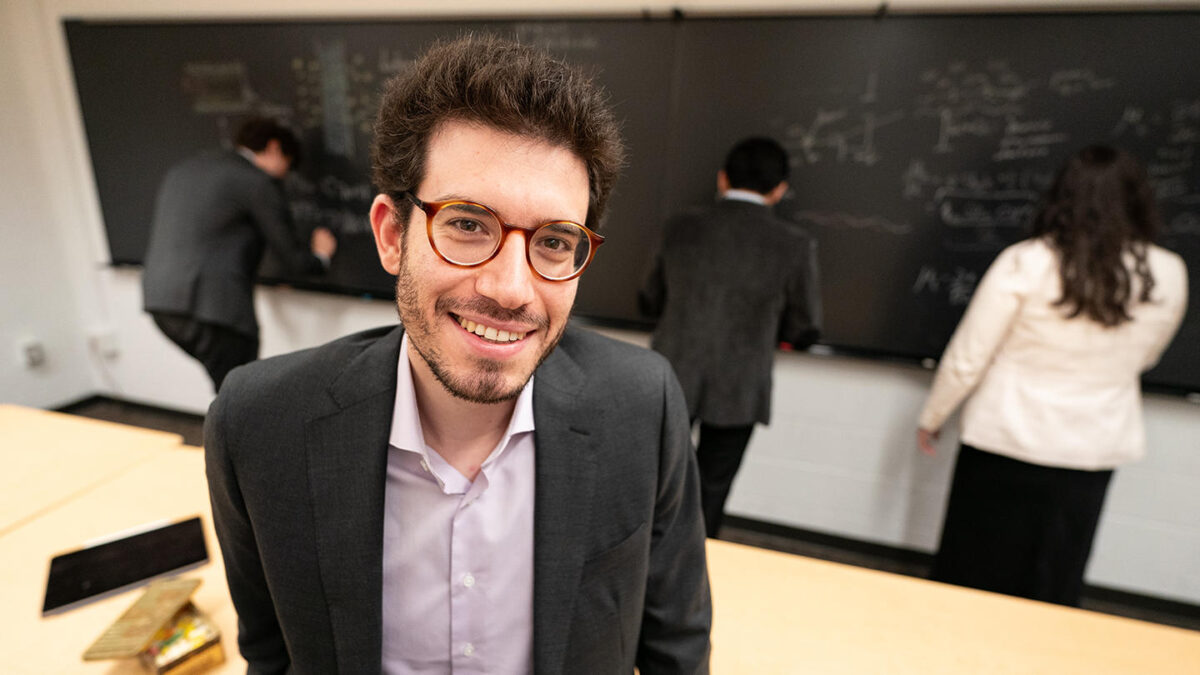
Dimitrios Fraggedakis, an expert in the mathematical foundations of chemical and electrochemical engineering, has been awarded an Early Career Award from the U.S. Department of Energy’s (DOE) Office of Science for his research into the mechanisms behind selective ion separations.
Fraggedakis, an assistant professor of chemical and biological engineering and an Andlinger Center associated faculty member, investigates what propels interactions between electrically charged particles, called ions, in materials with extremely tiny pores. Fraggedakis studies how the ions’ size, charge, and local pore environment impact those interactions. This research is central to recovering lithium, nickel and other critical minerals from solutions with high concentrations of salt, as well as removing radioactive elements from nuclear waste.
As one of 67 awardees, Fraggedakis is recognized by the Energy Department as a leader of American technology and ingenuity. In total, the awardees represent 38 universities and 11 DOE facilities across 26 states.
Fraggedakis joined the Princeton faculty in August 2024. He was awarded a Doctoral New Investigator Award from the ACS PRF and a Princeton Engineering Innovation Research Grant in July 2026 for the project “Theory of electrodeposition for metals and multicomponent alloys.” His research interests involve developing theoretical models of electrochemical and soft matter systems. Fraggedakis earned his Ph.D. from Massachusetts Institute of Technology in 2021 and his diploma of engineering from the University of Patras, in Greece, in 2015, and was a Miller Research Fellow at the University of California, Berkeley.
This article originally appeared on the Chemical and Biological Engineering department’s website.