Innovation grants could help build a moon base, block food-borne illness, and map the brain
NASA’s new plans for a permanent moon base emphasize using lunar resources for construction and operations. Bringing these plans to fruition in the coming decade will require foundational knowledge of the moon’s materials and how to optimize them for our needs, said Claire White, a professor of civil and environmental engineering and the Andlinger Center for Energy and the Environment.
Sending building materials from Earth would be prohibitively expensive, so investigating how to build with the moon’s resources is imperative, said White, who studies how to make cement more sustainable.
White’s expertise is also relevant to learning how to make cement from moon rock. And this year, her team received support for research on lunar cement from Princeton’s School of Engineering and Applied Science.
This is one of 21 Innovation Research Grants awarded by Princeton Engineering in 2026. The awards enable engineering faculty members to take their research in bold new directions that address critical issues in technology, health and the environment. The grants often fuel initial discoveries that lead to larger awards from external funding agencies.
The success of NASA’s Artemis II flight mission this spring has heightened interest in research related to lunar exploration, said White, and the early support from Princeton Engineering will spur progress toward securing external funding for the work. “The seed grant is the right launching place to get such research off the ground,” she said.
Basalt, Earth’s most common volcanic rock, is also abundant on the moon. Sophia Bergen, a fourth-year Ph.D. student in White’s lab, is testing ways to increase basalt’s reactivity to enable it to mix and harden like cement.
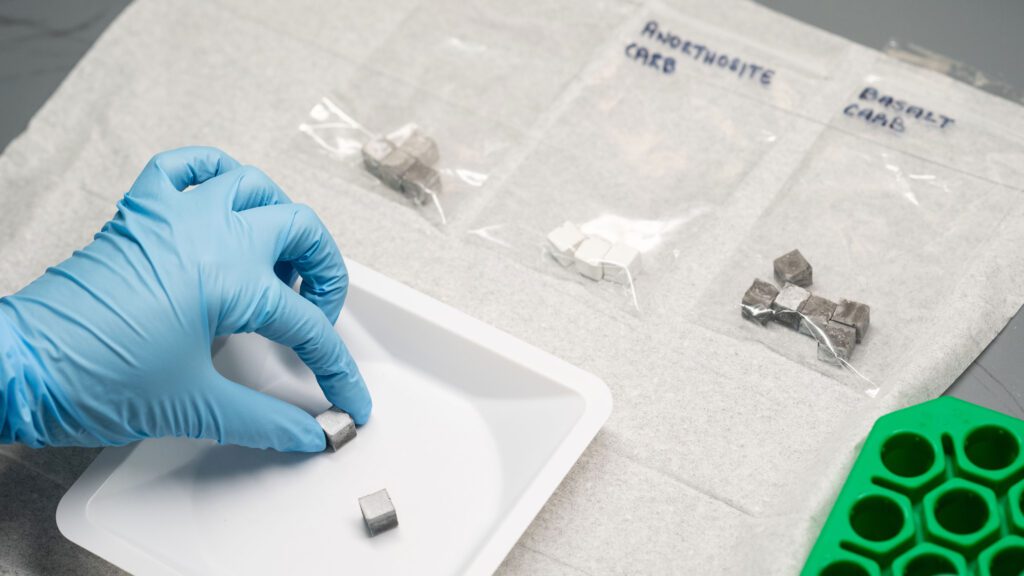
Bergen’s initial interest in studying basalt was mainly about decarbonizing cement on Earth because basalt has the potential to capture carbon dioxide from the atmosphere. “But also, I know NASA is going to be building on the moon,” said Bergen. “If we’re going to be investing all this time and energy into thinking about both separately, we might as well think about them together.”
White and Bergen’s work on lunar concrete is supported by the Project X Fund, which enables Princeton Engineering faculty members to pursue exploratory research geared toward “creativity, tinkering and risk-taking.”
The Innovation Research Grants are funded by Princeton alumni, parents and other donors. This year’s awards, which total more than $3 million, include:
Project X Fund
Project X funding enables Princeton engineering faculty members to pursue exploratory research geared toward “creativity, tinkering and risk-taking.” The fund was made possible by G. Lynn Shostack in honor of her husband David Gardner, a 1969 Princeton graduate. In addition to Claire White, Project X grants were awarded to:
Ryan Adams, professor of computer science, and Paul Prucnal, professor of electrical and computer engineering, for the project “Ultra-efficient source-positional-encoded photonic neural networks” (also supported by the J. Insley Blair Pyne Fund);
Jia Deng, professor of computer science, for the project “Neural reconstruction and rendering for glasses-free 3D video communication”;
Aarti Gupta, professor of computer science, and Chi Jin, associate professor of electrical and computer engineering, for the project “Goedel-Code-Prover: Advanced reasoning models for code verification” (also supported by the James Mi *91 Research Innovation Fund for Data Science).
Addy Fund for Excellence in Engineering
The Addy Fund for Excellence in Engineering was established in 2017 by Lydia B. Addy and William M. Addy, a 1982 Princeton alumnus. Addy funds were awarded to:
Ryne Beeson, assistant professor of mechanical and aerospace engineering, and Gabriel Vecchi, the Knox Taylor Professor of Geosciences, for the project “Transformative tropical cyclone estimation and forecast skill improvement using physics-based AI and extreme event data assimilation” (also supported by the Chang Family Research Fund);
Claire Gmachl, the Eugene Higgins Professor of Electrical and Computer Engineering, Julia Mikhailova, associate professor of mechanical and aerospace engineering, and Gregory Scholes, the William S. Tod Professor of Chemistry, for the project “High-field THz-driven, mechanism-resolved dynamics behind mechanical, electronic and chemical properties in quantum materials: Toward predictive ultrafast control” (also supported by the Samberg Family Fund for Innovative Engineering);
Andy Guess, associate professor of politics and public affairs, Manoel Horta Ribeiro, assistant professor of computer science, and Brandon Stewart, professor of sociology, for the project “Understanding society through short-form video with large vision models”;
Antoine Kahn, the Stephen C. Macaleer ’63 Professor in Engineering and Applied Science, and Saien Xie, assistant professor of electrical and computer engineering and the Princeton Materials Institute, for the project “Photo-programmable circuits and optoelectronics with atomically thin materials.”
Helen Shipley Hunt Fund
Made possible by Helen Shipley Hunt, who earned a master’s degree in mathematics from Princeton in 1971, this fund supports research aimed at improving human health, with a focus on applied projects. Shipley Hunt funds were awarded to:
Joshua Atkinson, assistant professor of civil and environmental engineering and the Omenn-Darling Bioengineering Institute, and José Avalos, associate professor of chemical and biological engineering and bioengineering, for the project “Biochemical studies on PFAS ‘forever chemicals’ — biosensing and biodegradation” (also supported by the Wilke Fund for Innovation);
Kaiyi Jiang, assistant professor of bioengineering, and Zhuang Liu, assistant professor of computer science, for the project “Generative RNA foundation models for mRNA therapeutic design” (also supported by the Forese Family Fund for Innovation in Engineering). Jiang also received an award for the project “Invisible by design: AI-guided engineering of immune-evasive protein therapeutics.”
Tianaderrah Foundation
Grants from the Tianaderrah Foundation were awarded to:
Michelle DiBenedetto, assistant professor of mechanical and aerospace engineering, for the project “Revealing environmental-DNA dynamics in fluid systems”;
Benjamin Eysenbach, assistant professor of computer science, and Gautam Reddy, assistant professor of physics, for the project “Towards generative models for assembly and self-assembly”;
Tian-Ming Fu, assistant professor of electrical and computer engineering and bioengineering, and James Sturm, the Stephen R. Forrest Professor in Electrical and Computer Engineering, for the project “Extending the lifespan of biocomputer through structural patterning and teacher-student transfer” (also supported by the J. Insley Blair Pyne Fund);
Felix Heide, assistant professor of computer science, and Kaushik Sengupta, professor of electrical and computer engineering, for the project “X-band radar non-line-of-sight imaging” (also supported by the Helen Shipley Hunt Fund);
A. James Link, professor of chemical and biological engineering, for the project “A new antimicrobial compound to prevent Cronobacter food-borne illness” (also supported by the O’Brien Family Health Research Fund);
Guillermo Sapiro, the Augustine Family Professor in Electrical and Computer Engineering, Olga Troyanskaya, the Maduraperuma/Khot Professor of Computer Science, and Joshua Mincer, an anesthesiologist and physician-scientist at Memorial Sloan Kettering Cancer Center, for the project “A multimodal framework for digital phenotyping and precision pain understanding and management” (also supported by the Helen Shipley Hunt Fund).
Additional Engineering Research Funds
Dimitrios Fraggedakis, assistant professor of chemical and biological engineering, received support from an anonymous donor for the project “Theory of electrodeposition for metals and multicomponent alloys.”
Christina Kim, assistant professor in the Omenn-Darling Bioengineering Institute and the Princeton Neuroscience Institute, Mala Murthy, the Karol and Marnie Marcin ’96 Professor of Neuroscience, and Sebastian Seung, the Evnin Professor in Neuroscience and professor of computer science, received an award for the project “Detecting snapshots of synaptic activity in the wiring diagram of the brain.” This project is supported by a fund established in memory of J. Insley Blair Pyne, a physics and electrical engineering professor and Princeton graduate, to advance research at the intersection of engineering and neuroscience.
Liuchi Li, assistant professor of civil and environmental engineering, was awarded funds for the project “Harnessing the interplay among (many-body) frictional contact, porosity, and fluid flow towards effective and environmentally sustainable coastal protection.” His project is supported by the Morton and Donna Collins Fund for Innovation in Engineering, the Tung Slighton Family Fund and the David T. Wilkinson Innovation Fund.
Tom Silver, assistant professor of electrical and computer engineering, will pursue the project “Towards curious robot scientists that plan, experiment and learn” with support from the Yang Family Fund and funds from an anonymous donor.
This article originally appeared on the Princeton Engineering website.