One magnet turns origami robot into machine logic
Think of a robotic arm. The arm could be at rest, or the arm could grab, transport, or release an item. These distinct actions can be thought of as “states,” or a set of modes that the robotic arm can occupy.
In modern robotics, a set of possible states are typically managed computer models and often require batteries, motorized joints, and other unwieldy machinery. Now, researchers at Princeton University have uncovered how to achieve and control stable robotic states in a surprisingly simple manner: with only a single magnet.
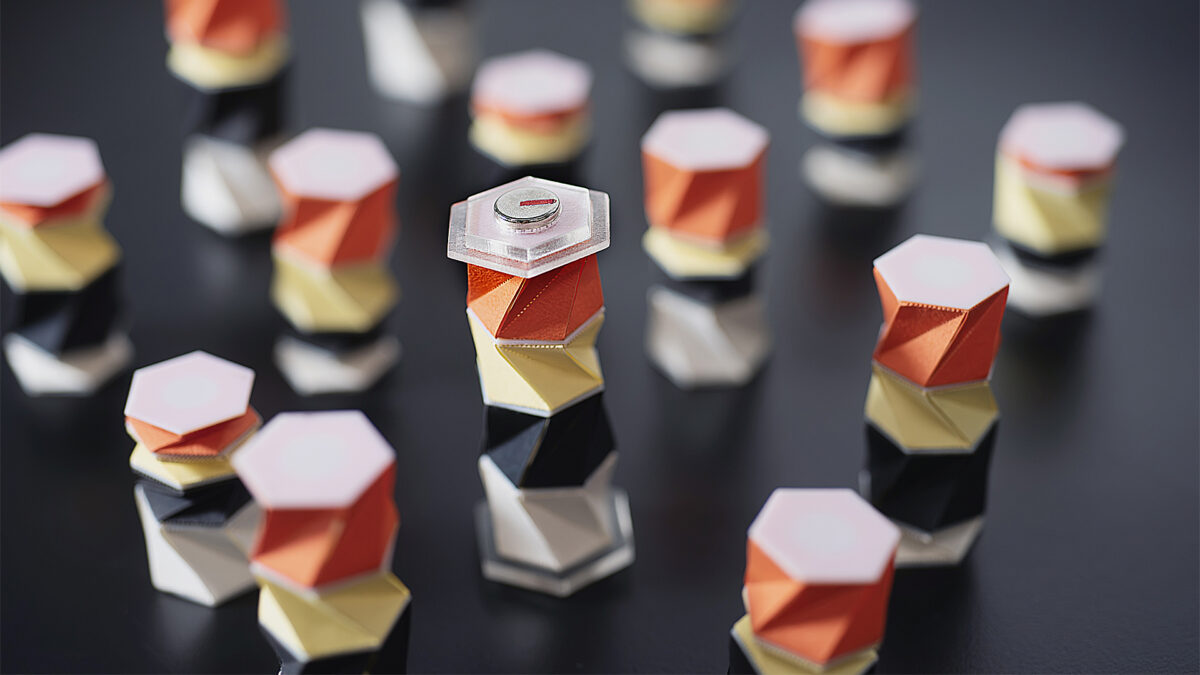
Since joining Princeton in 2021, Glaucio Paulino and his research team have been pioneering the development of lightweight, cylindrical soft robots with an origami-inspired structure, meant to help achieve innovative structural configurations and functionalities. The robot — which Paulino, the Margareta Engman Augustine Professor of Engineering at Princeton, hopes to see used in biomedical and space applications one day — is composed of four distinct segments, or cells, which can independently contract or expand at a light touch or twist.

But controlling the movement of contraction and expansion segment by segment had presented a challenge. The researchers pondered how to remotely, without touching, and selectively collapse and extend the cells into distinct stable configurations (one such configuration could be the first cell collapsed and the other three extended, another might be cells two and four collapsed with cells one and three extended, and so-on).
Yifan Rao discovered the answer by adding a magnet to one end and manipulating a magnetic field. “We can now selectively control the folding and unfolding in the multicell system,” said Rao, distinguished postdoctoral fellow at the Andlinger Center for Energy and the Environment. “That wasn’t possible for the previous origami robotic system.”
In a paper published on October 30 in the journal PNAS, researchers describe the mathematical framework developed by Rao, which allows researchers to program an external magnetic field that guides the robot through its series of physical states — 16 in total for the four-cell origami robot.
The magnet also acts as a sort of reset button which can guide the robot back to a known starting shape no matter how it was folded to begin with. “From there, magnetic pulses can guide it into any of its 16 stable configurations,” said Tuo Zhao, postdoctoral research associate in civil and environmental engineering and paper co-author. “This opens up a fundamentally new way of controlling robots.”
The control relies on designing the structure and the magnetic field together. “Each cell has a different energy barrier—a different hurdle it must overcome to fold or unfold,” said Konstantinos Manos, a graduate student in electrical and computer engineering and paper co-author. “By designing those barriers and applying precisely oriented magnetic pulses, we guide the structure through a predictable sequence of configurations.”
In previous iterations of the lab’s origami robot, researchers controlled the cells’ contraction and expansion by placing a magnet in between each segment. “For the multiple cells, we now only need one magnet,” said Rao. “That’s how the efficiency comes in.”
Today’s robotics landscape tends to be dominated by large, rigid robots that depend on complex internal wiring, bulky onboard energy storage, and conventional actuation systems. These are soft robots that are very light, very simple,” said Paulino. “The key idea is to put all the energy systems external to the robot, not inside the robot.”
The researchers said the framework also carries exciting implications for encoding information in the robot itself. “This research presents a new way of thinking about compute and a new way of making mechanical structures that can store information,” said Minjie Chen, associate professor of electrical and computer engineering and the Andlinger Center, and co-author of the paper.
An important feature of origami is that a completed structure holds its shape. Other soft robots are made of materials that deform under pressure, “but when you release it, it bounces back to the origin and you cannot store any information on the loading history inside of it,” said Rao.
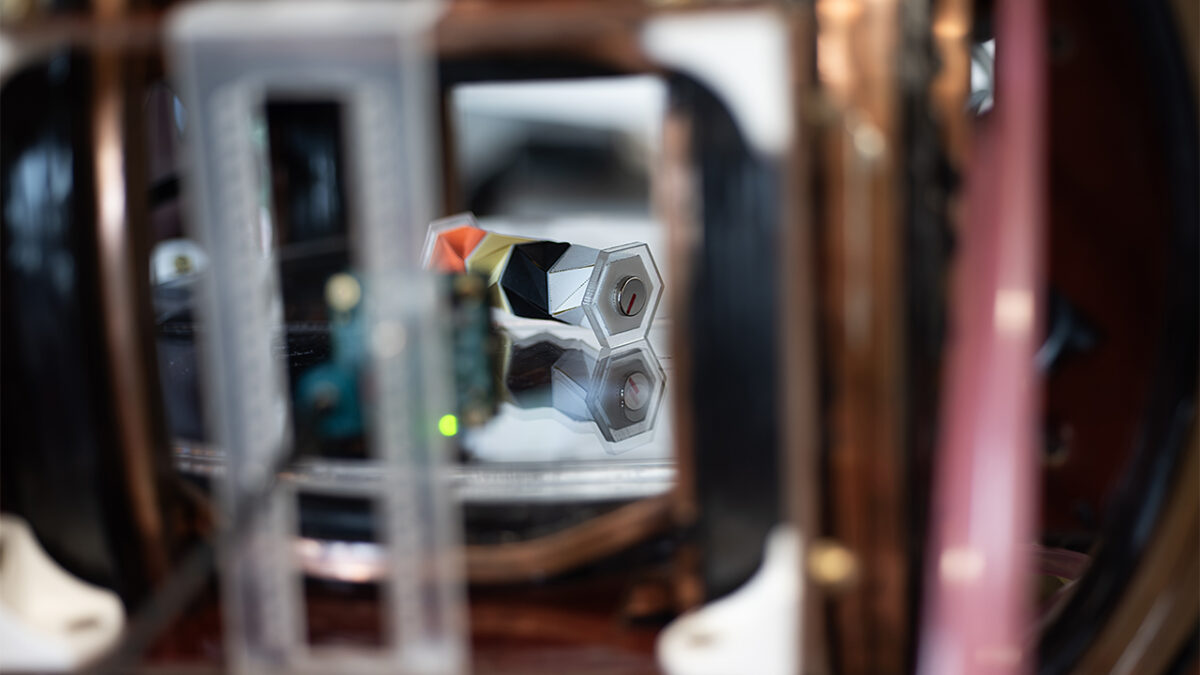
The various states of folded and unfolded cells of the robot could be understood like the ones and zeroes used in the binary system for computing. This opens up the potential for the structure to be used to uniquely encode information in a way that is impervious to hackers.
However, Paulino sees the most promising future for Rao’s framework in enabling the lab’s robotic design to be used for intravenous drug transport for medical applications. The structure is still too large for such a task, but if it were to be miniaturized, the hollow robot could carry medicine through the veins or arteries of a patient with an external magnetic field — in the form of something akin to an MRI machine — controlling the navigation.
“This research represents a beautiful integration of several fields of science: mathematics, mechanics, dynamics, manufacturing, origami,” said Paulino. “Yifan and the team have been able to put all this together and demonstrate that it works, and this is just the beginning.”