Experts discuss how to build a more resilient rare earths supply chain at Andlinger Center retreat
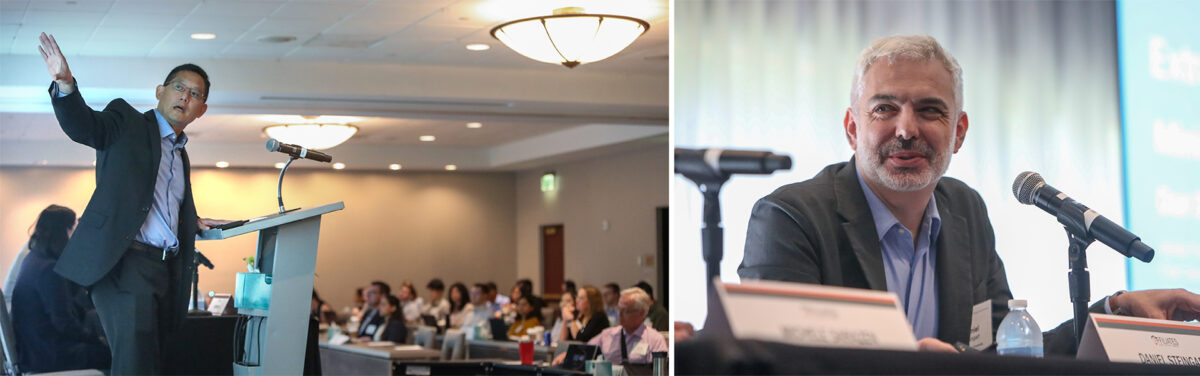
On June 16, experts from academia, industry, and the public and private sectors joined the Andlinger Center’s thirteenth annual Princeton E-ffiliates Partnership Retreat to discuss potential pathways and bottlenecks for harnessing and scaling the production of rare earth elements in the U.S.
Rare earth elements are a set of 17 critical minerals, including yttrium, neodymium, and cerium, that are critical for use in high-tech electronics, defense systems, and clean energy technologies. Currently, the U.S. imports more than 75 percent of its rare earth elements, leaving industry beholden to price fluctuations, supply restrictions, and geopolitical tensions. Global demand for rare earths is expected to triple by 2035.
“The industry’s challenge is less the science or the engineering,” said Vasileios Tsianos, senior vice president of Neo Performance Materials and chairman for the Rare Earth Industry Association during a keynote address. “Instead, it is the struggle to industrially scale these complex production systems competitively and earn a defensible market share that would lead to supply chain resilience and optionality.”
Discussions at the E-ffiliates retreat centered on the opportunities to enhance traditional supplies of rare earths, how to harness new unconventional resources for extracting these elements, and the potential for electro-processing techniques to be the next frontier of recovery and processing.
Enhancing traditional supplies
Less than two percent of rare earths mined worldwide are extracted in the U.S. and much of the processing after extraction happens abroad. Speakers explored how to scale up and innovate domestic mining and processing practices, focusing on how to build talent, increase efficiency, and create resilience.

For the U.S. to gain a foothold in mining, Senior Vice President Environment and Sustainability Global at Worley Mary Lou Lauria said a critical question is how to transfer the skills and the knowledge of new technologies to the existing talent pool.
“Mining nowadays in the USA is very high tech,” said Pengbo Chu, assistant professor of earth and environmental engineering at Columbia University. “If you go to a processing plant, you see different automation everywhere.”
Chu suggested improving the flow of information between the different unit operations to make the processes more efficient.
“This isn’t necessarily a resource challenge as much as it is a systems challenge,” said Jud Marte, senior vice president of engineering at MP Materials, summing up the best approach. The discipline of taking all the different processes involved in rare earth extraction and processing and getting them to work together in harmony is the real key, Marte said.
Yet, a full supply chain that involves every process from extraction to the final product may not be financially feasible. Ultimately, achieving greater rare earth supply resilience for the U.S., the speakers agreed, will rely on accessing and strengthening every part of the supply chain, even if a fully domestic mine-to-magnet operation isn’t achieved. “Even if you don’t end up building a full supply chain that fully supplies demand from domestic sources, you need to understand every part,” said Anthony Ku, the panel moderator and non-resident fellow at the Andlinger Center.
Harnessing unconventional resources
Critical minerals are abundant in a number of waste, recycled, and other unconventional sources, including in wastewater, electronic scrap, and along the ocean floor. While rare earth extraction from these sources may seem promising, the ability to extract and process them at scale is highly uncertain.
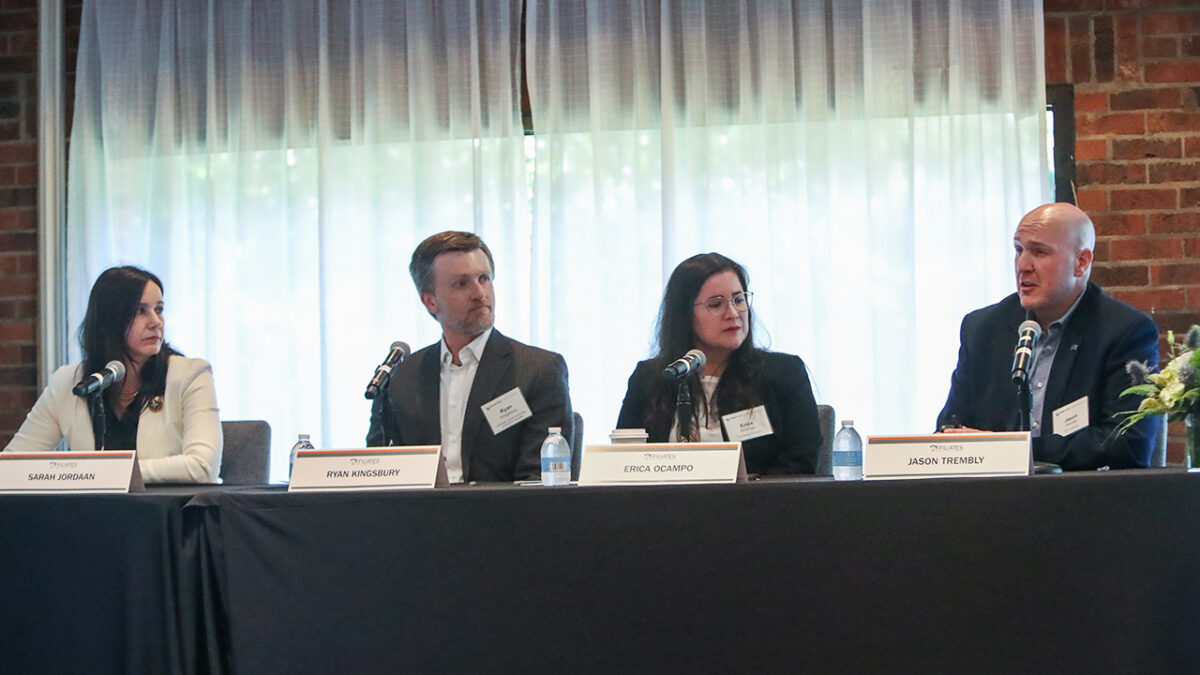
More than 30 million tons of critical minerals are present in industrial wastewaters, according to research from the lab of Ryan Kingsbury, assistant professor of civil and environmental engineering and the Andlinger Center. “Some of those critical minerals are present in quantities that actually exceed the projected demand for those minerals from clean energy technologies,” said Kingsbury.
However, filtering industrial wastewaters is difficult, and “once we separate the critical minerals from everything else, separating critical minerals from one another is still very challenging,” said Kingsbury. “That remains one of the frontier scientific challenges.”
Even then, the process of scaling from the laboratory to a pilot plant is filled with complexity. “You have to pay for equipment, energy costs, and a pilot scale facility,” said Jason Trembly, professor of mechanical engineering at Ohio University. “That has a significant impact.”
On the floor of the Pacific Ocean in a region called the Clarion-Clipperton Zone, a field of potato-sized polymetallic nodules that are rich in nickel, copper, manganese — metals needed for battery production — present a promising opportunity for deep sea mining. Though the processing of the metals would be comparable to those extracted from more traditional mines, the presence of four metals in one rock and the fact that nodules can be collected without digging, drilling, or blasting means that the intensity of the process is much lower, said Erica Ocampo, chief sustainability officer of The Metals Company.
Even so, the environmental responsibility of the opportunity is still under debate. Sarah Jordaan, associate professor of civil engineering and the Trottier Institute for Sustainability in Engineering and Design at McGill University, discussed the importance of applying and improving methodologies for measuring environmental impact such as life cycle assessment to fully understand the benefits and costs of harnessing unconventional resources for critical minerals. Research on biodiversity and environmental impact assessments should further be employed for a substantial understanding of baseline ecosystems, said Jordaan.
The Next Frontier: Electro-processing

Rare earth element mining traditionally produces hazardous waste in addition to using fossil fuels. The final panel of the day centered around the ways clean electricity might replace traditional fossil-fuel driven and solution-based processing to enhance sustainability of rare earth extraction and separation. “Electrically driven processes, such as the use of plasma and electrolysis, offer the opportunity for alternative, potentially more sustainable methods of mining,” said Emily Carter, Gerhard R. Andlinger ’52 Professor in Energy and the Environment, co-chair of the retreat, and moderator of the panel.
The conversation centered around the use of low temperature plasmas, which could be useful not only for fracturing rock but also for cleaning mineral surfaces of impurities and creating oxidants for extraction. Yiguang Ju, Robert Porter Patterson Professor of Mechanical and Aerospace Engineering, said effectively controlling plasma chemistry could be a major challenge. “We can obtain diagnostics of the plasma only phase, and you can get bulk and surface knowledge of the solid from material science,” said Michele Sarazen, associate professor of chemical and biological engineering. But, she said, the plasma-solid interface is where research efforts need to be focused.
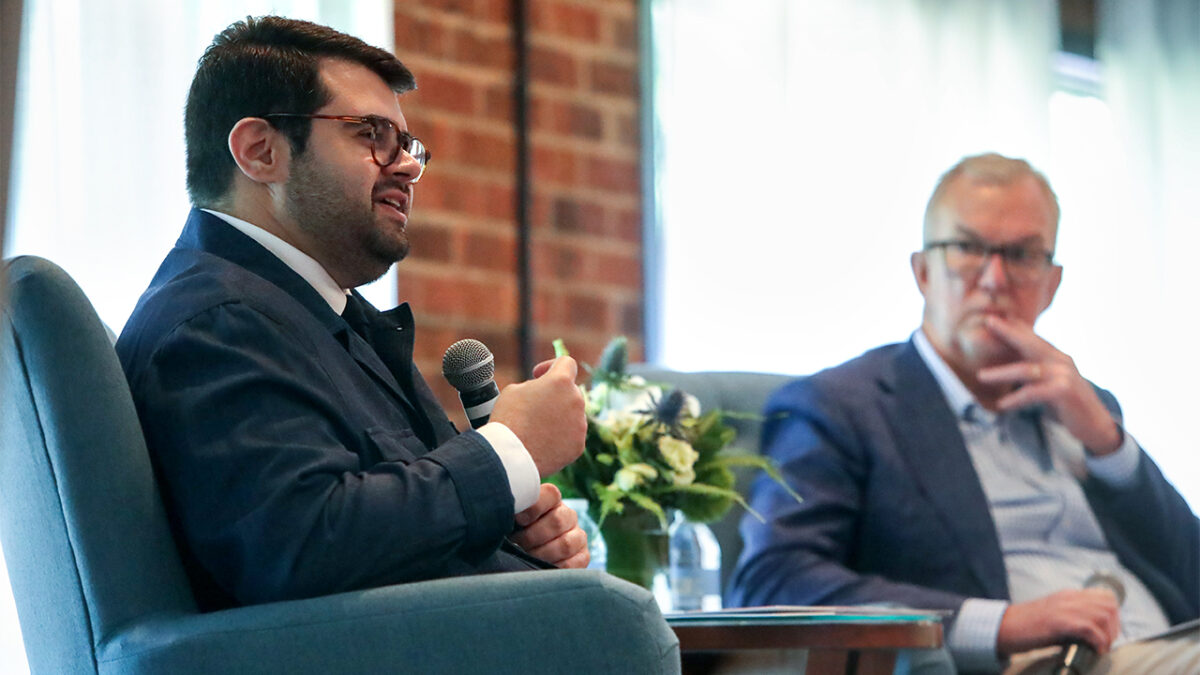
Still, there are benefits to using plasma and other electro-processing methods over standard extraction processes, such as acid leaching. Instead of wasting acid and creating other costs, said Daniel Steingart, professor of chemical engineering and climate at Columbia University, you only need the reactors to create the plasma.
Wrapping up the conference, Chris Greig, Theodora D. ’78 and William H. Walton III ’74 Senior Research Scientist at the Andlinger Center who co-chaired the event, said the discussions of the day highlighted the real challenges confronting US efforts to strengthen its rare earth value chain, especially if primarily focused only on onshoring of conventional resource extraction and processing. Promising emerging technologies and pathways offer hope but will need significant capital and durable political backing to be brought to full scale. “I think these opportunities look incredible and they could be game changing in the future,” he said. “Ultimately, they offer potential for a truly circular economy and they deserve serious support.”