2026 Maeder Fellows advance solar cell performance and sustainable critical ion recovery
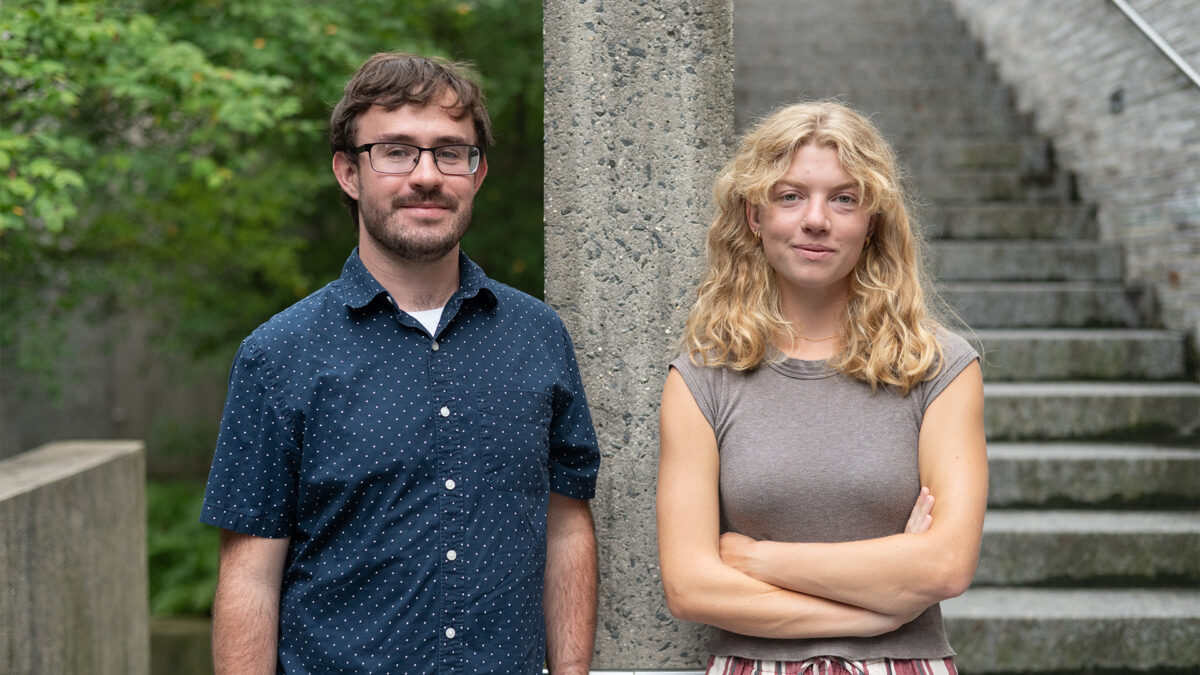
The Andlinger Center has selected Elizabeth Wall and Austin Booth as Maeder Graduate Fellows for the 2026-2027 academic year.
Both graduate students in chemical and biological engineering, Wall and Booth are each applying their research to solving energy problems sustainably. Wall’s research is concerned with improving solar cells with perovskites. Booth investigates the ability of membrane materials to recover useful resources from wastewater.
Each year, the Maeder Graduate Fellowship is awarded to one or two graduate students who demonstrate strong potential to develop solutions for a sustainable energy and environmental future. The fellowship is supported by the Paul A. Maeder ’75 Fund for Innovation in Energy and the Environment and covers the students’ tuition and stipend for the 2026–2027 academic year.
Improving solar cell performance with perovskites
Advised by Lynn Loo, Theodora D. ’78 and William H. Walton III ’74 Professor in Engineering and professor of chemical and biological engineering, Elizabeth Wall studies perovskites for photovoltaic applications.
Perovskites, a class of crystalline compounds, show potential for increasing the energy absorption efficiency of typical silicon solar cells. “Silicon only absorbs a certain part of the solar spectrum,” said Wall. By adding a perovskite — which absorbs a wider range of the light spectrum — in tandem with a silicon cell, researchers can create a cell that generates more electricity.
Yet, creating perovskite solar cells at scale is a challenge. “Perovskites are usually deposited as thin films, which means that they are only several hundred nanometers thick,” said Wall. Lab-scale devices are typically deposited on the centimeter-scale. “The next step is figuring out how to deposit perovskite films over large areas.”
Wall works on a method that helps to deposit the perovskite films on a solar cell uniformly, improving the solar cell reliability. “I care a lot about the environment and sustainability,” said Wall. “This research is tied to improving or to reducing our use of fossil fuels and that’s exciting for me.”
Membranes for sustainable ion separations
Austin Booth, who is advised by Kelsey Hatzell, associate professor of mechanical and aerospace engineering and the Andlinger Center, researches membrane materials for recovering useful ions from brines and wastewater.
In particular, Booth studies a membrane material known as MXene (pronounced like “Maxine”) — atomically thin flakes of titanium carbide. These flakes can be layered to create a permeable membrane, which researchers then chemically modify to selectively recover specific metal ions from water. Typical separation methods, such as distillation, are energy intensive or may leave behind harmful waste streams. MXene membranes, by comparison, require less energy and are environmentally stable, making them a sustainable alternative.
Booth’s primary research focus is applying MXene for separating lithium ions from other ions. The chemical stability of MXenes allows them to perform in caustic environments where lithium ions may be found, like battery waste, which would present a solution to the complexities of battery recycling.
Over the course of the fellowship, Booth plans to investigate MXene membranes for separating other critical minerals, including cobalt, magnesium and lanthanum. “If we can move away from distillation and go towards membrane processes, that’d save a lot of energy,” said Booth.
Through the Maeder Graduate Fellowship, Wall and Booth will have the opportunity to advance these approaches over the coming academic year while contributing to the Andlinger Center’s broader mission of developing practical solutions to energy and environmental challenges.