Ariane Adcroft: Fresh thinking in building efficiency could have a big impact
Ariane Adcroft had always had a sense that she wanted to explore sustainability in her studies, but she was surprised to discover a detailed interest in the built environment through her time in Forrest Meggers’ CHAOS Lab. As an Andlinger Center summer intern, Adcroft, a Princeton mechanical and aerospace engineering student, has explored multiple projects and gained awareness of how crucial building efficiency will be in reducing energy needs.
“Buildings use around 40% of all of the energy consumed in the U.S.,” Adcroft said. “It’s a big field that people don’t think about very often. My work in the CHAOS Lab gave me a sense for how important building heating and cooling is.”
With this considerable potential impact in mind, the research group of Forrest Meggers, associate professor of architecture and the Andlinger Center for Energy and the Environment, focuses on cooling and heating for architecturally optimized systems (hence, ‘CHAOS’ Lab). They work to find ways to make buildings more efficient and aim to use the architectural design of surfaces and mass in buildings for maximum efficiency and human comfort.
Adcroft has carried out several projects that all work on this theme from different angles. In one of the projects during her first summer, she collected data on a unique home in Princeton that was designed and built in the mid-1970s: the Kelbaugh House. “It’s owned by an individual, but it has this really interesting exterior wall called a Trombe wall, which is designed to use the sun for passive heating and cooling for the house,” Adcroft explained.
The Trombe wall consists of a south-facing thick concrete wall painted black, with a glass layer set six inches in front on the outside. In winter, the sunlight is absorbed by the concrete, which heats the wall in turn heating both the house on the inside and the air that is trapped between the wall and the glass, like a very efficient greenhouse. Vents at the top and bottom of the wall into the house also set up a convection cycle for more heating: the hot air between the glass and wall moves into the house whilst the cold air at the bottom of the house is drawn out into the space behind the glass to be heated. Overnight, the wall slowly releases the built-up heat to keep the house comfortable.
Conversely, in summer, the sun is much higher in the sky, and its light is largely reflected off the glass, so it can’t be absorbed so much by the concrete wall. Vents to the outside at the top of the glass wall enable hot air to escape, drawing in cool air from the opposite, shaded side of the house to keep the whole inside of the house cool.
For her project, Adcroft developed a new sensor network and data collection system for the home, which was critical for characterizing the building’s thermal performance and designing efficiency upgrades.
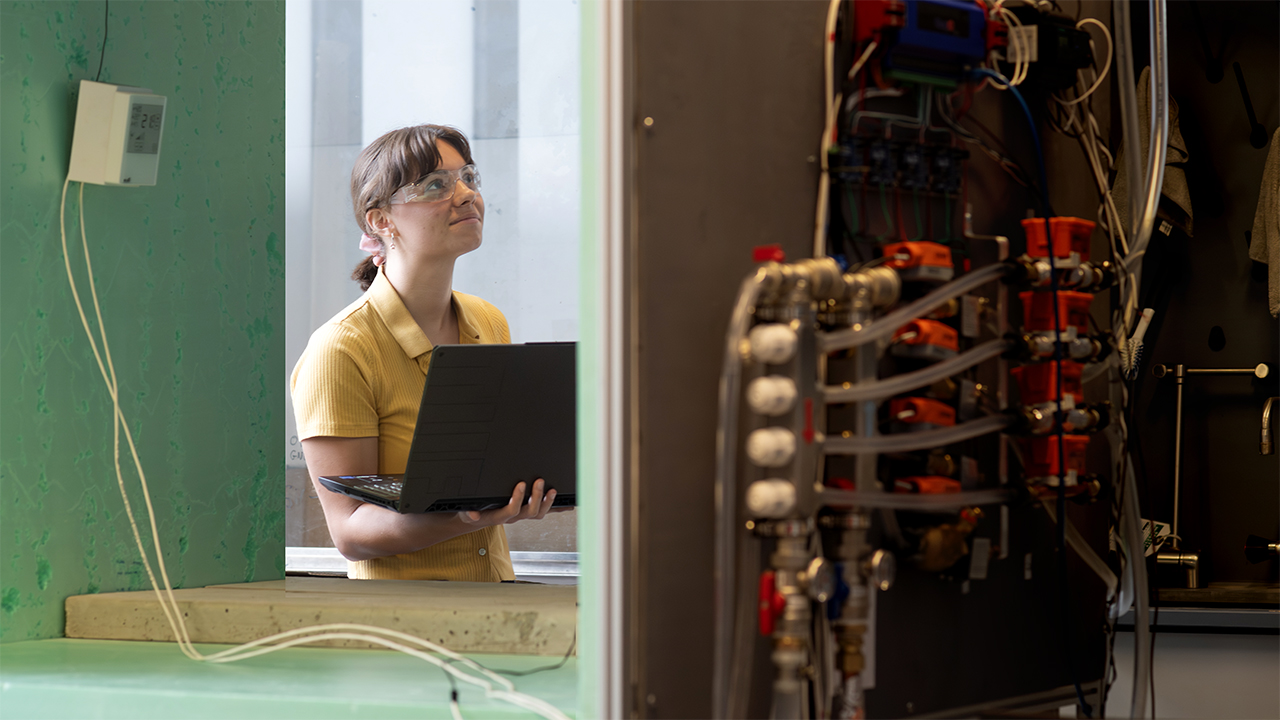
During her second summer in the CHAOS Lab, Adcroft worked on more conventional and widely applicable building technologies. She helped construct a climate chamber to study different interior climate control strategies, from standard air-based heating and cooling systems to alternative technologies like radiant cooling and thermally active concrete. She also designed and installed a network of sensors to identify the conditions and control strategies for maximizing the efficiency of each system.
“Our aim is to find out what control sequences use the least energy,” she explained. “Using building automation software in your building, you can reduce your energy usage by about 50%.”
Sometimes saving energy in buildings requires thinking more pragmatically about how people use them. For instance, the system in a commercial building can be set up in summer so that between nine and five, a room is kept at a cool temperature, but at night it can be warmer because no one will be in it. In this way, you can balance how much energy you’re using while still achieving thermal comfort for the occupants.
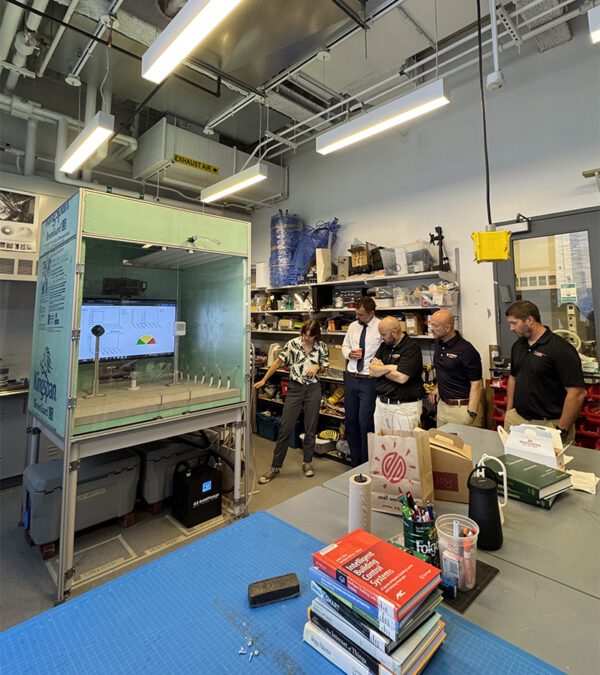
For this project, the team is using industry-standard products, so finding more efficient ways to run these components could have wide-ranging implications in many real-world situations. As Adcroft notes, whilst the impact of making an individual building more efficient is not huge, if you can expand the concept to numerous buildings across the U.S. and even globally, the energy savings would be substantial.
This summer Adcroft worked with Ph.D. students Peteris Lazovskis and James Coleman, who both had jobs in industry before starting on their Ph.D. studies. This experience has given them additional insight into how to translate the research from the lab to applied environments. “In the CHAOS Lab, we realize that the real impact of our work ultimately depends on who reads and uses it,” says Lazovskis. “We work hard to translate ideas from the lab to real-life whenever possible.”
Having worked with Lazovskis and Coleman, Adcroft feels that industry may be the place where she could work to make the most significant changes in the future. “Usually, what happens in academia is written about in papers but doesn’t actually get implemented,” she explained. “So part of the motivation for wanting to go into industry is that it seems that’s where there could be the biggest impact on the real world.”