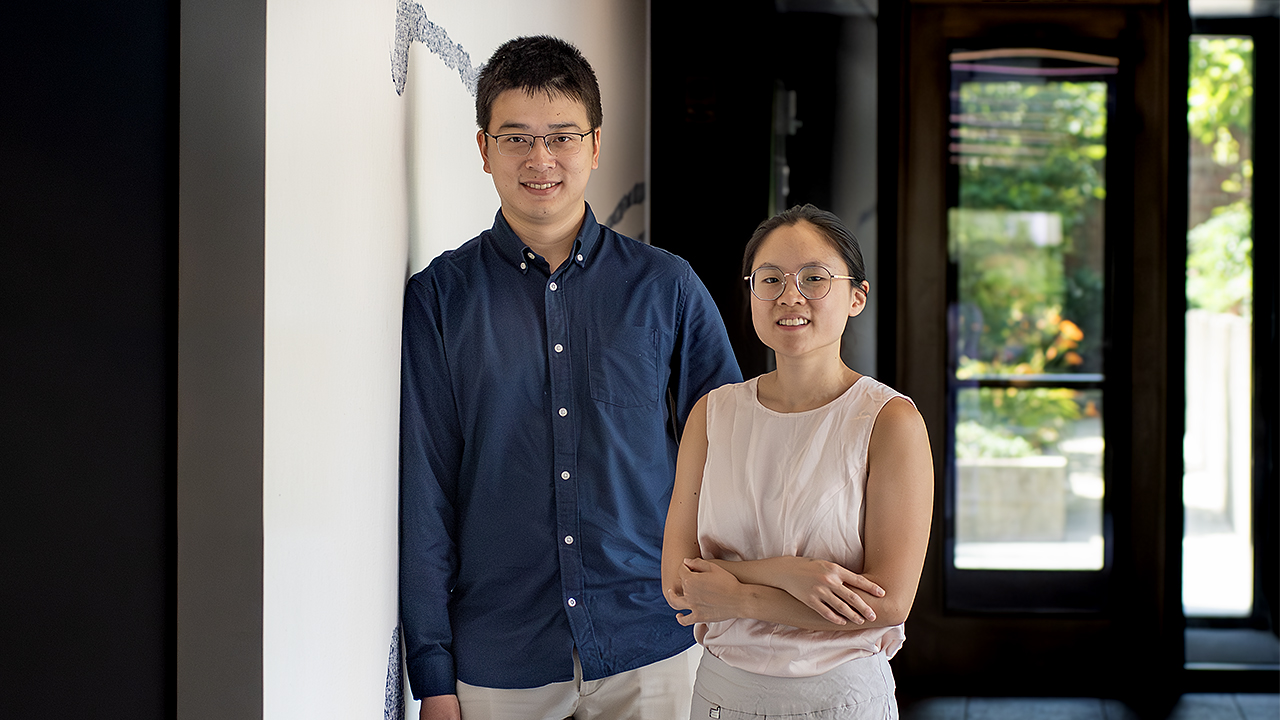
Distinguished Postdoctoral Fellows probe wind-wave interactions and supercooled water
Jinshi Chen and Debbie Zhuang have joined the Andlinger Center as its newest Distinguished Postdoctoral Fellows. Chen will examine the dynamics of misaligned wind and waves in the context of offshore wind energy and global climate models, while Zhuang will study the properties of supercooled water, including how carbon dioxide is transported and absorbed in supercooled aerosols.
The Distinguished Postdoctoral Fellows program supports outstanding scholars whose research is related to energy and the environment, with a focus on innovative technological solutions, smart economic analyses, and impactful policy solutions to pressing energy and environmental challenges.
Jinshi Chen: Exploring wind-wave interactions for offshore wind
While promising renewable energy sources for regions with oceans too deep for fixed offshore wind turbines, floating offshore wind turbines are much more complicated to model due to their complex interactions with both air and ocean currents.
However, most simulations of floating offshore wind turbines assume that wind and ocean currents are moving in the same direction, making them unreliable predictors for how the turbines will perform in real-world conditions in which the two are usually moving in different directions.
Chen will work with Luc Deike, an associate professor of mechanical and aerospace engineering and the High Meadows Environmental Institute, and Michael Mueller, the Donald R. Dixon ’69 and Elizabeth W. Dixon Professor of Mechanical and Aerospace Engineering. Together, they will study how misaligned wind-wave interactions influence momentum and energy transfer at the air–sea interface, how these interactions drive the growth or decay of waves, how they shape vertical wind-speed profiles, and how they affect floating offshore wind turbines. His work will inform current wind turbine models and guide control strategies for floating turbines.
“Floating turbines are subject to forces both from the wind and waves,” Chen said. “It’s important to understand how the turbines will fluctuate in response to both forces — especially when the forces are misaligned — in order to develop a control algorithm to increase their efficiency and decrease the chance of premature failure.”
During his fellowship, Chen will draw from his Ph.D. work with MIT and Woods Hole Oceanographic Institution to probe the interactions between near-shore ocean waves and the beach. Using numerical simulations and observations, Chen studied the physics of how waves break near the shoreline. His work provided insight into how energy and momentum is transferred during wave breaking, including the formation of wave rollers and undertow, which may transport particles like sediments or microorganisms towards the beach or offshore.
By pivoting from land-sea to wind-wave interactions, Chen said the Distinguished Postdoctoral Fellowship will provide him with the opportunity to connect his Ph.D. work to a broader research theme aimed at integrating wind-wave-land interactions. Ultimately, he said he hopes to one day lead his own research lab that investigates wind-wave-land interactions and their implications for how contaminants, gases, and other aerosols are transported in the coastal area, one of the most important regions for human society.
“In oceanography, the easy problems have all been solved. Now we only have the most difficult ones left,” Chen said. “Being at Princeton will give me the chance to interact with many different faculty members whose research directions might intersect with my own, broadening my perspective and hopefully leading to long-lasting collaborations.”
Debbie Zhuang: Probing the dynamics of supercooled water and carbon dioxide
While Zhuang completed her Ph.D. at MIT studying materials for lithium-ion batteries, she said the Distinguished Postdoctoral Fellowship will allow her to dive deeper into water and ionic solutions — an interest she first developed as an undergraduate researcher.
“I remember being completely shocked that there were still so many unanswered questions about what seemed like such a basic thing,” Zhuang said. “I was amazed at how complex and complicated such a seemingly simple system could be.”
Working with Dimitrios Fraggedakis and Michael Webb, both assistant professors of chemical and biological engineering, Zhuang will research the molecular-scale dynamics between carbon dioxide and supercooled water, which is water that remains a liquid even below its freezing point. Supercooled water plays an important role in atmospheric processes including cloud formation, yet it remains understudied because it defies many traditional thermodynamic conventions.
“Supercooled water remains a liquid even when it would be more thermodynamically stable as a solid,” Zhuang said. “Most of the techniques that we have to tackle materials problems are rooted in an assumption of thermodynamic stability, so we really need new methods to understand what’s happening with supercooled water.”
Zhuang will leverage Fraggedakis’ expertise in theory and dynamics and Webb’s background in molecular simulations to develop a cohesive approach for studying the properties of supercooled water, as well as how molecules like carbon dioxide are absorbed and transported in supercooled aerosols. Because of supercooled water’s low temperature, Zhuang said molecules move much slower than normal within supercooled aerosols and require alternative techniques for characterization. At the same time, Zhuang said that insights from her work on the arrested dynamics of carbon dioxide molecules could inform technologies for moisture-based direct air carbon capture.
In addition to her research interests, Zhuang plans to use her time at the Andlinger Center to connect with researchers across disciplines — particularly those working to inform energy policy — to develop an integrated perspective on energy and environmental challenges.
“My focus is mainly on engineering and especially solving technical challenges for technologies that are at the earliest stages of real-world impact, so it will be interesting to meet with people who are studying what it takes to bring emerging technologies out of the lab and into the energy system,” Zhuang said.
The Distinguished Postdoctoral Fellowships were supported by generous gifts from John E. Cross ’72 and Mary Tiffany Cross and the de Carvalho-Heineken Family Fund for Environmental Studies.
Related articles:
- Distinguished Postdoctoral Fellows develop stable insulating polymers and origami-inspired robots
- Distinguished Postdoctoral Fellows study social systems and analyze atmospheric dynamics
- Distinguished postdoctoral fellows to leverage new technology to achieve net-zero and develop energy smart ceramics