Gerhard R. Andlinger Visiting Fellow to tackle stability issues in high-performance solar cells
By the Andlinger Center for Energy and the Environment
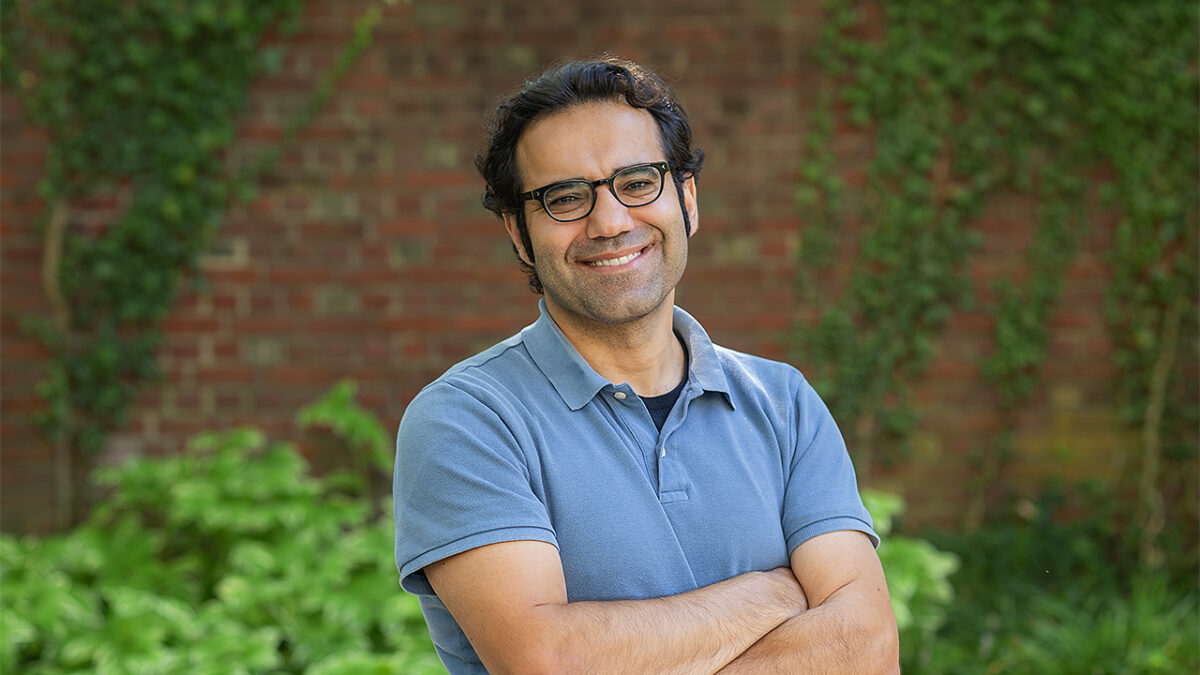
Michael Saliba has joined the Andlinger Center for Energy and the Environment as a Gerhard R. Andlinger Visiting Fellow, aiming to use his time in Princeton to find ways to enhance the stability of high-performance solar cells.
Saliba’s research focuses on perovskites, a new class of semiconductors that show exceptional promise for sustainable energy production. Saliba has worked with hybrid perovskites since their efficiency as solar cell materials was first discovered, starting with his Ph.D. at Oxford University. He continued his research at various institutions including EPFL and Fribourg in Switzerland and the Technical University Darmstadt in Germany, before becoming a full professor and the director of the Institute for Photovoltaics at the University of Stuttgart, Germany, in 2020.
Perovskite solar cells have efficiencies that rival more traditional silicon solar cells, and have key advantages, such as being relatively inexpensive and easy to process from solutions at ambient temperatures. This unlocks exciting prospects for perovskites, such as using them for “solar paint” on a wall or on curved or flexible surfaces for applications in transportation or space. Still, there are challenges that need to be overcome.
“Perovskites have one major issue, which is long term stability. Are they truly stable for two decades, three decades, or even longer?” asks Saliba. He plans to work with Princeton faculty including Barry Rand, Iain McCulloch, Lynn Loo, and Antoine Kahn to study how the solar cells break down and therefore how their stability could be improved: “In situ diagnostics that are available here are of paramount importance to find real time pathways of degradation.”
Beyond perovskite stability, Saliba will examine tandem solar cells, where perovskites are layered with silicon in a single solar cell so more of the solar light spectrum can be captured for energy conversion. He also hopes to collaborate on lifecycle assessments of perovskite materials and explore ways to make their scaled-up manufacture as sustainable as possible.
Saliba, who has previously undertaken research stays at Stanford and Cornell Universities, says he values the highly collaborative interactions made possible through extended visits to other institutions and the connections between the U.S. and Europe: “I think the answer to barriers is to build more bridges. It’s an exciting mix of people here at the Andlinger Center doing fundamentals in many different areas, coupled with excellent infrastructure making it a unique and world class environment.”