Annual Report for the Academic Year 2024–2025
Director’s Message
In both the United States and across much of the globe, 2025 has been a challenging year for the clean energy transition. While 2024 was the first year that the world’s average temperatures breached 1.5°C above pre-industrial levels, clean energy technologies and policies have faced mounting political, economic, and social pressures around the world.
At this moment of uncertainty, it is important to underscore that the mission and goals of the Andlinger Center remain consistent to those that shaped the Center’s creation — and indeed, they have only intensified. At the Andlinger Center, we are steadfast in our commitment to developing transformative solutions to secure a sustainable energy and environmental future for the planet. And that mission has become increasingly urgent as the devastating impacts of climate change have made themselves manifest in more frequent and severe extreme weather, rising sea levels, and climate-induced displacement.
Now more than ever, it is imperative that the Andlinger Center is focused and clear about its efforts to ensure that our work has the greatest societal impact. In early 2025, our faculty and I came together to finalize a five-year strategic plan for the Andlinger Center that will allow us to align our efforts around initiatives on which our researchers are well-positioned to lead. The strategic plan will lend clarity to our efforts as we navigate an unpredictable funding landscape.
The plan outlines six priority research areas for the center, which we classify as “Research Initiatives.” These initiatives include greening the grid; industrial decarbonization; buildings and transportation; carbon capture, utilization, and storage; the water-energy-resource nexus; and climate resilience engineering. By identifying new opportunities for collaboration, we expect these initiatives will develop into full-fledged research platforms, poised to tackle the greatest energy and environmental challenges facing the planet. In the pages that follow, you will read about the cutting-edge work of our faculty, researchers, students, and corporate partners to drive meaningful progress across each of these focus areas.
In both the United States and across much of the globe, 2025 has been a challenging year for the clean energy transition. While 2024 was the first year that the world’s average temperatures breached 1.5°C above pre-industrial levels, clean energy technologies and policies have faced mounting political, economic, and social pressures around the world.
We at the Andlinger Center will continue our work to secure a sustainable future for all. Our mission is larger than any one of us as individuals, and its scope extends beyond any one of our lifetimes.
Our strategic plan also recognizes that the work of the center is inherently interdisciplinary, with faculty who are leaders in energy technology development, energy and environmental systems modeling, and policy research. While we align our efforts around our research initiatives, it is critical that we remain flexible and responsive enough to address new and emerging energy challenges, such as the proliferation of AI and its associated energy demand over the past year. You can read more about how Andlinger Center and Princeton faculty are shaping conversations around AI on pages 4 and 5.
As we develop our research programs, we are continually looking to grow the number of opportunities for our research community and find new ways for our early-career researchers to benefit from and engage with the Andlinger Center’s work. From our newly established Minor in Sustainable Energy and our Early Career Leadership Forum to building connections for Princeton students with industry experts, we recognize the importance of equipping our next generation of leaders with the skills, knowledge, and experience they need to make a positive impact on the world.
Despite the current headwinds, we at the Andlinger Center will continue our work to secure a sustainable future for all. Our mission is larger than any one of us as individuals, and its scope extends far beyond any one of our lifetimes. It is a mission that inspires and draws top-tier researchers and industry partners from around the world to the Andlinger Center, and it is one that I believe is worth fighting for.
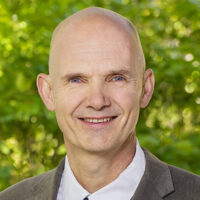
Iain McCulloch, Director, Andlinger Center for Energy and the Environment; Gerhard R. Andlinger ‘52 Professor in Energy and the Environment; Professor of Electrical and Computer Engineering and the Andlinger Center for Energy and the Environment
Captions: Iain McCulloch (Photo by David Kelly Crow)