Annual Report for the Academic Year 2024–2025

Sustainable Buildings and Transportation
With expertise spanning materials science, process modeling and optimization, and policy, researchers at the Andlinger Center are lowering the carbon intensity of the built environment.
Research in Action
Electric vehicles at risk
While electric vehicles (EVs) are widely recognized as a key pillar of the energy transition, in July 2025 the United States government passed legislation to repeal Biden-era tax credits aimed at incentivizing EV adoption, sunsetting the credits after September 2025.
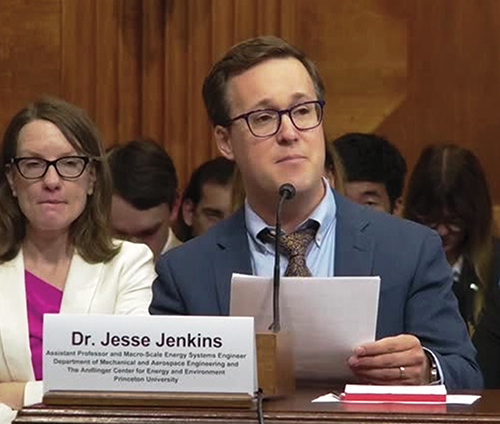 Jesse Jenkins, who leads the REPEAT Project to provide regular, timely, and independent environmental and economic evaluation of federal energy and climate policies as they are proposed and enacted, analyzed the system-wide impacts of repealing the EV tax credits to quantify the consequences of the repeal on carbon emissions and estimate the risk to the EV industry in the U.S.
The findings of the REPEAT report demonstrated that repealing the EV tax credit would:
- lower sales of battery electric vehicles by about 30% in 2027 and 40% in 2030,
- cumulatively result in 8.3 million less EVs and plug-in hybrids on U.S. roads in 2030,
- place between 29% and 72% of battery cell manufacturing capacity currently operating or online by the end of 2025 at risk of closure, and
- place as much as 100% of planned construction and expansion of U.S. electric vehicle assembly at risk of cancellation.
Captions: (Cover) Pratik Foto / Adobe Stock
(Inset) In July 2024, Jenkins testified before the Senate Budget Committee about recent trends in the electric vehicle transition in the U.S., as well as strategies for overcoming barriers to electric vehicle adoption.
NEW FINDINGS
Leading the charge to better batteries
As demand grows for longer driving ranges for electric vehicles and longer-lasting devices, researchers have turned to solid-state batteries as a high-powered alternative to today’s lithium-ion batteries.
With support from a U.S. Department of Energy Energy Frontier Research Center, Kelsey Hatzell is leading efforts to improve the performance and manufacturability of solid-state batteries. Her work is focused on maintaining even contact between the internal components of solid-state batteries, which is critical for maintaining high-performance batteries and avoiding untimely short circuits.
In one study, Hatzell and postdoctoral researcher Se Hwan Park examined how applying various degrees of external pressure to the battery system influenced the degree of contact between the solid electrolyte and a component known as the current collector, which connects the battery to the outside circuit.
In a second study, the team applied thin silver-carbon coatings between the electrolyte and the current collector to improve the contact between the two components. The team found that the structure and size of these coatings had a major influence on the quality of contact, helping to ensure that ions were evenly plated and stripped as the battery was charged and discharged.
Beyond experiments, Hatzell and her colleagues reviewed the broader field of battery research and charted a research roadmap for translating lab successes to commercial-scale production. With global companies like Samsung and Toyota aiming to mass-produce solid-state batteries by the late 2020s, the team’s work could help bridge critical knowledge gaps. “
The challenge will be getting from research to the real world in only a few years,” said Hatzell. “Hopefully the work we’re doing now can underpin the development and deployment of these next-generation batteries at a meaningfully large scale.”

FUND FOR ENERGY RESEARCH WITH CORPORATE PARTNERS
Filling in the empty spaces of solid-state battery research
While solid-state batteries offer energy densities that far surpass today’s lithium-ion batteries, challenges like uneven lithium plating and stripping remain major barriers to their widespread use. This unevenness can lead to the formation of voids, which are empty spaces that degrade the battery’s performance and lifespan. Supported by the Andlinger Center’s Fund for Energy Research with Corporate Partners, Kelsey Hatzell will study how voids form in real-time as solid-state batteries are operated. In doing so, Hatzell’s team will address fundamental knowledge gaps in solid-state battery behavior and inform the design of more robust and reliable solid-state battery technologies. The project will be carried out with Rana Mohtadi at Toyota Research Institute in North America as the corporate partner.
GRANT FOR INNOVATIVE RESEARCH IN ENERGY AND THE ENVIRONMENT
Stabilizing solid-state batteries
The Andlinger Center awarded a Grant for Innovative Research in Energy and the Environment to Craig Arnold, the Susan Dod Brown Professor of Mechanical and Aerospace Engineering, and Claire White to improve the stability of solid-state batteries. Using a variety of characterization techniques, the team will investigate how battery structure and material properties influence performance during repeated charging cycles, paving the way for future research to optimize the electrochemical processes that govern the longevity and performance of solid-state batteries.
Intern Spotlight
Ariane Adcroft
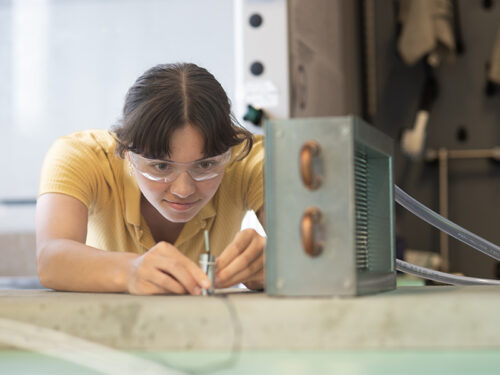
As a two-time summer intern in Forrest Meggers’ CHAOS Lab, mechanical and aerospace engineering student Ariane Adcroft has explored a wide range of topics in the built environment — many of which extend beyond her formal coursework at Princeton.
During her first summer, Adcroft collected data on a unique home in Princeton that passively harnesses solar energy for heating and nighttime temperatures for cooling. Designed by architect Douglas Kelbaugh, the house features a southern-facing, dark-painted cement wall with a thin layer of glass that traps daytime solar radiation for slow release overnight, in turn cooling the wall to act as a daytime heat sink. Adcroft developed a sensor network and data collection system for the home, which was critical for characterizing the building’s thermal performance and designing efficiency upgrades.
That work laid the foundation for her internship this past summer when Ashcroft helped construct a climate chamber to study different heating and cooling technologies, from conventional air-based heating and cooling systems to alternative technologies like radiant cooling and thermally active concrete. She also designed and installed a network of sensors to identify the conditions and control strategies for maximizing the efficiency of each system.
“Each internship taught me a number of skills, from data analysis to building and troubleshooting mechanical systems,” Adcroft said. “Being in and around the Andlinger Center for the last couple of years and hearing from different researchers has really given me a sense of how important our work is.”