Annual Report for the Academic Year 2024–2025

Greening the Grid
Acknowledging the power sector’s role as a lynchpin for economy-wide decarbonization, the Andlinger Center is advancing clean energy and grid modernization solutions to transition toward sustainable electric power.
RESEARCH IN ACTION
Negotiating trade-offs between land use and the energy transition
Australia’s pathway to a net-zero economy by 2060 is far from straightforward.
Siting the solar and wind energy necessary to decarbonize the country’s economy and maintain its extensive energy exports to become a clean energy superpower will require significant capital investment — to the tune of around $6.2 trillion USD. It will also require around 110,000 square kilometers of land, equivalent to over one and a half times the size of Tasmania.
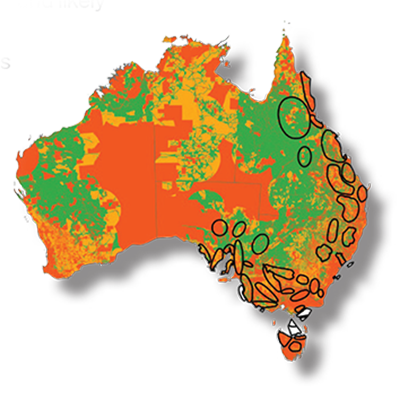 Yet a team of researchers from the Andlinger Center, University of Queensland, and University of Melbourne have demonstrated that decarbonization in Australia is possible while avoiding harm to important areas for biodiversity outcomes, safeguarding agricultural activities, and respecting Indigenous land rights — as long as stakeholders work together.
Without collaboration, however, the researcher’s analysis found Australia could find itself facing a clean energy shortfall of over 500 gigawatts and an unwanted and likely costly pivot to an alternative energy pathway.
In their work, the team outlined a “traffic light’ approach to renewables deployment, identifying where projects could be easiest to site (green), where they could be potentially sited pending further stakeholder engagement (orange), and where development would be off-limits (red).
The researchers, including research scholar Andrew Pascale and Chris Greig, say their framework can facilitate transparent and inclusive stakeholder dialogue, integrating diverse viewpoints into the broader mission of national decarbonization.
This research was partially supported by the Andlinger Center’s Fund for Energy Research with Corporate Partners.
Captions: (Cover) Nikolai Tsvetkov / Adobe Stock
(Inset) The researchers’ proposed ‘traffic-light’ approach to energy planning in Australia. The black circles indicate areas identified as candidate renewable energy zones by the Australian Energy Market Operator.
FUND FOR ENERGY RESEARCH WITH CORPORATE PARTNERS
Modeling complex power systems
Jürgen Hackl received a grant from the Andlinger Center’s Fund for Energy Research with Corporate Partners to develop a modeling framework for power systems that captures the complex interactions of the modern grid more effectively than existing network models. Hackl’s team will build scalable grid forecasting models that support both short-term grid management and long-term grid planning strategies, with a goal of increasing grid forecasting accuracy, robustness, and overall power system efficiency. The project will be carried out with Beacon Power Services as the corporate partner, bringing industry expertise in power systems operations to support the research.
Thermal energy storage and gas-fired power plants
The Andlinger Center’s Fund for Energy Research with Corporate Partners supported research aimed at analyzing how thermal energy storage (TES) systems — an emerging technology that temporarily stores energy by heating or cooling a medium — could help mitigate emissions from natural gas power plants. TES can be charged via excess heat from combustion turbines as they start up or shut down or from excess electricity from the grid, allowing operators to later use that stored heat to supplement or replace natural gas combustion. Jesse Jenkins will lead a team that includes co-PIs Eric Larson and Christos Maravelias, the Anderson Family Professor in Energy and the Environment, to analyze the techno-economic feasibility, market potential, and energy system impacts of integrating TES into natural gas combined cycle power plants. A corporate partnership has already been initiated for the project .
NEW FINDINGS
Analyzing the EPA’s actions
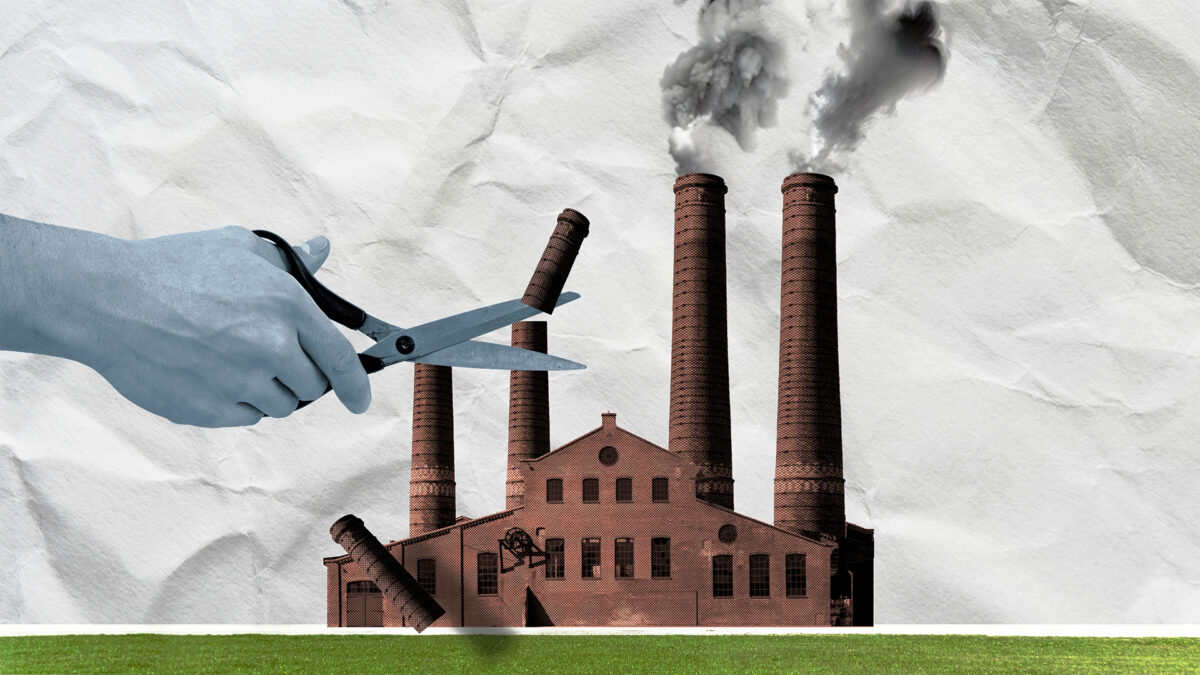
In March 2025, the U.S. Environmental Protection Agency (EPA) announced its intention to rollback regulations finalized in 2024 aimed at curbing greenhouse gas emissions from fossil fuel-fired power plants. The regulations set carbon dioxide limits for new gas-fired combustion turbines and provided guidelines for existing coal, oil, and gas-fired steam generating units.
That same month, Jesse Jenkins and associate research scholar Qian Luo published an analysis highlighting the rules’ role in driving down carbon emissions from the power sector and spotlighting the potential impacts of repealing the rules. The analysis also identified potential ways for the rules to be modified to achieve even deeper and more cost-efficient emissions reductions. The team found that:
- under the finalized EPA regulations, power sector emissions could fall 51% compared to 2022 levels, compared to only 26% without the rules.
- most emissions reductions from the regulations would come from accelerated coal plant retirements, accounting for around 70% of the total emissions reductions from the rules.
- the regulations targeted at natural gas plants only affect new natural gas power plants. Consequently, the 2024 regulations could lead to new natural gas plants operating at a lower capacity while ramping up production from less efficient existing natural gas generators, reducing the benefits of the new rules.
- additional regulations targeting existing gas plants could achieve power sector emissions reductions up to 88% below 2022 levels, at an even lower average cost of abatement than the 2024 regulations.
Captions: (Illustration by Bumper DeJesus)
MAEDER GRADUATE FELLOWSHIP
Graduate fellows tackle grid planning under uncertainty and efficient power delivery
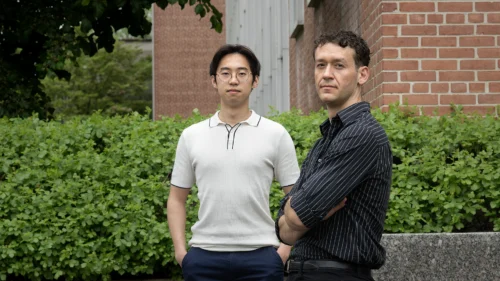
Graduate students Shukai Wang and Gabe Mantegna were awarded the 2025 Maeder Graduate Fellowship in Energy and the Environment. The fellowship is awarded to the graduate students each year who have demonstrated strong potential to develop solutions for a sustainable energy and environmental future.
Wang, who is advised by Minjie Chen, researches ways to make power delivery systems more energy efficient to keep pace with the skyrocketing energy demands of data centers. Wang focuses his research on modeling power magnetics materials, which are critical components of power delivery systems. By modeling the magnetics materials under a variety of operating conditions, Wang is helping magnetics designers make smaller and more energy efficient power delivery systems.
Mantegna, who is advised by Jesse Jenkins, is developing robust optimization models that can help grid planners and utilities make long-term planning decisions — even when there are uncertainties around future energy demand or the availability and incentives for energy technologies. As part of his project, Mantegna is working directly with energy planners in California to develop his methods, present his findings, and ensure his work is practical for real-world applications.
The Maeder Graduate Fellowship is supported by the Paul A. Maeder ‘75 Fund for Innovation in Energy and the Environment.
RESEARCH FELLOWSHIPS
Exploring misaligned wind-wave interactions for energy and the environment
 Jinshi Chen joined the Andlinger Center in May 2025 as a Distinguished Postdoctoral Fellow. Working with Luc Deike, associate professor of mechanical and aerospace engineering and the High Meadows Environmental Institute, and Michael Mueller, the Donald R. Dixon ’69 and Elizabeth W. Dixon Professor of Mechanical and Aerospace Engineering, Chen will study the interactions between misaligned ocean waves and wind and the implications of those dynamics for floating offshore wind turbines. The results could also help inform global climate models of the ocean’s carbon capture and aerosol transportation capabilities.
Funding is provided by the de Carvalho-Heineken Family Fund for Environmental Studies.
Pushing perovskite solar cells forward
 In August 2025, Michael Saliba joined the Andlinger Center as a Gerhard R. Andlinger Visiting Fellow from Stuttgart University, where he is a full professor and the Director of the Institute for Photovoltaics. Hosted by Barry Rand, Saliba will collaborate with a number of Princeton researchers to develop high-performing perovskite solar cells with long-term stability. Perovskite solar cells are highly tunable alternatives to silicon solar cells, which dominate today’s commercial solar market.
During his visiting fellowship, Saliba will also explore the interplay of chemistry, physics, and materials science to advance the development of high-performance tandem solar cells, in which different types of solar cells are stacked on top of each other to increase their efficiency at converting solar energy into electricity.
Funding is provided by the Gerhard R. Andlinger Professorships and Visiting Professorships in Energy and the Environment Fund.