Annual Report for the Academic Year 2024–2025
AI and Computing
2024 ANNUAL MEETING
AI’s double-edged role in the clean energy transition
The Andlinger Center convened high-ranking experts from across academia and industry at its 13th Annual Meeting to unpack the opportunities and risks of AI for the clean energy transition.
On one hand, speakers said the energy consumption from AI and its associated data centers will exacerbate challenges to already struggling clean energy ambitions. On the other, AI’s ability to quickly process and react to unprecedented amounts of data will unlock new ways of approaching energy and climate challenges.
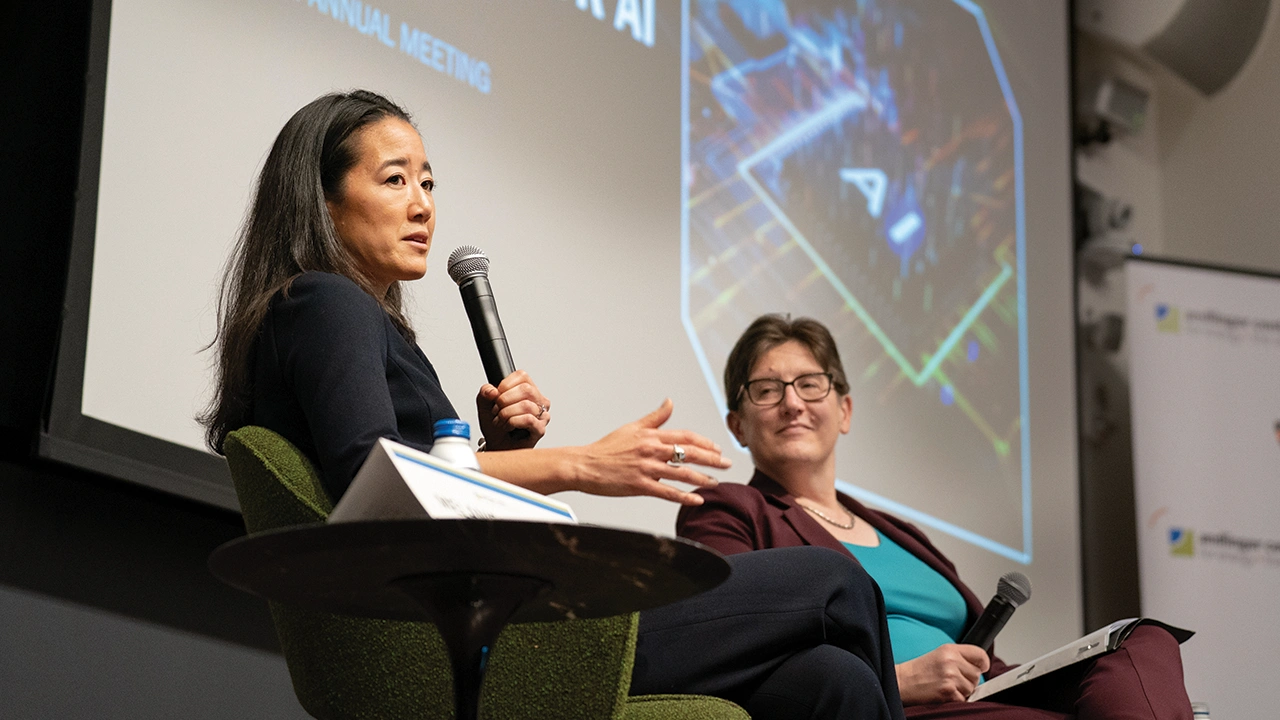
Keynote speaker Melanie Nakagawa, Microsoft’s Chief Sustainability Officer, said the key to navigating the energy and environmental challenges of AI’s rise is to consider its impacts across the global ecosystem.
“Ultimately, this is a systems challenge,” Nakagawa said. “We want to create an impact beyond our company, so we are investing in solutions and advocating for policies that can support a net-zero future for everyone.”
Panelists underscored that AI and its associated data centers will be just one driver of future energy demand, alongside the wider adoption of electric vehicles and the growth of emerging energy technologies. Beyond AI, they said the real challenge is preparing the energy system for this period of sustained growth after decades of plateaued energy demand.
Lucia Tian, head of clean energy and decarbonization technologies at Google, argued that AI’s growing energy footprint is also an opportunity to grow global investments in clean energy technologies that will catalyze the broader energy transition.
“Some of our early investments and partnerships can bring these emerging technologies that are at a premium today down the cost curve, so they can be available for everyone,” Tian said.
Captions: (Top) Melanie Nakagawa and Jennifer Rexford, Princeton’s provost and the Gordon Y.S. Wu Professor in Engineering, discuss the energy and environmental challenges of AI. (Photos by Tori Repp / Fotobuddy)
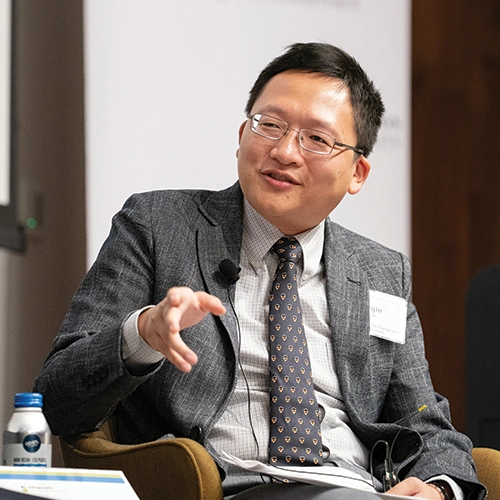
(Inset) Annual Meeting co-chair Minjie Chen moderated a panel on how AI can also unlock new approaches for addressing energy and environmental challenges.
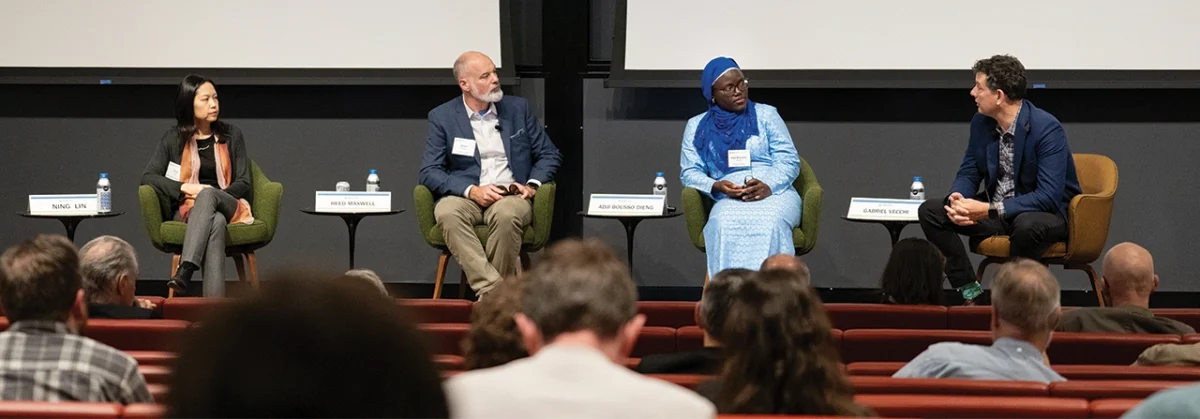
(Bottom) The “AI for Climate” panel highlighted the limitations of AI tools for climate and environment research. Left to right: Ning Lin, professor of civil and environmental engineering; Reed Maxwell, the William and Edna Macaleer Professor of Engineering and Applied Science and Professor of Civil and Environmental Engineering and the High Meadows Environmental Institute; Adji Bousso Dieng, assistant professor of computer science; and moderator, Gabriel Vecchi, Director, High Meadows Environmental Institute at Princeton University; Professor, Geosciences Department and High Meadows Environmental Institute.
convening stakeholders
Continuing the conversation
Following the Annual Meeting, the Andlinger Center hosted representatives from the New Jersey Governor’s Office, Board of Public Utilities, and Economic Development Authority in February 2025 for a workshop on the intersection of AI and energy. The workshop established shared priority areas between Princeton University and New Jersey state agencies related to AI and energy and identified key research gaps, with several Princeton faculty presenting their work. Those research gaps included ways that AI can be harnessed to improve energy efficiency and accelerate the pace of decarbonization, as well as the best ways for the state to meet the growing energy demands from AI and its associated data centers. The workshop marked the start of an ongoing conversation between Princeton faculty and state agencies about how New Jersey can best address the challenges and opportunities that AI poses for the state’s energy sector.
AI at the Andlinger Center
Here are a few ways that Andlinger Center researchers are leveraging the power of artificial intelligence and machine learning to drive progress on energy and environmental issues.
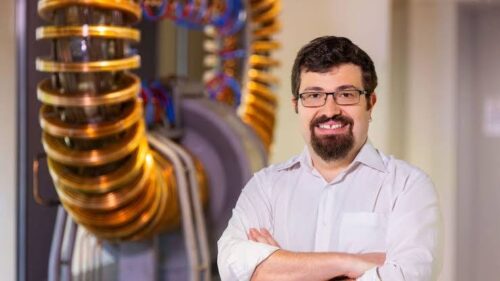
Egemen Kolemen is using AI tools to enable real-time plasma control during fusion reactions. His team has developed an AI controller that can forecast potential plasma instabilities and take corrective action to avoid reaction-ending disruptions.
Z. Jason Ren is harnessing machine learning and AI to solve challenges in the water and wastewater sector, including better quantifying the greenhouse gas emissions from various treatment processes, predicting the performance of novel materials, and managing the risks associated with wastewater discharge.