Annual Report for the Academic Year 2024–2025
Water as a Versatile Resource
Leading the charge toward a circular economy, researchers at the Andlinger Center are transforming water and wastewater systems for improved resource management and effective pollution remediation.
RESEARCH IN ACTION
Tackling soaring demand for lithium and other critical minerals
Born from research conducted at Princeton with support from the Andlinger Center, a new startup is upending decades-old approaches for the way the world extracts lithium and other materials.
Co-founded by Z. Jason Ren and Sean Zheng, a former Andlinger Center Distinguished Postdoctoral Fellow, Princeton Critical Minerals has developed a new technology to increase minerals production from evaporation ponds, which today generate around 40% of the world’s lithium and most of its naturally occurring nitrate.
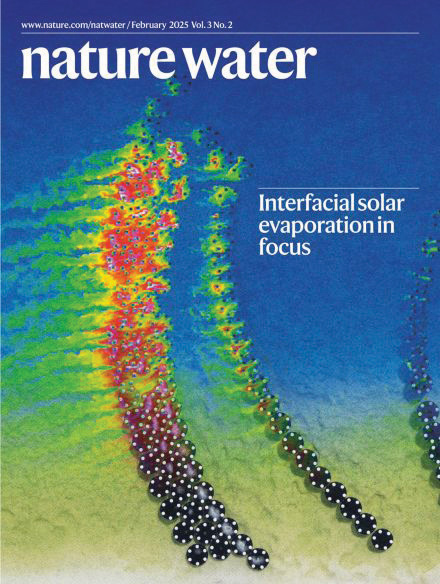 Resembling a black disc that floats on the surface of an evaporation pond, the lilypad-like technology is similar to adding a second sun to conventional, open evaporation ponds. In field tests conducted at evaporation ponds in South America through a partnership with chemical company Sociedad Química y Minera de Chile (SQM), Princeton Critical Minerals (PCM) demonstrated that its technology boosted evaporation rates when compared to open ponds by anywhere between 40% and 122%, depending on the composition of the brine in the pond.
“In many ways, the processes for mineral extraction are the same today as they were three decades ago,” said Zheng. “Our technology could really revolutionize the conventional approach to critical minerals extraction.”
Ren said the partnership has opened new research questions for his lab group at Princeton. His efforts with PCM have helped him expand what he sees as the impact of his work.
“My hope is that PCM’s story can inspire my colleagues at Princeton to think about how their research might also extend beyond the lab and into the real world,” Ren said.
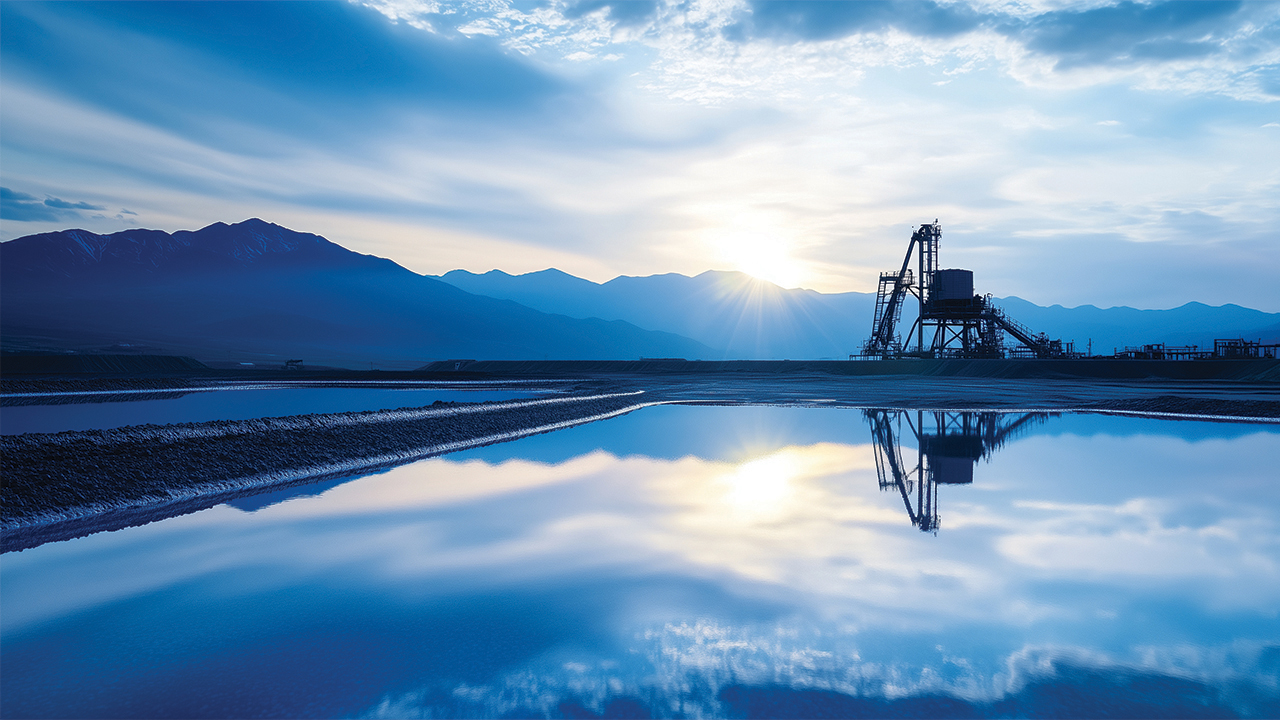
Captions: (Cover) Maksym / Adobe Stock
(Inset) Ren and Zheng’s work with Princeton Critical Minerals was featured on the cover of the February 2025 issue of Nature Water.
NEW FINDINGS
Modernizing ion-exchange research for a circular economy
Separating charged particles is at the heart of almost any energy and environmental technology, from technologies for water purification and energy storage to critical minerals harvesting and pollution remediation.
Yet the dominant paradigm for the past century — separating ions from one another on the basis of either size or charge — has become increasingly insufficient for the advanced separation problems facing the world today. The paradigm particularly breaks down when trying to separate two materials with similar sizes and charges, such as lithium and sodium ions.
Ryan Kingsbury’s lab is working to bring ion- exchange research up to speed with the global push toward a circular economy, in which waste is minimized and resources are used and reused as long as possible. His group is leveraging insights from physical chemistry, quantum mechanics, and molecular simulations to identify new ways for separating substances from complex mixtures, which could supercharge efforts to recycle industrial and manufacturing waste.
“I see our group as trying to write a new rule book to help understand what the underlying principles are and how to apply them to different situations,” Kingsbury said. “We have this rich knowledge about the different chemistries of various ions, and my group is working to apply that knowledge to engineer better separation processes.”
NEW FINDINGS
The next generation of separation membranes
Separating ions with similar sizes and charges is an enduring challenge for researchers and companies seeking to recover valuable materials from industrial processes while filtering out waste. Kelsey Hatzell’s group is exploring one family of 2D membranes, known as MXenes, with a highly tunable structure that offers a pathway to efficient ion-ion separations. In one study, the group demonstrated how lithium, sodium, and calcium ions in solution compete with one another as they traverse the nanostructure of an MXene membrane. In another, the researchers found that the amount of water itself present within each layer of the membrane has a strong influence on its overall structure, durability, and performance. By studying the structure and performance of MXene membranes at different length-scales — macro, meso, and micro — Hatzell’s group is uncovering fundamental insights that will help pave the way for the next- generation of separations technologies.
INTERN SPOTLIGHT
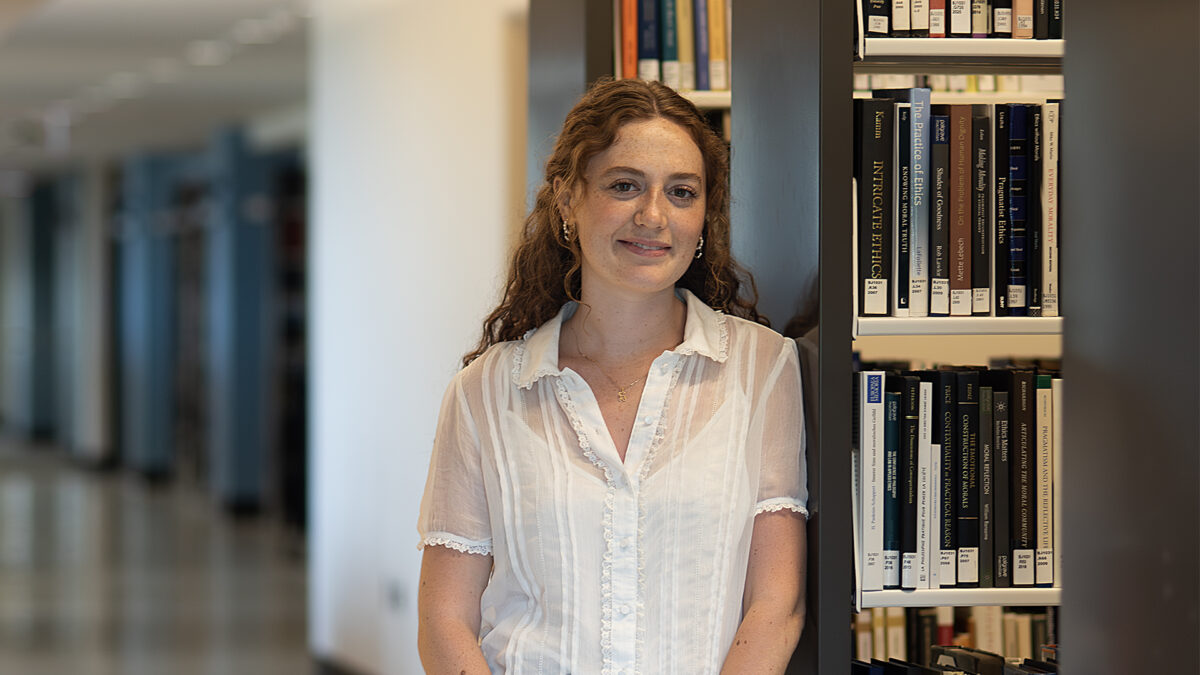
Ashley Holmes
While environmental engineering student Ashley Holmes always knew that she wanted to work in an environmental field, it wasn’t until coming to Princeton that she felt drawn to the water sector. Supported by the Andlinger Center’s summer internship program after her sophomore year, Holmes worked with Moonshot Missions, a non-profit that helps communities and utilities secure affordable access to clean water.
Embedded in the organization’s Great Lakes Team, Holmes helped to prepare a document for wastewater utilities that provides guidance and best practices for phosphorus removal from wastewater. She also participated in a site visit to prepare and present climate resilience strategies to a small wastewater facility in Wisconsin located only a few yards away from the Oconto River that had become vulnerable to increasingly frequent flooding.
Not only did her internship with Moonshot Missions help her excel in a course she took the following semester on technologies for water pollution, but she said it also showed her the many innovations taking place in the water sector.
“We’ve been doing water treatment for many years, so it might seem at first like a well-established field without much growth,” Holmes said. “But I learned that there are always new challenges, whether that be emerging contaminants like PFAS, new and more efficient treatment technologies, or hardening infrastructure against the impacts of climate change. There are still many opportunities for creativity and innovation.”
Captions: Ashley Holmes at Firestone Library. (Photo by Bumper DeJesus)
INDUSTRY ENGAGEMENT
Powering hydrogen production with impaired water
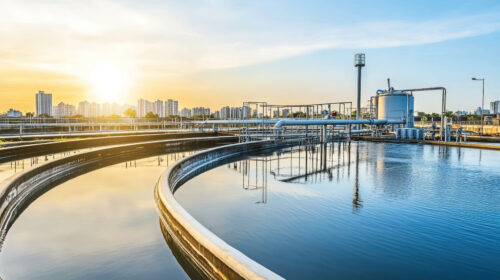 Z. Jason Ren is working with E-ffiliates member New Jersey Resources to evaluate the potential of using treated wastewater effluent as an input for hydrogen electrolysis, thereby avoiding the need for operators to draw from and place stress on the local drinking water supply. At the same time, the hydrogen and oxygen produced via electrolysis can be directly useful to the operation of the wastewater treatment plant. Ren’s group is assessing the potential of different water treatment technologies to provide a reliable water supply for electrolysis. They are also analyzing the overall system efficacy in terms of water quality and hydrogen and oxygen production, as well as identifying challenges and opportunities for commercial scale-up.
Captions: (Inset) yuan / Adobe Stock