Annual Report for the Academic Year 2024–2025

Transforming Industry
Tackling carbon emissions from hard-to-abate industries — including chemicals, fuels, and building materials — the Andlinger Center is transforming industrial processes to leverage clean energy and sustainable feedstocks.
Industry Engagement
Toward a more sustainable chemicals industry
The chemicals industry is both essential to modern life and exceedingly hard to decarbonize. And because global demand for chemicals is expected to grow significantly over the next half century, the industry is being challenged to lower its greenhouse gas emissions while growing its production volumes and maintaining its profitability.
To help inform chemical industry leaders and policymaker decision-making, Eric Larson and Chris Greig worked with E-ffiliates member Deloitte to produce a technical report assessing strategies to achieve deep emissions reductions from the global chemicals industry. Robert Socolow, professor emeritus of mechanical and aerospace engineering, in his Foreword to the report, described the collaboration as “an extraordinarily bold and productive partnership.”
The research focused on facilities across four world regions — North America, Europe, Middle East, and China — producing ten so-called building block chemicals that today account for an estimated 1 billion tonnes per year of greenhouse gas emissions (about 70% of all chemical industry emissions).
Grounding their research in the takeaways from three workshops with industry leaders in North America and Europe, the team developed a techno-economic model to project the industry’s emissions for the next half century under a variety of scenarios dependent on the strength of governance, level of coordination, and demand for sustainable goods. The researchers also conducted an opportunity assessment to identify the most promising markets for chemical-derived products with lower carbon footprints.
The study’s results indicate that abating emissions by 2050 under the most ambitious modeling scenario would require an average annual capital investment across the four study regions of $27 billion above and beyond capital that would be spent in the normal course of business. The market analysis revealed that the consumer packaging, automotive, food and beverage, and personal care markets for chemicals-derived products would be the highest-priority areas for investments in sustainability. The researchers said their findings will inform chemical industry leaders, public policy makers, and other stakeholders on the current state of emissions from the chemicals industry, the feasibility of announced net-zero emissions targets, and near-term opportunities for emissions reductions.
Captions: (Cover) Aerman / Adobe Stock
Grant for Innovative Research in Energy and the Environment
Greener steelmaking
The Andlinger Center supported an interdisciplinary team led by Yiguang Ju, the Robert Porter Patterson Professor of Mechanical and Aerospace Engineering, to study a new, net-zero emissions approach for manufacturing and recycling steel. Ju’s team will explore the use of hydrogen and ammonia in conjunction with low-temperature plasmas to lower the emissions intensity of the steelmaking process, which today accounts for around 8% of global carbon emissions.
Accelerated geologic hydrogen production
Catherine Peters, the Magee Professor of Geosciences and Geological Engineering and a professor of civil and environmental engineering, received an award to explore methods for accelerating the production of geologic hydrogen, which is naturally yet inefficiently generated deep below the Earth’s surface. Peters will partner with the Institute for Rock Magnetism at the University of Minnesota to use geomagnetic diagnostics on magnetite to draw inferences about how the iron in magnetite is partitioned into various end-products, which is important for understanding the availability of natural hydrogen and identifying ways to accelerate its production. The Grant for Innovative Research in Energy and the Environment is funded by The Parallax Fund for Energy and the Environment, The Clifford and Helen Cross Memorial Charitable Lead Annuity Trust, The Addy/ISN North American Low Carbon Emission Energy Self-Sufficiency Fund, The Anonymous Research in Energy & Environment Fund, and the Andlinger Center for Energy and the Environment.
 New Findings
Recycling cements to drive down emissions — without slacking on strength
Each year, the cement and concrete industry is responsible for around 8% of the world’s carbon emissions. If the industry was a country, it would be the third-largest emitter after China and the U.S. The primary culprit behind the industry’s large footprint?
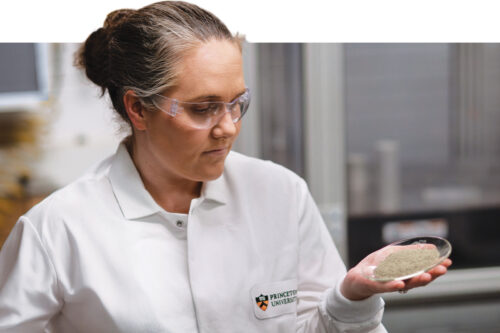
A material known as Portland cement, which is by far the most common binder used to create concrete but generates significant carbon emissions due to the chemical and thermal processes involved in its production. Yet a collaboration between the labs of Andlinger Center faculty Claire White and Sérgio Angulo of the University of São Paolo has revealed a new way forward for the cement industry that not only lowers its carbon intensity but also moves the world toward a more circular economy. The approach involves recovering cement from demolished buildings and other construction projects, heating the powder at 400 – 500 °C to remove tightly bound water molecules, and then mixing that recycled cement powder with small amounts of finely ground Portland cement.
In lab experiments, the researchers showed that mixtures containing up to 80% of this recycled cement demonstrated strength gains on par with the industry standard Portland cement. If fully realized and deployed in coordination with other emerging technologies that replace cement, the researchers estimated that emissions from the cement industry could be cut by up to 61%.
“The leap forward here is that you can now get short- and long-term properties that are essentially the same as Portland cement by itself with a low-carbon alternative overwhelmingly composed of recycled materials,” said White.
Angulo also noted that the approach could breathe new life into construction and demolition waste that would otherwise end up in either a landfill or low-quality applications such as in pavements or soils. “With this technology, you could imagine cities becoming much more circular than today,” Angulo said. “Materials from demolished infrastructure can be directly used in new building projects.”
Captions: Claire White (Photo by Bumper DeJesus)
Fellowships
Sustainable biomanufacturing
 In June 2025, the Andlinger Center welcomed biotechnologist Sarah Glaven as a Gerhard R. Andlinger Visiting Fellow to chart a sustainable future for the emerging biomanufacturing industry, in which biological systems like microorganisms are leveraged to generate valuable materials, chemicals, and other products. Glaven, who brings over 16 years of experience as a biotechnology researcher and top White House scientist for the bioeconomy, is working closely with Z. Jason Ren to apply a net-zero emissions framework originally developed for the wastewater sector to the biomanufacturing industry. She is working more broadly with Clifford Brangwynne, director of the Omenn Darling Bioengineering Institute, to grow Princeton’s involvement in the biotechnology sector.
“I have both the scientific and the policy background to not just contribute to basic understanding of biotechnology, but also to have conversations with stakeholders about what the industry needs to scale sustainably,” Glaven said. “That sweet spot — where technology, energy and the environment, and policy overlap — is where my experience and the Andlinger Center’s mission intersect.”
Intern Spotlight
Anherutowa Calvo
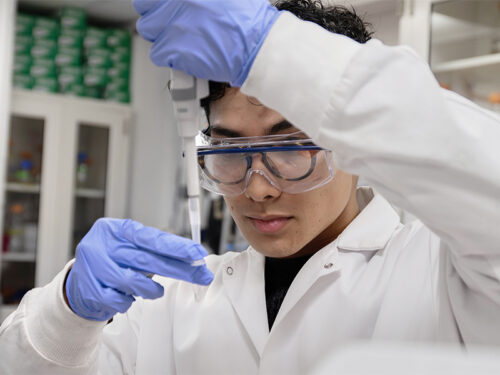
With support from the Andlinger Center’s summer internship program, chemical and biological engineering undergraduate Anherutowa Calvo gained hands-on experiential learning at the intersection of bioengineering and energy. Calvo worked with Jonathan Conway, assistant professor of chemical and biological engineering, to explore a unique bacteria with promising applications for biofuels production.
While most microorganisms require plant matter to be extensively pretreated and separated into digestible components — costing time, money, and efficiency — the bacteria that Calvo worked with can break down plant matter with minimal to no pretreatment. During his internship, Calvo harnessed tools from bioengineering, such as designing vectors to knock out specific genes in the bacteria, to study how the bacteria breaks down and transports various sugars.
Calvo, originally from the island of Guam, said he appreciated how the bioengineering skillset he gained during his summer internship is transferable to a broad range of fields, including healthcare and pharmaceuticals research.
“Having the chance to do a bit of everything and explore my interests through hands-on experiences has been incredibly helpful as I think about what impact I want to make on the world,” Calvo said.