Annual Report for the Academic Year 2024–2025
Cross-Sector Solutions
Andlinger Center faculty reach across disciplines and sectors to tackle the complex and interrelated challenges of the clean energy transition, helping countries around the world achieve economy-wide decarbonization.
Industry Engagement
Trust and the energy transition
In December 2024, over 60 energy and related infrastructure executives, government representatives, NGOs, and researchers convened on Princeton’s campus to examine how trust between stakeholders can shape the pace of the global energy transition.
 Co-organized by the Andlinger Center and Princeton E‑ffiliates Partnership member Worley, a global professional services company of energy, chemicals, and resources experts, the From Ambition to Reality Summit yielded meaningful discussions about how to restore, maintain, and build the trust between energy stakeholders needed to meet international climate targets. Chris Greig, Elke Weber, postdoctoral researcher Anandita Sabherwal, and 2024 Maeder Graduate Fellow and psychology student Jordana Composto partnered with the Worley team to create a candid forum for high-ranking executives to engage authentically about their challenges and experiences working in the energy sector. “One of the privileges of being at the Andlinger Center and Princeton is our ability to engage some of the strongest business and academic leaders around the world’s thorniest challenges,” said Greig.
The Princeton and Worley teams will use the summit’s discussions to inform their Infrastructure for Trust project, which explores how durable trust can be systematically built and maintained between stakeholders to deliver energy infrastructure at the speed and scale required to meet global climate targets. The summit was part of the From Ambition to Reality series, a cornerstone of the partnership between the Andlinger Center and Worley that outlines the shifts in infrastructure delivery practices that are needed to bridge the gap between climate goals and on-the-ground progress.
Captions: (Cover) Ng / Adobe Stock
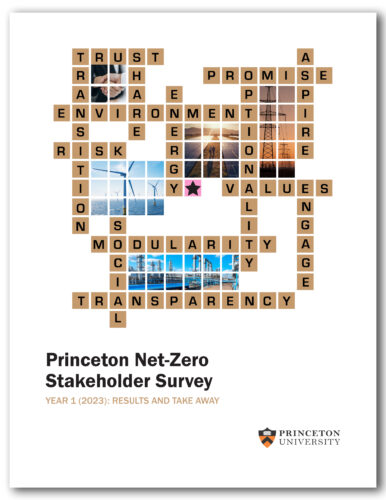
(Inset) The partnership with Worley has also led to the Net-Zero Stakeholder Survey, which gauges stakeholder perceptions about the progress made on key paradigm shifts for net-zero energy infrastructure delivery.
RESEARCH IN ACTION
Designing human-centered decarbonization strategies
When it comes to the clean energy transition, not every technology is equal, and some solutions that appear strongest at a glance can be politically infeasible or bring unwanted impacts to local air quality. Wei Peng studies how to design politically and socially durable decarbonization strategies.
 A major focus of Peng’s research group is understanding the health impacts of different decarbonization strategies to ensure that the clean energy transition yields both climate and health benefits. Peng’s recent work has unlocked insight across sectors and regions.
Coal retirements in Pennsylvania: Peng’s group found that retiring half of the coal plants in Pennsylvania by prioritizing retirements in environmental justice areas could reduce electricity-related carbon dioxide emissions in the state by up to 12%, cut air pollutant emissions by up to 75%, and avoid up to 20% of the deaths attributable to fine particulate matter exposure when compared to a business-as-usual, no-retirement scenario.
Electric vehicle manufacturing in China and India: If China and India were to fully onshore their supply chains for electric vehicle manufacturing, national sulfur dioxide emissions could increase by up to 20% over today’s levels, with manufacturing centers becoming unwanted air pollution hotspots. Peng’s team identified solutions, such as implementing stricter air pollution standards and exploring alternative battery chemistries, to ensure the electric vehicle transition yields maximum societal benefits.
An all-of-society approach to U.S. climate policy: Peng’s group found that combining federal and subnational clean energy actions could avoid 6,600 premature deaths from air pollution nationally in 2030, with net health co-benefits found in every state and nearly every county. Regions like the Midwest and South, with high levels of existing fossil fuel consumption, would particularly benefit from coordinated national, state, and local climate policies.
COURSE HIGHLIGHT
Integrated assessment models for climate policy and energy research
In fall 2024, Wei Peng launched a new course focused on using integrated assessment models (IAMs) to inform climate and energy policy. The course introduced students to two major types of IAMs: detailed-process IAMs that assess how technology choices and mitigation pathways shape regional emissions and global climate outcomes, and benefit-cost IAMs that estimate the social cost of carbon or determine optimal emissions trajectories for maximizing global welfare. Through hands-on projects and policy simulations, students gained practical experience using IAMs to explore real-world climate scenarios.
FUND FOR ENERGY RESEARCH WITH CORPORATE PARTNERS
Bridging energy systems modeling and societal impact
Energy systems models are vital tools for shaping national decarbonization strategies, but they often overlook local realities, air quality, health outcomes, and other societal impacts. To address this gap, Wei Peng will lead a new project to develop an integrated modeling framework that connects advanced energy systems models with a global integrated assessment model. Supported by the Andlinger Center’s Fund for Energy Research with Corporate Partners and carried out in collaboration with Google, the project will explore how decarbonization strategies affect global supply chains, trade, and public health. Along with co-PI Eric Larson and in partnership with the Korea Advanced Institute of Science and Technology (KAIST), the team will apply this modeling framework to South Korea to inform the country’s national climate policy.