Annual Report for the Academic Year 2024–2025
Carbon Management
Through technology and policy solutions, the Andlinger Center is lowering the barriers for widespread adoption of carbon capture, utilization, and storage, recognizing its important role in supporting a net-zero energy future.
RESEARCH IN ACTION
Recycling carbon emissions into useful products
To tackle emissions from hard-to-decarbonize sectors like aviation and manufacturing, a new study outlines how carbon dioxide can be captured and transformed into valuable products, including jet fuel, methanol, concrete, and more.
The congressionally mandated study, led by Emily Carter, the Gerhard R. Andlinger Professor in Energy and the Environment and senior strategic advisor and associate laboratory director at the Princeton Plasma Physics Laboratory, charts a roadmap for research and policies that would enable the large-scale recycling of carbon dioxide emissions. The report, produced by a National Academies of Sciences, Engineering, and Medicine committee chaired by Carter, also identifies market opportunities and infrastructure needs for carbon utilization.
The committee found that the best market opportunities for carbon dioxide utilization include high-demand products for which there are no zero-carbon substitutes such as jet fuels, oxygenates and carbonates such as methanol and lactic acid, and in long-lived building materials such as concrete that allow for durable carbon storage.
The report follows a 2023 study, which was delivered in less than a year to guide decision- making and investments in infrastructure, and emphasized the importance of co-locating carbon utilization facilities near sources where carbon dioxide is stripped from industrial processes to limit the buildout of expensive carbon dioxide transportation pipelines.
Overall, Carter said, reusing carbon not only results in useful products, but helps pay for the considerable expense of implementing carbon capture and sequestration technologies, which are part of most strategies for reducing emissions. “If you make money on a useful product, it’s a way of offsetting the cost of sequestration,” she said.
Captions: (Cover) Elmira / Adobe Stock
RESEARCH FELLOWSHIPS
Studying supercooled water and carbon dioxide

Debbie Zhuang joined the Andlinger Center in June 2025 as a Distinguished Postdoctoral Fellow to study the interactions between carbon dioxide and supercooled water, or water that remains a liquid even below its freezing point. Zhuang will work alongside Dimitrios Fraggedakis and Michael Webb, both assistant professors of chemical and biological engineering, to research the molecular-scale dynamics between carbon dioxide and supercooled water that occur high in the atmosphere. She also plans to study the behavior of carbon dioxide in confined ion- exchange membranes, potentially uncovering new approaches for direct-air carbon capture.
Funding is provided by a generous gift from John E. Cross ’72 and Mary Tiffany Cross.
NEW FINDINGS
Carbon debt of forest-based bioenergy
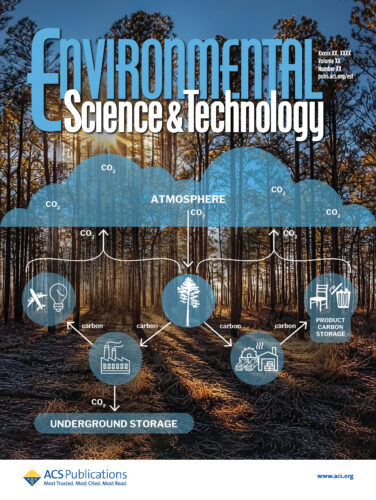
Biomass-based energy is often considered carbon-neutral, based on the assumption that its carbon was recently absorbed from the atmosphere. However, researchers led by Eric Larson quantified carbon emissions when using forest-based biomass to produce electricity or biofuels. They found that a facility’s carbon payback period — the time it takes for a project to offset the greenhouse gas emissions associated with its biomass use — varied widely depending on the type of forest, its age structure, and regional demands for other wood products. For instance, facilities employing carbon capture and storage (CCS) and consuming 3 million green tons of wood annually yielded carbon payback periods below 10 years when drawing wood from pine-dominated working forests in coastal plain or gulf coast regions of the southeastern U.S. In a hardwood-dominated forest basin in Virginia, those facilities never achieved carbon payback, even with CCS.
Captions: (Inset) Eric Larson’s research was featured on the cover of the April 29, 2025 issue of Environmental Science & Technology.
NEW FINDINGS
Shared carbon capture networks
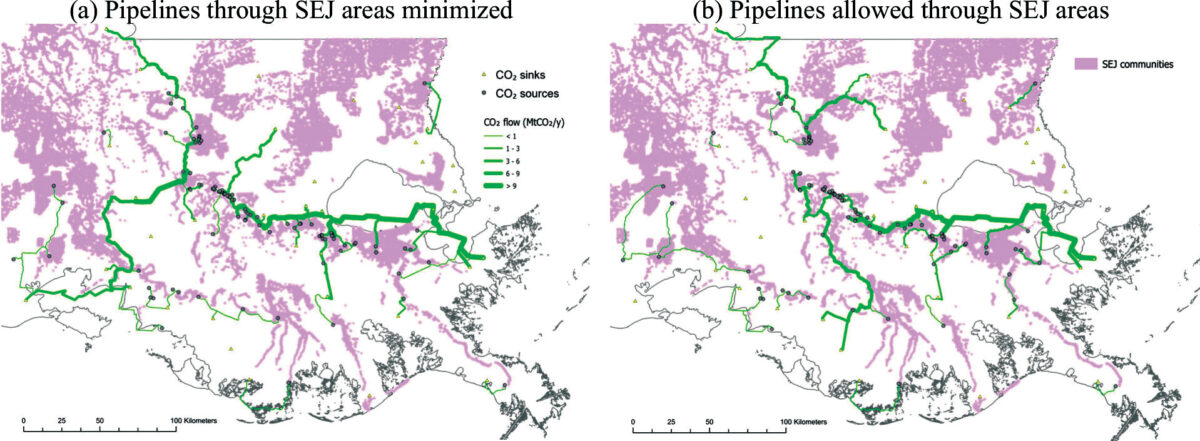
 Led by Eric Larson, researchers in the Energy Systems Analysis Group found that sharing infrastructure for transporting and storing captured carbon dioxide emissions across multiple industrial facilities could cut costs by over 60% and reduce pipeline buildout by over 75% in Louisiana compared with scenarios without infrastructure sharing. The few carbon capture projects operating in the U.S. today have been designed with single-user pipelines transporting the captured carbon dioxide to an underground injection site.
Beyond lowering costs for individual facilities, shared infrastructure would also reduce the impact on local communities and ecosystems by minimizing the installation of new underground pipelines required for carbon dioxide transport and lowering the number of required underground storage sites.
The researchers also identified shared infrastructure as an opportunity to address equity considerations. Compared to optimal statewide pipeline networks designed without constraints, network designs constrained to avoid historically disadvantaged communities resulted in an 82% reduction in pipelines running through those communities while only increasing total pipeline network size by 3% — an over 72% reduction in pipeline buildout in comparison to each facility building its own dedicated pipeline.
Captions: The researchers modeled shared carbon dioxide pipeline networks that connect capture sites with storage sites in southeast Louisiana with (left) and without (right) constraints to avoid historically disadvantaged communities. (Image courtesy of the researchers)
COURSE HIGHLIGHT
Negative Emissions Technologies
In the spring semester, Kelsey Hatzell taught a course on negative emissions technologies. Students in the class surveyed the field of carbon capture, conversion, and storage technologies that could play a critical role in the global energy transition. Throughout the semester, Hatzell explained the technical principles that underlie various carbon capture and conversion technologies and led students in hands-on exercises, such as a demonstration of how carbon dioxide can be valorized into solid carbon.