Annual Report for the Academic Year 2024–2025

Climate Resilience
As the impacts of climate change intensify, researchers at the Andlinger Center are developing solutions that mitigate climate risks to human health, infrastructure, and energy and food systems.
RESEARCH IN ACTION
Helping energy systems weather the storm
Though only a Category 1 storm, Hurricane Fiona caused a total blackout when it struck Puerto Rico in 2022, exposing the vulnerabilities of the island’s fragile energy infrastructure. Yet in the aftermath, the hurricane provided a rare opportunity to learn about a power system during an extreme weather event. LUMA Energy, the private power company that, since 2021, has been responsible for power distribution and power transmission in Puerto Rico, collected high- resolution outage data in 10-minute intervals as Fiona made landfall on the island.
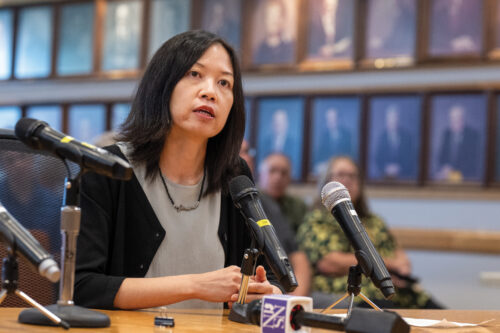
A team of Princeton engineers is analyzing the data to help LUMA Energy and other system operators to better understand their power grids in the face of increasingly frequent and severe climate extremes, from hurricanes to heat waves. Supported in part by a 2024 grant from the Andlinger Center’s Fund for Energy Research with Corporate Partners, the Princeton team, led by Ning Lin, professor of civil and environmental engineering, developed models to quantify the risks of catastrophic blackouts to energy systems and help grid planners develop day-ahead operational strategies in advance of extreme weather events.
The day-ahead dispatch model outperformed the current state-of-the-art strategies, cutting operational costs by 20% and avoiding the use of nearly a gigawatt of expensive, emergency energy dispatch — all while providing solutions over 10 times faster than existing commercial and open-source models.
“We hope that our work can help energy systems everywhere to adapt to the risks posed by climate extremes, whether they be hurricanes or other hazards,” said Lin.
Captions: (Cover) Nakarin / Adobe Stock
(Inset) In August 2024, Ning Lin testified about her research on coastal resiliency during a joint hearing of the New Jersey Senate Environment and Energy Committee and Assembly Environment, Natural Resources, and Solid Waste Committee. (Photo by Sameer A. Khan / Fotobuddy)

2025 E-FFILIATES RETREAT
Confronting Reality: Climate Goals and Decarbonization
As the world struggles to make the necessary progress toward its climate goals, the Andlinger Center convened experts from across academia, industry, and the public sector to discuss strategies for navigating the social, economic, and political headwinds facing the energy transition.
Sponsored by the Princeton E-ffiliates Partnership program, speakers advocated for practical, implementation-oriented approaches to the energy transition. Some argued that reframing climate targets around other societal goals beyond emissions reductions, such as air quality or industrial competitiveness, could help motivate more politically durable climate action.
Alongside approaches for accelerating clean energy deployment, panelists discussed strategies for encouraging investment into climate adaptation. Noting that humans are already feeling the negative effects of climate change, the panelists underscored that investments into adaptation would immediately improve livelihoods while making long-term energy pathways more resilient. They also underscored that investments in adaptation can drive additional economic and development activity by reducing perceived disaster risks and supplying significant social and environmental co-benefits.
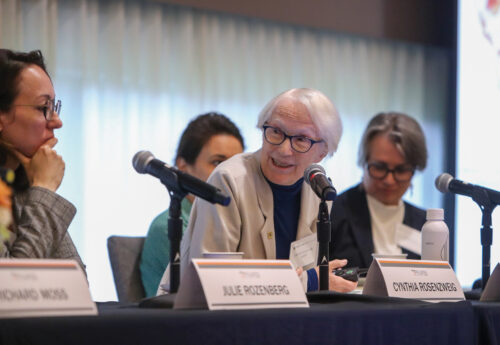 “Adaptation should be part of every energy pathway,” said Cynthia Rosenzweig, an adjunct senior research scientist at Columbia University’s Center for Climate Systems Research, emphasizing that new technologies deployed to mitigate greenhouse gases will have to withstand increasingly severe climate hazards.
Speakers also discussed the circumstances under which countries might consider deploying riskier climate solutions like solar geoengineering. However, they concluded that such controversial backstop strategies would likely prove too challenging and morally fraught to govern.
Overall, the day’s discussions emphasized pragmatic, resilient, and implementation-focused energy pathways over risky moonshots. “As Warren Buffett said, ‘In order to succeed, you must first survive,’” said retreat co-chair Chris Greig. “When we think about setting ambitious targets, we must also think about building the institutions and structures we need to be capable of delivering on them.”
Captions: (Top) Retreat co-chair Wei Peng moderated a fireside conversation between Armond Cohen, executive director of Clean Air Task Force, and Navroz Dubash, professor of public and international affairs and the High Meadows Environmental Institute.
(Inset) Cynthia Rosenzweig spoke about the importance of climate adaptation. (Photos by Lori M. Nichols)