Annual Report for the Academic Year 2025–2026
Director’s Message
Global developments in the past year have dramatically highlighted the interconnected nature of challenges related to climate risk and energy security. Unprecedented demand growth for electricity and critical materials has exacerbated resource constraints and exposed supply-chain vulnerabilities. At the same time, support for clean energy, climate, and sustainability research in the United States is facing a period of prolonged uncertainty. Starting last year, more than a dozen federal awards supporting Andlinger Center-related research were terminated or modified in ways that eliminated future funding.
Thanks to institutional support, many affected faculty members were able to continue their work with minimal disruption. Even so, the outlook remains challenging. Recent changes in the federal research funding landscape have raised new questions about the future availability and prioritization of research support.
Against this backdrop, the importance of rigorous, solutions-oriented research has grown. Guided by the six research initiatives identified in our 2025 strategic plan, specifically Carbon Capture, Utilization, and Storage; Climate Resilience Engineering; Decarbonizing Buildings and Transportation; Industrial Decarbonization; Renewable Energy Systems; and the Water-Energy-Resource Nexus, our faculty, students, and researchers continued to translate fundamental discoveries into practical impact. Across these areas, researchers have developed next-generation technologies and new approaches and understandings for advancing sustainability.
For example, Kelsey Hatzell’s team is developing a new, more durable type of battery, which you can read about on page 16. On page 19, we highlight the research of Z. Jason Ren evaluating how wastewater could be used as a source for hydrogen production. The Andlinger Center has additionally awarded funding to a range of our researchers including Barry Rand, who is working on protecting perovskites solar cells from degradation (page 18), and Chris Greig who is seeking to lower the barriers preventing commercial investment in decarbonization technologies (page 15).
Building on the success of Net-Zero America and Australia, the Net-Zero Initiative expanded through active collaborations in China, India, Brazil, and South Korea. These partnerships reflect the reality that developing decision making tools for the energy transition is a global undertaking, one that depends on both rigorous analysis and strong collaboration with local experts. Together, these efforts are helping policymakers, industry leaders, and communities better understand pathways for achieving emissions-reduction goals and navigating the broader societal and environmental implications of those choices. You can read more about new Net-Zero partnerships on page 4 of this booklet.
While research underpins our mission, we are committed to seeking solutions through interdisciplinary collaboration and external engagement. Through the Princeton E-ffiliates Partnership, the Center continues to bring together leaders in industry, government, academia, and the nonprofit sector to address emerging issues ranging from industrial circularity and biomanufacturing to data-center development and critical mineral supply chains. These engagements keep our activities grounded in real-world demands while creating opportunities for research to inform decision-making at scale. On page 32, you can find more about those relationships and read about the latest members to join our E-ffiliates program.
We also remain focused on developing the next generation of energy and environmental leaders. This year marked an important milestone as the first cohort of students completed Princeton’s “Minor in Sustainable Energy.” Combined with internships, fellowships, seminars, and hands-on research opportunities, these programs provide our early stage researchers with the knowledge, skills, and perspectives needed to address increasingly complex challenges throughout their careers. Read more about the Andlinger Center’s education program on page 28.
As we look ahead, the path forward for energy and environmental research remains uncertain as the funding landscape continues to evolve. Yet the need for innovation, evidence-based decision-making, and sustained collaboration has never been greater. I remain confident that our community’s ingenuity and dedication will continue to drive significant progress. Together, we are advancing the knowledge, technologies, and leaders needed to build a more resilient, secure, and sustainable future, and that gives me every reason for optimism about the years ahead.
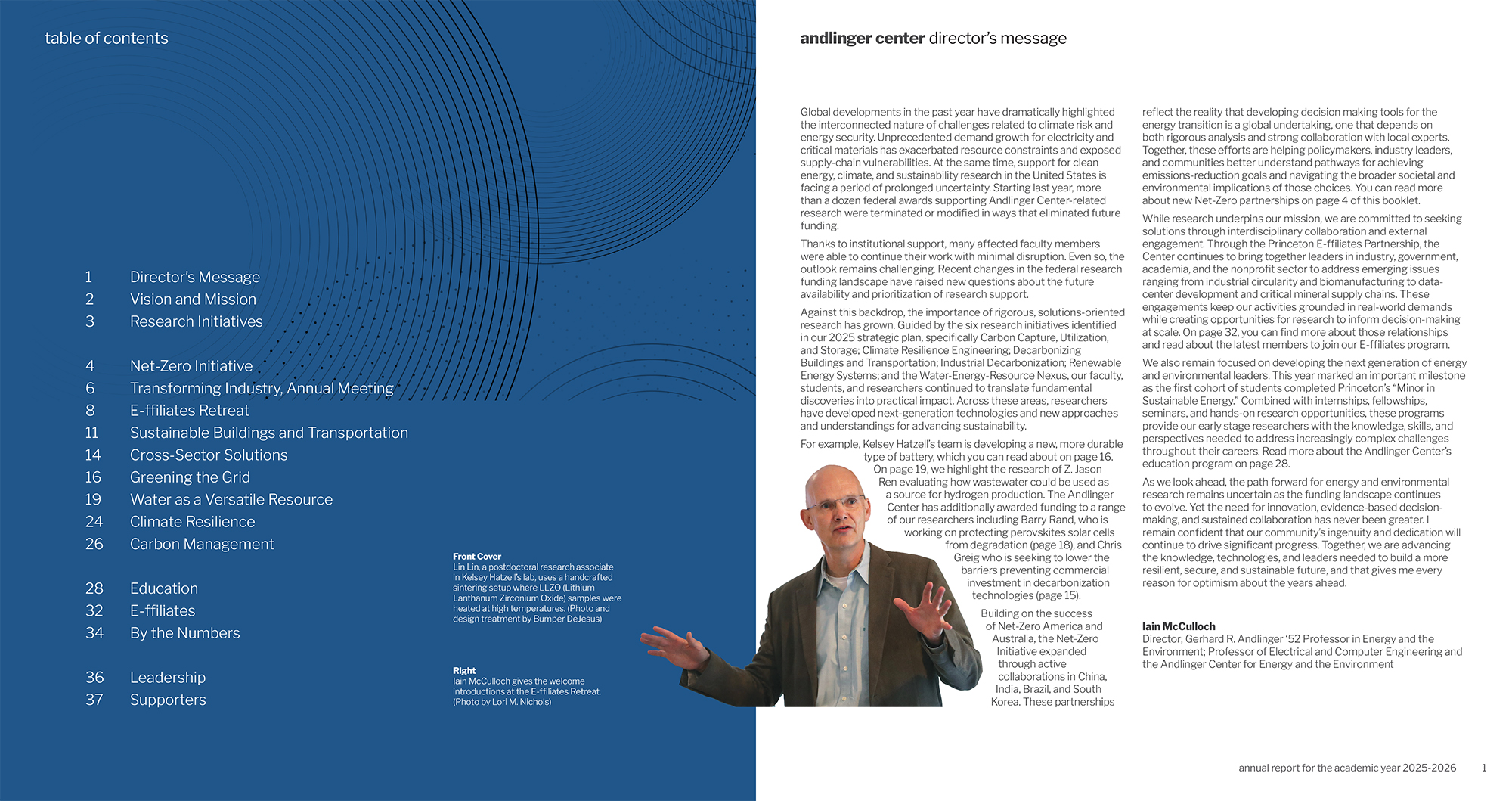
Caption: Iain McCulloch gives the welcome introductions at the E-ffiliates Retreat. (Photo by Lori M. Nichols)