Annual Report for the Academic Year 2025–2026
Greening the Grid
Acknowledging the power sector’s role as a lynchpin for economy-wide decarbonization, the Andlinger Center is advancing clean energy and grid modernization solutions to transition toward sustainable electric power.
RESEARCH IN ACTION
Blending cathode materials for a new type of battery
New technologies driven by advances in AI — such as self-driving taxis, delivery drones, and wearable medical monitors — demand batteries that are lighter, longer lasting, safer and more powerful. To make them, engineers must improve a key battery component called a cathode.
The cathode, a battery’s positive electrode, is usually the most expensive part of the battery and often determines whether a battery is commercially viable. Because it typically contains most of the battery’s active material, the cathode drives performance including capacity, power, safety and stability.
At Princeton, a research group led by Kelsey Hatzell is working to understand a range of questions concerning battery development and the manufacturing of new battery systems, including promising advances in solid state batteries.
Solid-state batteries promise to transform energy storage by improving battery performance and mitigating the risk of fire and other hazards. But engineers must overcome technical challenges before the new batteries can move into mass production. To solve these challenges, Hatzell’s group teamed up with scientists at Brookhaven National Labs to look inside solid-state batteries under operating conditions.
 The goal: build safe batteries with enough energy density to last all day and enough power density that users can get a full charge in minutes rather than hours. The strategy: combine two types of cathode materials into a new type of solid-state device.
The results, published in the journal Advanced Energy Materials, demonstrate that a blend of two leading cathode materials integrates both materials’ advantages while mitigating thermal risk. Using experiments with batteries that Princeton engineers collected at Brookhaven National Lab, researchers looked inside solid-state batteries and explored novel ‘blended’ formulations that combine Lithium Iron Phosphate (LFP) and Nickel Manganese Cobalt (NMC). The blended cathode showed ability to meet performance requirements, and the research demonstrated steps needed to work with the LFP-NMC blend.
The researchers wanted to understand how blending these two materials could create a new type of cathode with advantages of both materials while minimizing the heat-related drawbacks of NMC cathodes. Particularly, they wanted to understand the factors behind the electrochemical performance of the blended cathode, its thermal performance and stability.
Hatzell said the goal is to provide a clear path to a manufactured device. To develop workable batteries, researchers need to address the full spectrum of manufacturing challenges. “Our laboratory has been looking at the synergy between new materials, packaging, and external/internal effects related to heat generation,” she said.
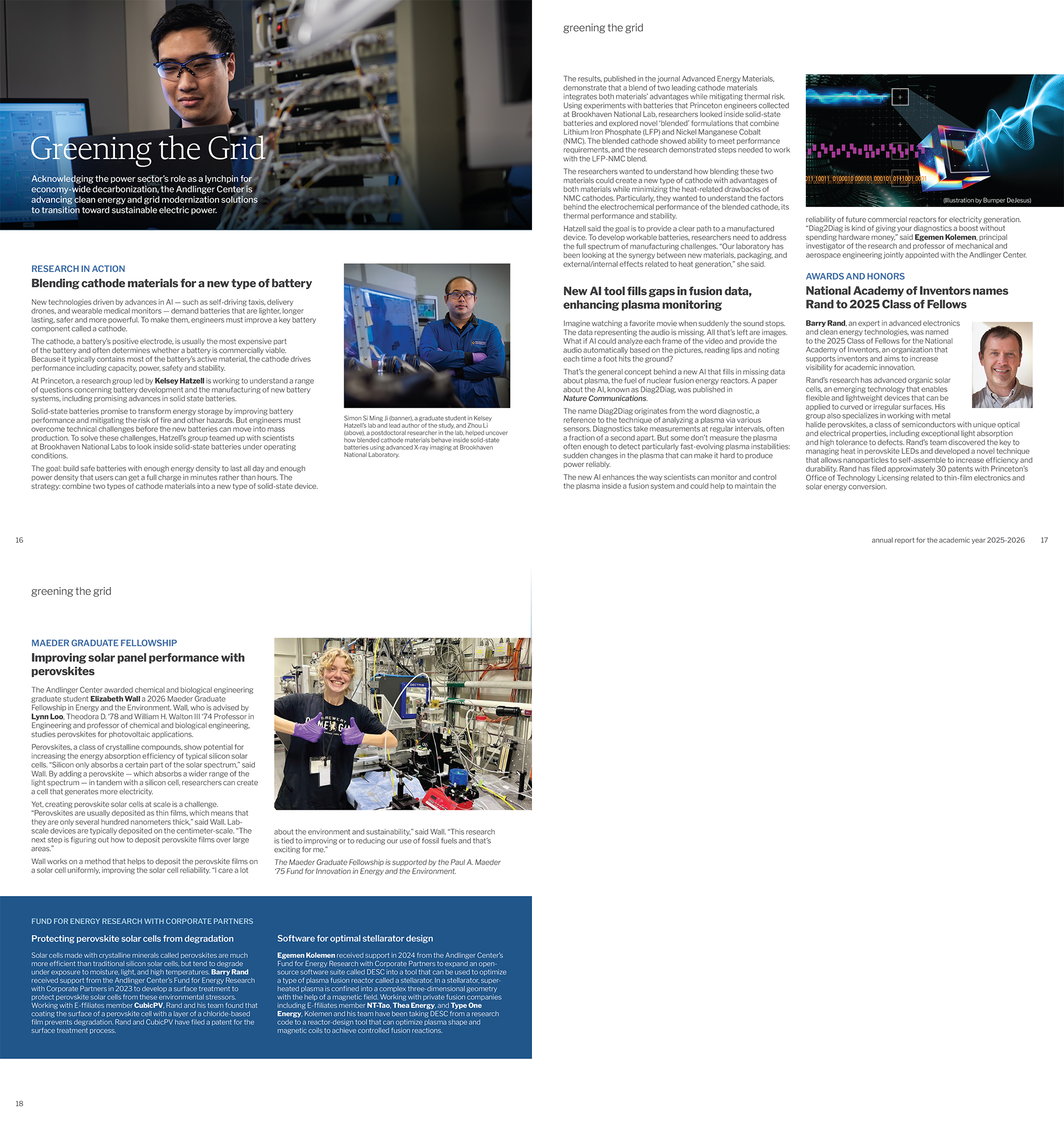
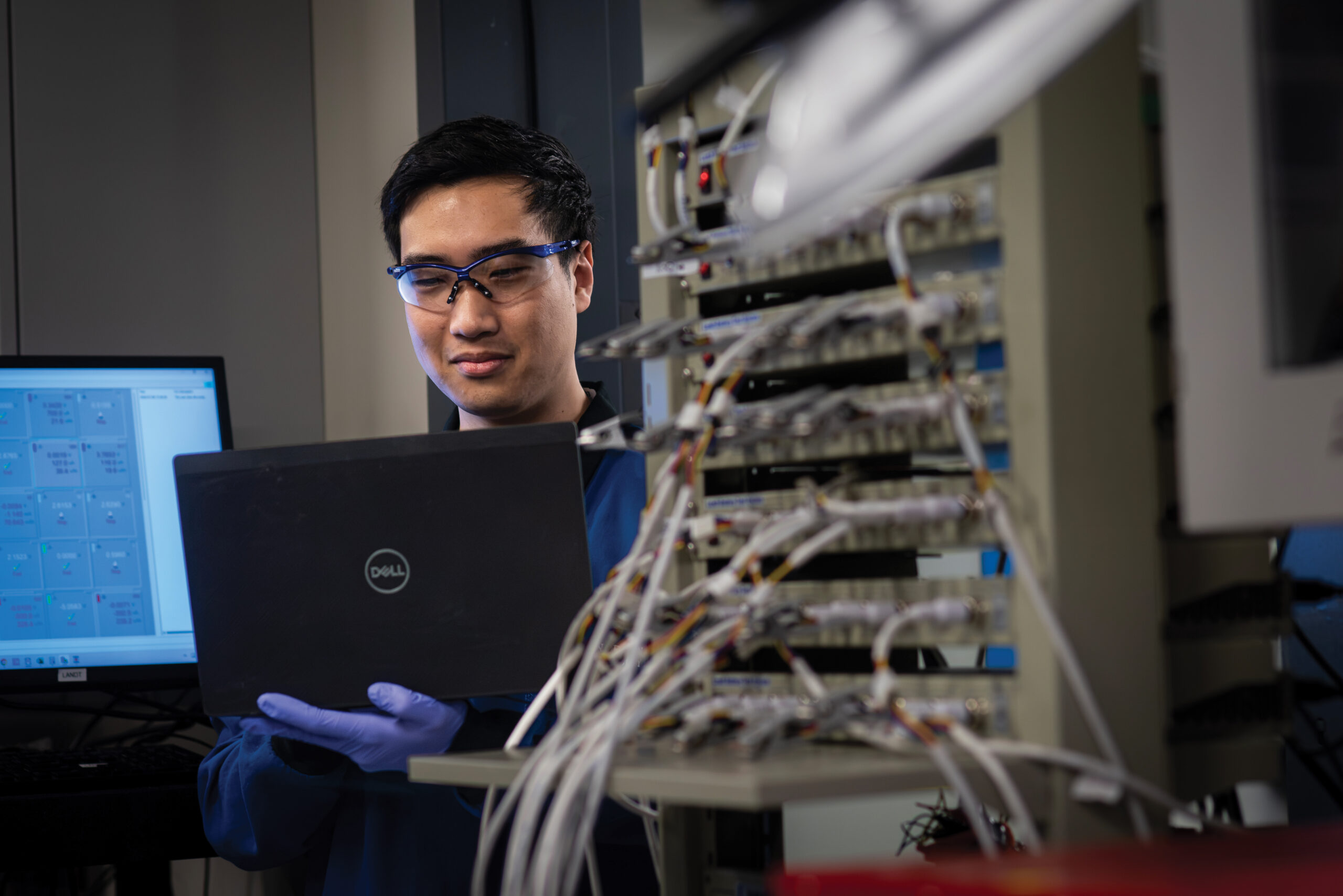
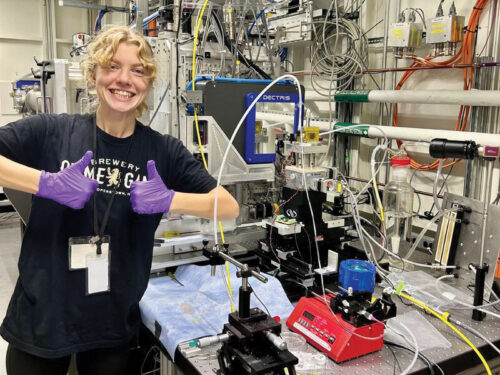
Captions: Simon Si Ming Ji (banner), a graduate student in Kelsey Hatzell’s lab and lead author of the study, and Zhou Li (above), a postdoctoral researcher in the lab, helped uncover how blended cathode materials behave inside solid-state batteries using advanced X-ray imaging at Brookhaven National Laboratory. (Photos by Bumper DeJesus)
RESEARCH IN ACTION
New AI enhances the view inside fusion energy systems
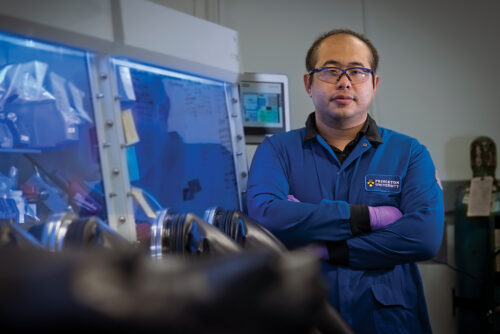
Imagine watching a favorite movie when suddenly the sound stops. The data representing the audio is missing. All that’s left are images. What if AI could analyze each frame of the video and provide the audio automatically based on the pictures, reading lips and noting each time a foot hits the ground?
That’s the general concept behind a new AI that fills in missing data about plasma, the fuel of nuclear fusion energy reactors. A paper about the AI, known as Diag2Diag, was published in Nature Communications.
The name Diag2Diag originates from the word diagnostic, a reference to the technique of analyzing a plasma via various sensors. Diagnostics take measurements at regular intervals, often a fraction of a second apart. But some don’t measure the plasma often enough to detect particularly fast-evolving plasma instabilities: sudden changes in the plasma that can make it hard to produce power reliably.
The new AI enhances the way scientists can monitor and control the plasma inside a fusion system and could help to maintain the reliability of future commercial reactors for electricity generation. “Diag2Diag is kind of giving your diagnostics a boost without spending hardware money,” said Egemen Kolemen, principal investigator of the research.
Captions: (Illustration by Bumper DeJesus)
AWARDS AND HONORS
Barry Rand elected to National Academy of Inventors
 Barry Rand, an expert in advanced electronics and clean energy technologies, was named to the 2025 Class of Fellows for the National Academy of Inventors, an organization that supports inventors and aims to increase visibility for academic innovation.
Rand’s research has advanced organic solar cells, an emerging technology that enables flexible and lightweight devices that can be applied to curved or irregular surfaces. His group also specializes in working with metal halide perovskites, a class of semiconductors with unique optical and electrical properties, including exceptional light absorption and high tolerance to defects. Rand’s team discovered the key to managing heat in perovskite LEDs and developed a novel technique that allows nanoparticles to self-assemble to increase efficiency and durability. Rand has filed approximately 30 patents with Princeton’s Office of Technology Licensing related to thin-film electronics and solar energy conversion.
Captions: Barry Rand. (Photo by Bumper DeJesus)
MAEDER GRADUATE FELLOWSHIP
Improving solar cell performance with perovskites
 The Andlinger Center awarded chemical and biological engineering graduate student Elizabeth Wall a 2026 Maeder Graduate Fellowship in Energy and the Environment. Wall, who is advised by Lynn Loo, Theodora D. ’78 and William H. Walton III ’74 Professor in Engineering and professor of chemical and biological engineering, studies perovskites for photovoltaic applications.
Perovskites, a class of crystalline compounds, show potential for increasing the energy absorption efficiency of typical silicon solar cells. “Silicon only absorbs a certain part of the solar spectrum,” said Wall. By adding a perovskite — which absorbs a wider range of the light spectrum — in tandem with a silicon cell, researchers can create a cell that generates more electricity.
Yet, creating perovskite solar cells at scale is a challenge. “Perovskites are usually deposited as thin films, which means that they are only several hundred nanometers thick,” said Wall. Lab-scale devices are typically deposited on the centimeter-scale. “The next step is figuring out how to deposit perovskite films over large areas.”
Wall works on a method that helps to deposit the perovskite films on a solar cell uniformly, improving the solar cell reliability. “I care a lot about the environment and sustainability,” said Wall. “This research is tied to improving or to reducing our use of fossil fuels and that’s exciting for me.”
The Maeder Graduate Fellowship is supported by the Paul A. Maeder ‘75 Fund for Innovation in Energy and the Environment.
Captions: Elizabeth Wall’s research focuses on perovskite photovoltaics and environmental control of perovskite processing. (Photo courtesy of Lynn Loo)
FUND FOR ENERGY RESEARCH WITH CORPORATE PARTNERS
Protecting perovskite solar cells from degradation
Solar cells made with crystalline minerals called perovskites are much more efficient than traditional silicon solar cells, but tend to degrade under exposure to moisture, light, and high temperatures. Barry Rand received support from the Andlinger Center’s Fund for Energy Research with Corporate Partners in 2023 to develop a surface treatment to protect perovskite solar cells from these environmental stressors. Working with E-ffiliates member CubicPV, Rand and his team found that coating the surface of a perovskite cell with a layer of a chloride-based film prevents degradation. Rand and CubicPV have filed a patent for the surface treatment process.
Software for optimal stellarator design
Egemen Kolemen received support in 2024 from the Andlinger Center’s Fund for Energy Research with Corporate Partners to expand an open-source software suite called DESC into a tool that can be used to optimize a type of plasma fusion reactor called a stellarator. In a stellarator, super-heated plasma is confined into a complex three-dimensional geometry with the help of a magnetic field. Working with private fusion companies including E-ffiliates member NT-Tao, Thea Energy, and Type One Energy, Kolemen and his team have been taking DESC from a research code to a reactor-design tool that can optimize plasma shape and magnetic coils to achieve controlled fusion reactions.