Annual Report for the Academic Year 2025–2026
Water as a Versatile Resource
Leading the charge toward a circular economy, researchers at the Andlinger Center are transforming water and wastewater systems for improved resource management and effective pollution remediation.
RESEARCH IN ACTION
Dirty water boosts prospects for clean hydrogen
Wastewater can replace clean water as a source for hydrogen production, eliminating a major drawback to hydrogen fuel and reducing water treatment costs by up to 47 percent, according to research from the lab of Z. Jason Ren.
Producing hydrogen with renewable energy, known as green hydrogen, relies on electrolysis to split water into hydrogen and oxygen gas. Green hydrogen electrolysis uses renewable electricity and produces low carbon emissions, but requires ultrapure water, created by treating tap water or groundwater with processes such as reverse osmosis to remove impurities that could interfere with electrolysis.
The team tested whether they could bypass the purification process by using treated wastewater rather than tap water. In this scenario, the wastewater is “reclaimed,” meaning treated to the point where it could be discharged to aquifers or used for irrigation or industrial cooling. The method had been tried before but typically failed, Ren said. To find out why, the researchers performed diagnostic experiments in a proton exchange membrane water electrolyzer — the same technology currently used commercially with ultrapure water.
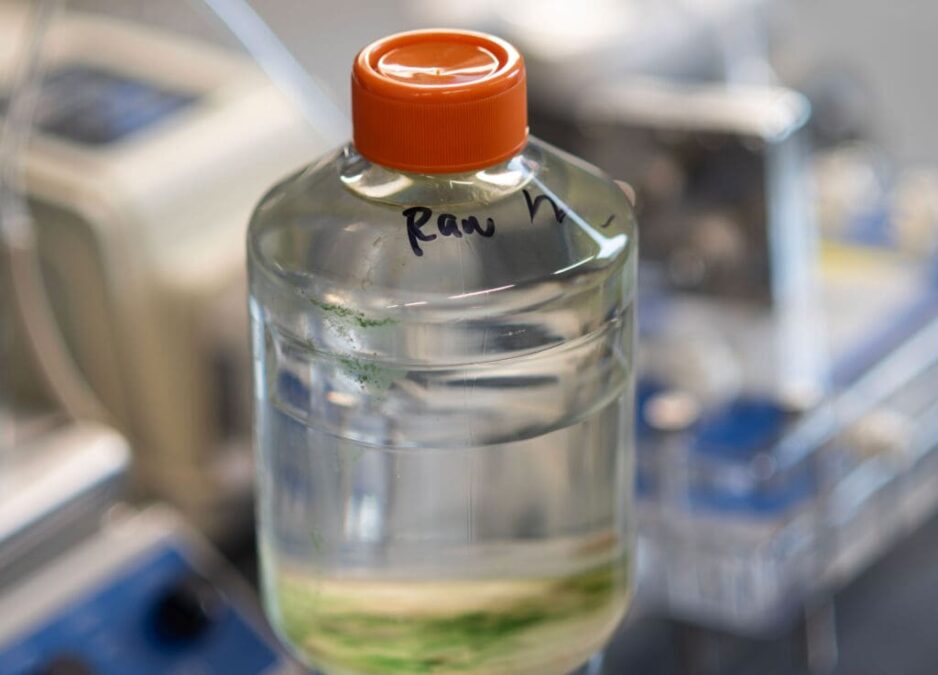
Analyzing the performance of pure water compared to reclaimed wastewater in the reactors, they identified ions of calcium and magnesium — the same minerals that cause scale buildup on household faucets and kettles — as the main cause of performance loss. These ions stick to the membrane, blocking ion transport.
To address this issue, the researchers came up with a simple solution: acidifying the water with sulfuric acid. The resulting acidic buffer acts as a rich source of protons that outcompete other ions, maintaining ion conductivity, sustaining electrical current and enabling continuous hydrogen production.
“It’s expensive to remove all those ions so you have ultrapure water going into the electrolyzer,” said Ren. “Now, you can just acidify it a bit, then put ion-containing water into the electrolyzer.”
His team estimated that using reclaimed wastewater rather than purified water could reduce the cost of water production by about 47% and the energy cost of water treatment by about 62%.
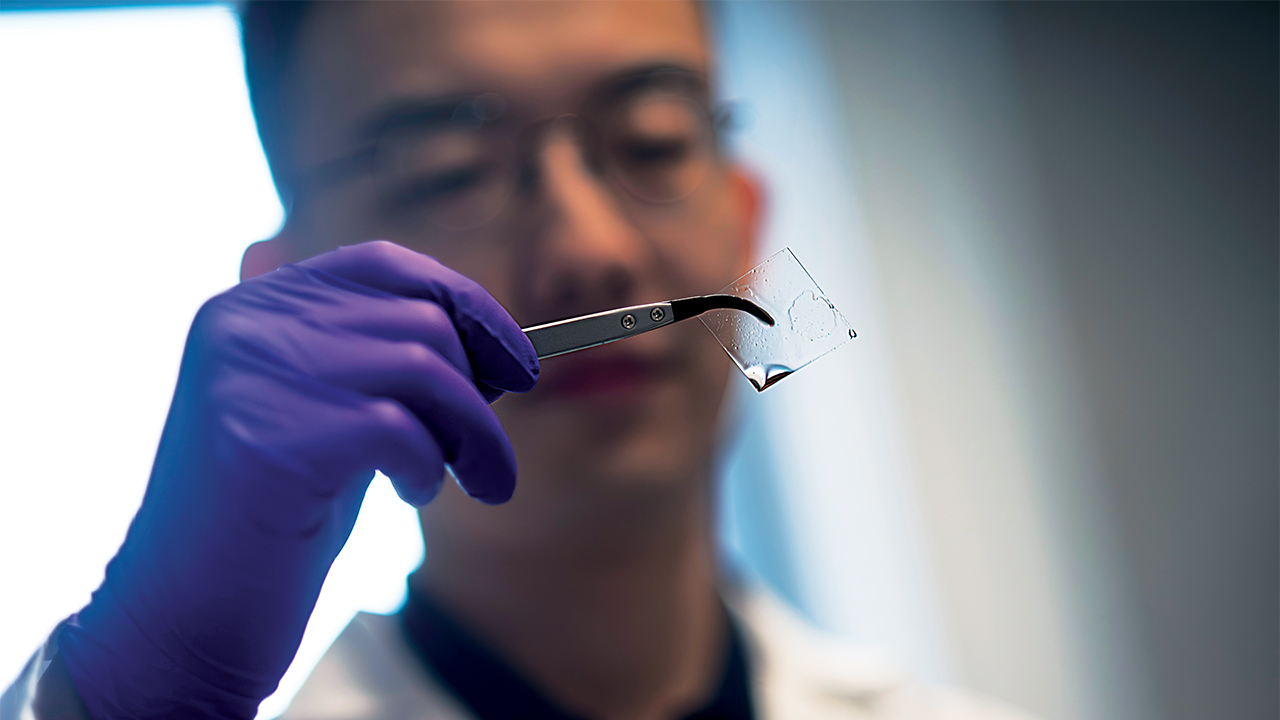
Captions: Banner: Princeton Ph.D. student Lin Du tested hydrogen electrolysis with reclaimed wastewater. Researchers found calcium and magnesium ions as the main cause of performance loss. These ions stick to the membrane, blocking ion transport and turning it from a porous pathway to a solid barrier. (Photo by Bumper DeJesus)

RESEARCH IN ACTION
Nations underestimate greenhouse emissions from wastewater systems, but the lapse is fixable
Research led by Z. Jason Ren shows that nations worldwide underestimate greenhouse gas emissions from wastewater systems. Outdated inventory methods and failure to include items like latrines and untreated sewage in national reports are main reasons.
In an article, the researchers reported that nations underestimated emissions of gases including methane and nitrous oxide by amounts ranging from 19% to 27%. The researchers said that much of the underestimate is caused by countries relying on 2006 Intergovernmental Panel on Climate Change (IPCC) guidance to estimate wastewater gas emissions rather than incorporating updates in the 2019 refinement.
 A secondary research team led by Mark Zondlo, professor of civil and environmental engineering, and Ren reported in another article that collectively sewer plants produced 1.9 times the nitrous oxide gas estimated by the Environmental Protection Agency and 2.4 times the methane.
Based on the new measurements, wastewater plants contribute 2.5 percent of U.S. methane emissions and 8.1 percent of nitrous oxide. Both methane and nitrous oxide are potent greenhouse gases, collectively responsible for about 22 percent of global warming since 1850, the researchers said.
“Wastewater plants are often complex. Many plants were built in the ’70s and have been added to with changing technologies,” he said. “Our approach says let’s look at the entire facility, let’s look at a lot of facilities and let’s look at different times.” – Mark Zondlo
The researchers said the good news is that much of the emissions are produced by a small number of wastewater plants. This means that taking steps to improve relatively few plants would have an outsized impact on overall pollution. Zondlo said the work highlights the importance of greenhouse gas emissions from wastewater systems, which play a key role in public and environmental health.
In a policy paper accompanying the first research article, Ren said that accurate estimates are a foundation for sound public reporting and practical decision-making in the wastewater sector. He urged the IPCC and policymakers to take note of these differences and move countries toward the most accurate wastewater standards when developing national inventories.
Captions: Researchers measured emissions from plants nationwide, including this one in Pennsylvania. (Photo courtesy of Nathan Li)
RESEARCH IN ACTION
New materials make high-performance membranes the filters of the future
From water desalination to waste recovery, countless industrial processes rely on separating charged molecules, known as ions, from water. Yet for many complex waste streams and environments, the conventional approaches to ion separations remain too costly and inefficient for widespread deployment, leaving potentially valuable ions to flow away.
Researchers in the lab of Kelsey Hatzell, are demonstrating how membranes made from next-generation materials called MXenes, a class of water-loving, single-layer materials with high electrical conductivity, show promise when separating ions and other compounds from complex solutions.
 The researchers investigated the performance of MXene membranes in solutions with more than one kind of ion, comparing how sodium, lithium, and calcium ions traveled through the tiny channels in the membrane by themselves and when they were in solutions with one another. In nearly every case, the ions moved slower through the membranes in multi-ion solutions than they did alone, signaling that the ions in these complex solutions were in direct competition. The findings could inform new membrane designs that are more effective at filtering one or another ion from a complex solution.
In another round of experiments, the team added cesium ions between the layers of the MXene membranes to change the amount of water present in the membrane. Cesium ions interfere with the weak forces that keep nearby water molecules close together, so by adding cesium, the researchers lowered the membrane’s water content. With less water, the membrane had narrower channels and fewer defects, ultimately yielding higher selectivity for ions such as lithium. The research suggests that ions like cesium could be a powerful tool to tailor the structure of these MXene membranes for specific tasks.
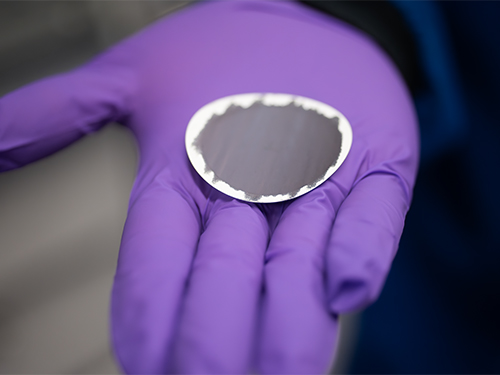
Captions: A close-up of a MXene membrane, a class of 2D nanomaterial that exhibits tunable surface properties. (Photo by Bumper DeJesus)
FUND FOR ENERGY RESEARCH WITH CORPORATE PARTNERS
Acid-base batteries for large-scale energy storage
As weather patterns become more extreme and unpredictable, harnessing wind and solar energy at scale for the electrical grid becomes more complicated. Batteries can solve the problem by storing large amounts of energy for long durations and then deploying that stored energy when needed. However, typical lithium-ion batteries — often found in electric vehicles — can supply grid-scale energy for only about four hours.
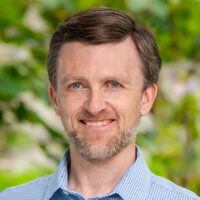 Supported by the Andlinger Center’s Fund for Energy Research with Corporate Partners, Ryan Kingsbury is working to advance the development of a long-duration, high efficiency acid-base flow battery for large-scale energy storage. Kingsbury, assistant professor of civil and environmental engineering and the Andlinger Center, is collaborating with corporate partner Captura on the research.
Acid-base flow batteries work by using membranes to split water molecules from a salt solution into a simple acid and base, which can then be stored indefinitely. When the acid and base are eventually recombined, the battery produces energy. However, some salt solutions can cause leakage across the membrane, greatly reducing efficiency. The researchers will evaluate the performance of acid-base flow batteries using different salt solutions in order to create the most energy efficient battery.
MAEDER GRADUATE FELLOWSHIP
Membranes for sustainable ion separations
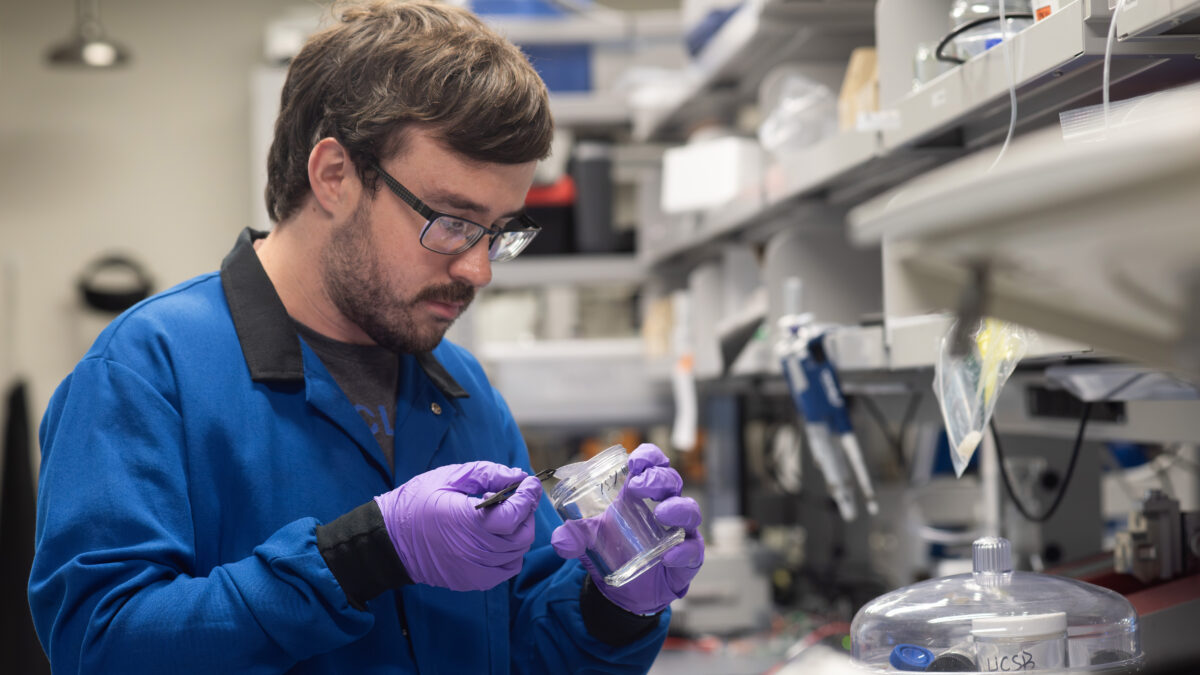
Chemical and biological engineering graduate student Austin Booth became an Andlinger Center Maeder Graduate Fellow in September 2026. Booth, who is advised by Kelsey Hatzell, researches membrane materials for recovering useful ions from brines and wastewater.
In particular, Booth studies a membrane material known as MXene (pronounced like “Maxine”) — atomically thin flakes of titanium carbide. These flakes can be layered to create a permeable membrane, which researchers then chemically modify to selectively recover specific metal ions from water. Typical separation methods, such as distillation, are energy intensive or may leave behind harmful waste streams. MXene membranes, by comparison, require less energy and are environmentally stable, making them a sustainable alternative.
Booth’s primary research focus is applying MXene for separating lithium ions from other ions. The chemical stability of MXenes allows them to perform in caustic environments where lithium ions may be found, like battery waste, which would present a solution to the complexities of battery recycling.
Over the course of the fellowship, Booth plans to investigate MXene membranes for separating other critical minerals, including cobalt, magnesium and lanthanum. “If we can move away from distillation and go towards membrane processes, that’d save a lot of energy,” said Booth.
The Maeder Graduate Fellowship is supported by the Paul A. Maeder ‘75 Fund for Innovation in Energy and the Environment.
Captions: Austin Booth’s research focused on membrane nanofiltration, an effective way to pick out and recover metals that are in high demand from wastewater and brine. (Photo by Bumper DeJesus)
INDUSTRY ENGAGEMENT
Managing environmental pollutants
Peter Jaffé worked with E-ffiliates member Komline to develop innovative solutions for managing environmental pollutants and increase the efficacy of industrial separation processes. One key area of interest is developing ways to remove “forever chemical” PFAS (per- and polyfluoroalkyl substances) from biosolids — the solid organic matter recovered from the wastewater treatment process — without destroying their value for agricultural applications. Currently, most existing technologies for removing PFAS from biosolids leave the waste materials unusable.
In the last year, Jaffé’s lab has focused on studying materials such as activated carbon and clays that are used to remove PFAS from stormwater runoff. They treated these sorbents with microbes to see if bacteria could degrade the absorbed PFAS, thus renewing the materials to an original PFAS-free state. This biological treatment of the sorbents increased the absorption of PFAS and allowed the chemicals to be broken down. Other uses are being investigated as the collaboration continues.
AWARDS AND HONORS
Jason Ren Named AAAS Fellow
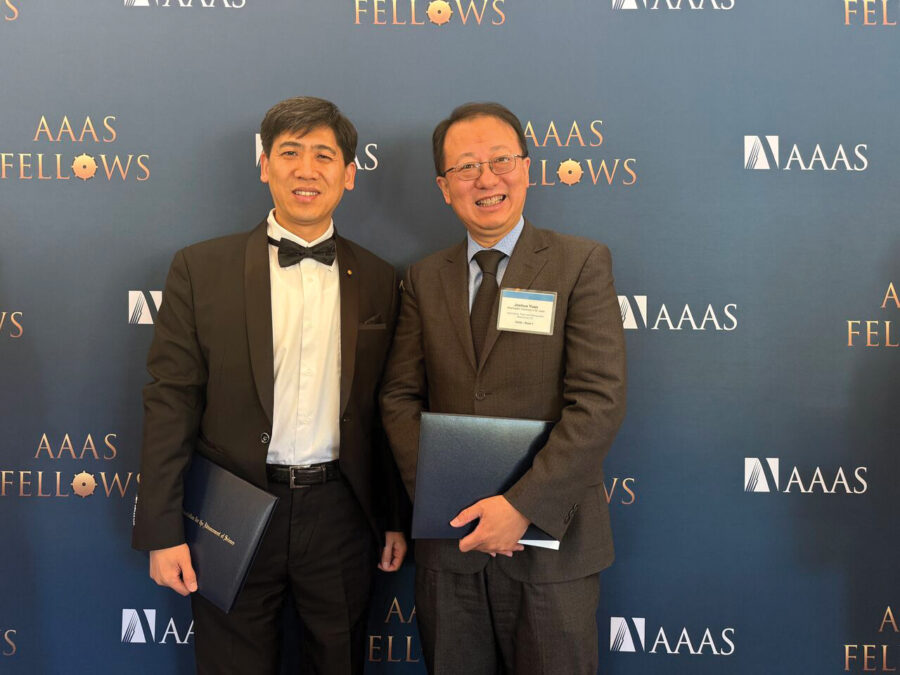
Jason Ren has been elected a fellow to the American Association for the Advancement of Science (AAAS). AAAS fellows are recognized for distinguished contributions across science, engineering, and innovation, including research, teaching, technology development, administration, and public engagement.
Ren was elected for “pioneering contributions to water-energy-climate nexus research, advancing resource recovery and decarbonization science, and national and local leadership in advancing implementation of water technologies.” Ren’s Water & Energy Technologies (WET) Lab integrates electrochemistry, microbiology, and data-driven methods to understand the carbon and electron flows and to improve the design, operation, and monitoring of complex engineering systems. His work has also been recognized through prior honors, including election as a Fellow of the Royal Society of Chemistry and the International Water Association, as well as the Paul L. Busch Award, the AEESP Frontier in Research Award, and the Walter L. Huber Civil Engineering Research Prize.
In addition to his academic research, Ren has worked with students to help translate innovations beyond the laboratory. He co-founded two companies, including Princeton Critical Minerals, which is advancing Princeton-developed technologies for extracting lithium directly from briny water and other materials. The company’s systems reduce energy use and chemical inputs compared to previous methods.
Captions: Z. Jason Ren and the 2025 AAAS Fellows celebrated their induction at a ceremony in Washington, D.C., on May 2026. (Photo courtesy of The American Association for the Advancement of Science)
AWARDS AND HONORS
Peter Jaffé named Distinguished Faculty Service Award Recipient
Jaffé, the William L. Knapp ’47 Professor of Civil Engineering and professor of civil and environmental engineering, received the Distinguished Faculty Service Award. The award recognizes faculty who have made exceptional contributions in service to Princeton within and beyond their academic departments.
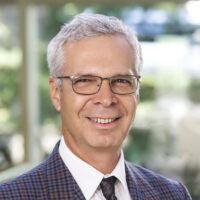 Jaffé has played a pivotal role in shaping several academic units at Princeton since joining the faculty in 1985. He was the first chair of the Department of Civil and Environmental Engineering from 1999 to 2005 and contributed significantly to the creation of the High Meadows Environmental Institute, founded in 1994 as Princeton Environmental Institute. He also played a key role in the early days of the Andlinger Center for Energy and the Environment, stepping in as associate director for research from 2013 to 2019.
His research interests relate to the physical, chemical, and biological processes that govern the transport and transformation of pollutants in the environment and their application toward the remediation of contaminated systems.