Annual Report for the Academic Year 2025–2026
Sustainable Buildings and Transportation
With expertise spanning materials science, process modeling and optimization, and policy, researchers at the Andlinger Center are lowering the carbon intensity of the built environment.
RESEARCH IN ACTION
Optics research uses dim light to produce bright LEDs
Digital displays on everything from televisions to iPhones to gaming devices have been transformed by organic-light emitting diode (OLED) technology because they provide exceptionally fast response times and low power consumption. Despite the benefits, the technology remains plagued by the “Blue Problem,” because generating blue light requires high energy and can lead to instability, making blue OLEDs challenging to operate.
The Blue Problem may be solved with a technique called upconversion. During upconversion, molecules absorb energy from incoming light and temporarily store it by shifting electrons into an excited orbital state. The excited molecules collide and release the stored energy as higher-energy (bluer) versions of light. Yet, older upconversion techniques require high-power input, limiting their applicability
Now, Princeton researchers have developed a technique that substantially improves the ability of materials to turn low-energy light into a high-energy version. Led by Barry Rand, professor of electrical and computer engineering and the Andlinger Center, the research team proposed leveraging a phenomenon called plasmonics to boost upconversion on a thin metal film. A paper on the work was published in the journal Nature Photonics.
Some materials, mainly metals, have electrons that are not bound to specific atoms and instead exist as free electrons in the metal. When light hits these free electrons, it sets off an oscillation that merges the light’s energy with the electrons’ movement. These oscillations, called plasmons, concentrate light and enhance the electromagnetic field.
The research team described how they used a silver film to generate surface plasmons by exposing the film to low-energy light. As the plasmons propagated across the silver film, they increased the absorption of light by upconversion molecules on the film by about ten times compared to previous setups. The researchers said that in experiments the increased absorption reduced the power needed to drive the reaction by 19 times compared to a non-plasmonic system.
The researchers then built an OLED to test the method and demonstrate viability. They used the plasmonic film to generate blue light, and then combined the blue light with green and red light from an existing OLED to generate white light. With their demonstration, the researchers showed that the thin-film technology can serve as a blue-light source without the need for high-energy input or special materials.
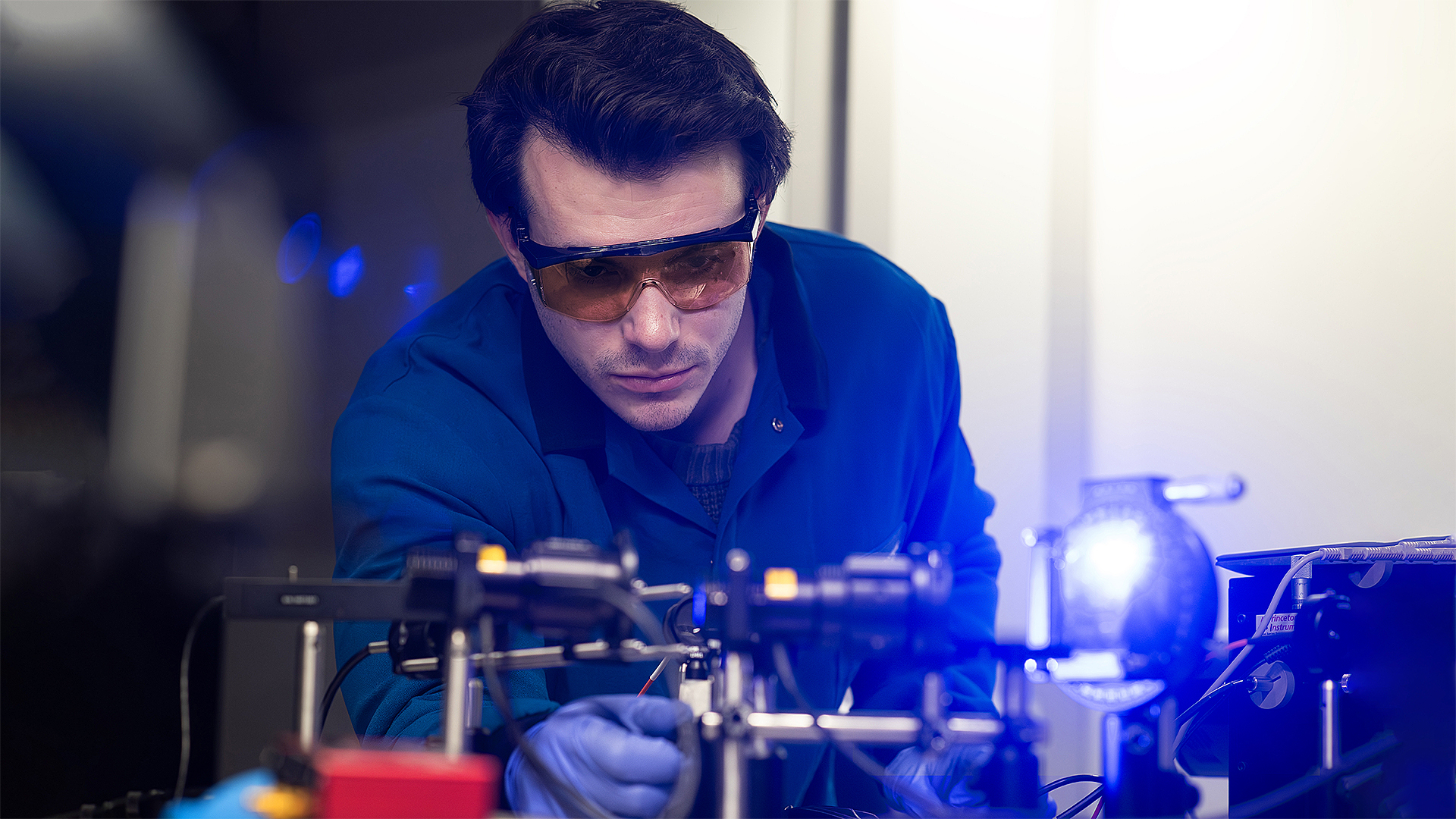
Captions: Banner: Jesse Wisch, a former Rand Lab graduate student now at Apple, led experimental work that could enhance lighting and displays. (Photo by Bumper DeJesus)
GRANT FOR INNOVATIVE RESEARCH IN ENERGY AND THE ENVIRONMENT
AI and robotics advance building efficiency
The Andlinger Center is supporting a team led by Arash Adel, assistant professor at the School of Architecture, to apply artificial intelligence and robotic manufacturing to radically improve the process of designing and manufacturing external insulation panels for buildings. External insulating panels can drastically cut energy wastage caused by inefficiencies in existing buildings’ design and construction, such as the lack of proper insulation.
In practice, the project will involve developing AI models to make digital reconstructions of building exteriors, using these models to design cost- and performance-optimized retrofit panels, and developing a robotics platform coupled with AI to create adaptive manufacturing of insulating panels from custom materials.
FUND FOR ENERGY RESEARCH WITH CORPORATE PARTNERS
Decarbonizing load-bearing systems in buildings
Buildings and infrastructure drive one-third of global carbon dioxide emissions. In turn, the largest share of those emissions are produced from the manufacturing of supportive structures that carry a building’s weight. These load bearing systems are typically created from new materials produced by energy-intensive processes.
With support from the Andlinger Center’s Fund for Energy Research with Corporate Partners, Sigrid Adriaenssens, Ritter Professor of Civil and Environmental Engineering, and Parastoo Abtahi, assistant professor of computer science, will develop an augmented reality construction framework for producing loadbearing systems from reclaimed masonry. The project will be carried out with the architectural and engineering firm SOM as the corporate partner.
RESEARCH IN ACTION
The proteins that could turn husks into fuel
 Stalks, husks and other crop waste show promise as feedstock for sustainable biofuels, but finding microbes that can convert woody plant matter into fuel at industrial scale has proven difficult. Now, researchers from the lab of Jonathan Conway, assistant professor of chemical and biological engineering, have taken a step toward engineering a bacterium that converts the material cellulose, found in nearly all plants, into fuels and valuable chemical products.
In a study, the research team looked at the metabolic system of the bacterium Anaerocellum bescii, which is capable of breaking down tough cellulose into bite-sized chunks of sugars, then eating those sugars and metabolizing them into fuel. The study identifies the proteins responsible for pulling those chunks inside the microbe’s cell to be metabolized into fuel and shows how editing the organism’s genome can make the microbe even more useful.
In addition to directly improving the microbe’s performance in making fuels, Conways’ group is seeking to better understand its basic biology. “The only way for metabolic engineering to really progress is by having a much better sense of what you are trying to engineer in the first place,” said the paper’s first author, graduate student Hansen Tjo.
Captions: Researchers hope to engineer microbes to convert biomass, like these soybean husks in the Conway lab, into useful chemical products, including fuel. (Photo by Bumper DeJesus)