Annual Report for the Academic Year 2025–2026
Education
Acknowledging the power sector’s role as a lynchpin for economy-wide decarbonization, the Andlinger Center is advancing clean energy and grid modernization solutions to transition toward sustainable electric power.
2026 Class Day
Training the next generation of leaders
The Andlinger Center’s Minor in Sustainable Energy gives Princeton students hands-on experiences with a wide range of energy and environmental topics, from exploring next-generation energy technologies to learning the intricacies of energy markets and regulations. The program challenges students to gain a well-rounded understanding of how energy and society interact, providing them with the rigorous foundation they need to make tangible, positive impacts on the world.
In the 2025-2026 academic year, the Andlinger Center honored 22 graduating seniors at the annual Class Day ceremony for their successful completion of the Minor in Sustainable Energy. Students were also recognized for undertaking a variety of independent research projects. The research submitted by the members of the graduating class covered topics including industrial decarbonization, critical minerals policy, photovoltaics, clean energy supply chains, and more.
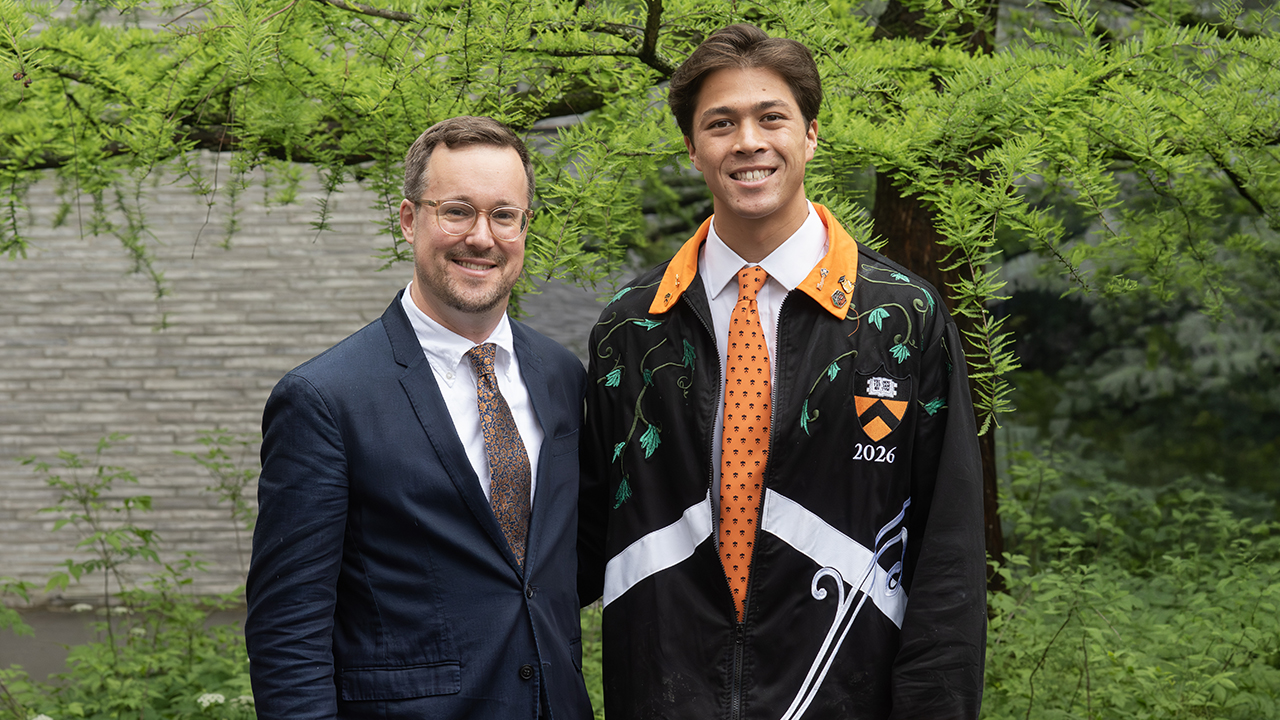
At the ceremony, the Andlinger Center Research Prize in Energy and the Environment was awarded to electrical and computer engineering student Alex Tseng for his work on an algorithm for battery dispatch, or the scheduled control of a battery storage system. The work was chosen for both its outstanding research and commitment to solving one of the world’s pressing energy challenges.
Large grid-connected batteries can store cheap, clean electricity when renewable energies — like wind and solar — produce more power than the grid needs. This stored energy can then be released later, during peak demand, reducing reliance on expensive, polluting power. Tseng’s thesis attempts to improve the forecasting and optimization required to control these assets so they can more effectively make the grid cheaper, cleaner, and more reliable.
“Part of the reason I came to Princeton was for the Andlinger Center,” said Tseng. The classes he took, he said, deepened his interest in quantitative methods for making the grid efficient and reliable. “Energy storage, which is really an emerging market, seems like the perfect thing to work in.”
Tseng and his classmates will pursue a diverse range of careers after graduation. Some students will proceed into graduate programs in fields varying from public affairs to aerospace engineering. Others will go into industry as environmental engineers or as investment analysts focused on renewable energy and carbon capture technologies.
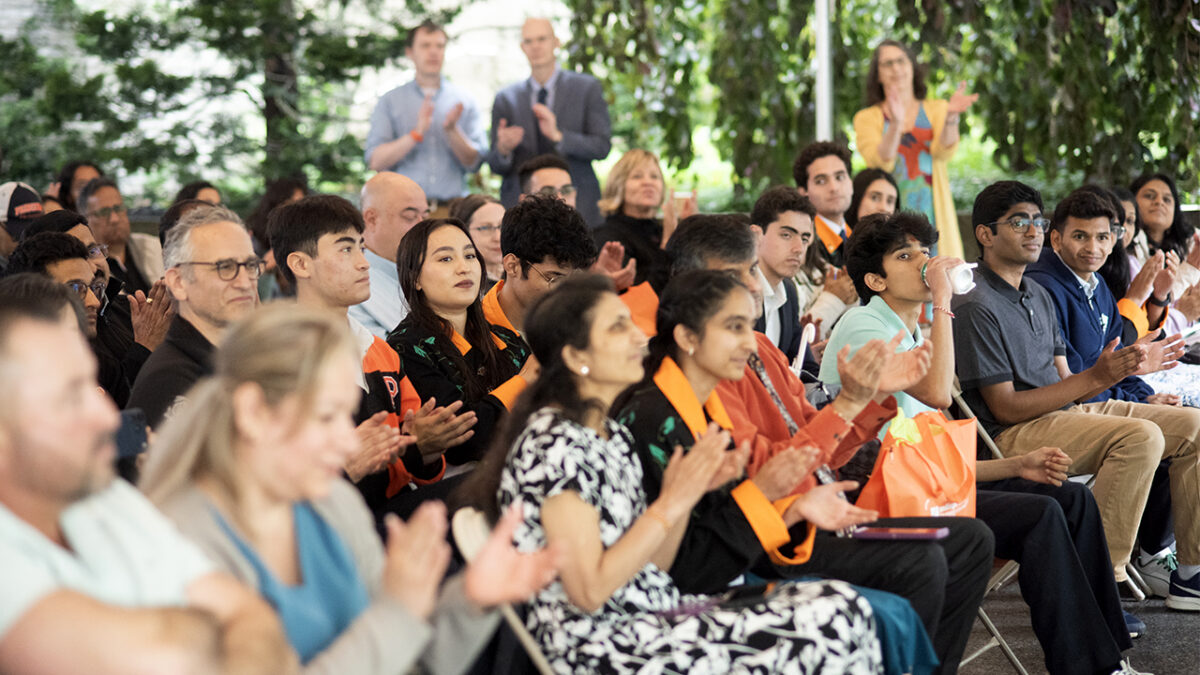
In closing the ceremony, Egemen Kolemen, professor of mechanical and aerospace engineering jointly appointed with the Andlinger Center and director of the Minor in Sustainable Energy, thanked the students and their families for joining in the celebration. “My colleagues and I offer each member of the Program in Sustainable Energy, Class of 2026, our warmest congratulations, and wish you the very best as you embark in your careers and future studies,” said Kolemen.
Read the full article
Captions:
Banner: Alex Tseng, under the guidance of his adviser Jesse Jenkins (left), conducted his thesis titled “Bidding on Tomorrow: Dispatch Algorithms for Energy Storage Resources.”
Top: Chana Mitty, a politics major, celebrates with her family during the Class Day ceremony in Maeder Courtyard. Mitty also received the Lyman H. Atwater Prize for the best thesis in the Department of Politics and graduated magna cum laude from the university.
Inset: Rebecca Chleboski, who completed her studies in electrical and computer engineering, receives her certificate and parting gift from Egemen Kolemen. (Photos by Bumper DeJesus)
Andlinger Center summer internships
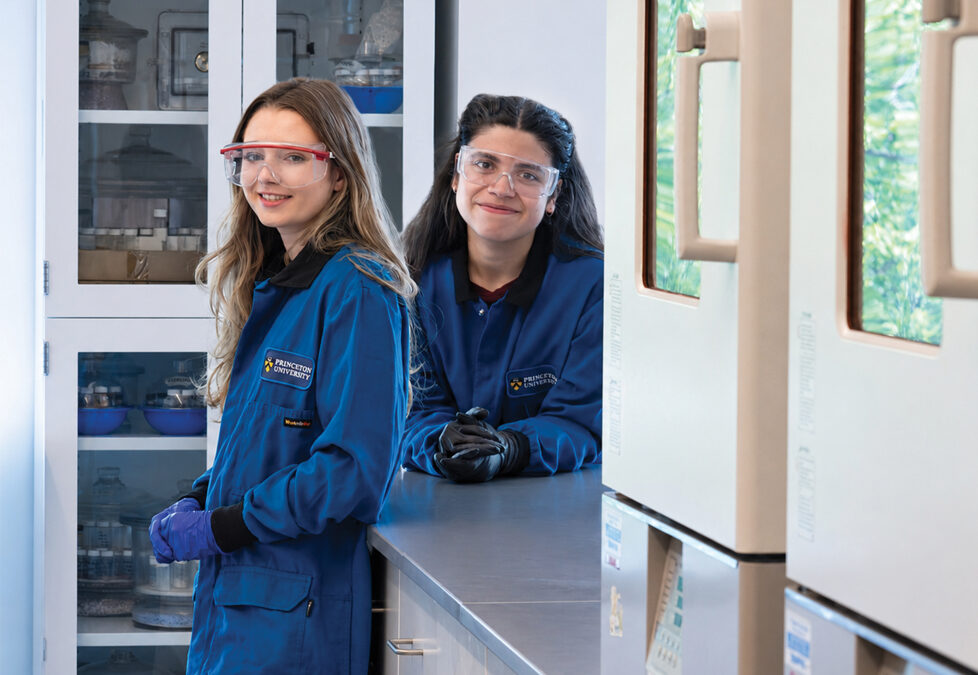
In 2026, the Andlinger Center funded 22 summer internships for Princeton students across 16 different energy and environmental research projects. Since the internship program began in 2011, the Center has supported 207 students, who have worked alongside Princeton faculty and our non-profit and public sector partners to tackle a myriad of energy and environmental challenges.
The student internship program is supported by the Peter B. Lewis Fund for Student Innovation in Energy and the Environment, The Sustainability Fund, the Dede T. Bartlett P03 Fund for Student Research in Energy and the Environment, and Princeton University’s Learning and Education in Service (LENS) initiative.
Kleiber Castanon (MAE ’27) and Kevin Tsao (MAE ’28) / Professor Yiguang Ju / Plasma Assisted CO2 Reduction
Minli Guo (ECE ’28) and Sarah Rinzan (ECE ’27) / Professor Barry Rand / Controlling the Orientation of Organic Emitters in Thin-Film Host Matrices
AJ Harris (CBE ’28) / Moonshot Missions / Water Utility Research Intern
Toroti Iolaosho (MAE ’28) and Seth Markey (MAE ’28) /Associate Professor Jyotirmoy Mandal / Designing Optical and Thermal Strategies for Thermoregulating Buildings and the Broader Environment
Ashley Jimenez (CBE ’28) and Gianna Maltbie (CBE ’29) / Associate Professor Michele Sarazen / Aqueous Pollutant Degradation Using Microporous Sponges
Roy Kariuki (ECO ’28) / American Council for an Energy-Efficient Economy / BEAR Hub Initiative Intern
Cole Kawaja (Undecided ’29) / Professor Ronnie Sircar / AI-Aided Electricity Grid Digital Twins
David Lee (ORF ’27) and Vishrut Thoutam (COS ’29) / Professor Egemen Kolemen / AI Foundation Models for Understanding and Controlling Fusion Plasmas
Nathan Lee (CBE ’29) and Eli Swerdloff (MAE ’29) / Associate Professor Kelsey Hatzell / Solid Horizons: Advanced Solid-State Batteries for Next-Generation Electric Mobility
Khadija Ndiaye (ECE ’28) / Associate Professors Jesse Jenkins and Forrest Meggers / Bridging Building Energy Models and Capacity Expansion for Climate-Resilient Electrification
Arshad Persaud (ECE ’29) / Associate Professor Forrest Meggers / Novel Control and Operation of Heat Pumps
Caitlyn B. Rodrigues (’29) / Instituto SENAI de Inovacao em Eletroquimica, Brazil Intern
Moulya Sayana (AST ’29) / Professor José Avalos / Biotechnological Solutions to Challenges in Sustainable Energy and the Environment
Amelie Sillitoe (PHY ’28) / Professor Emily Carter / Modeling Magnesium-Carbonate Ion Pairing in Water with Machine-Learning-Accelerated Molecular Dynamics Based on Density Functional Theory and Beyond
Sastha Tripathi (SPI ’28) / Environmental Defense Fund / Global Engagement and Partnerships Intern
Andrew Zhou (’29) / Global Centre for Maritime Decarbonisation Intern
Captions: (Illustration by Bumper DeJesus)