Annual Report for the Academic Year 2025–2026

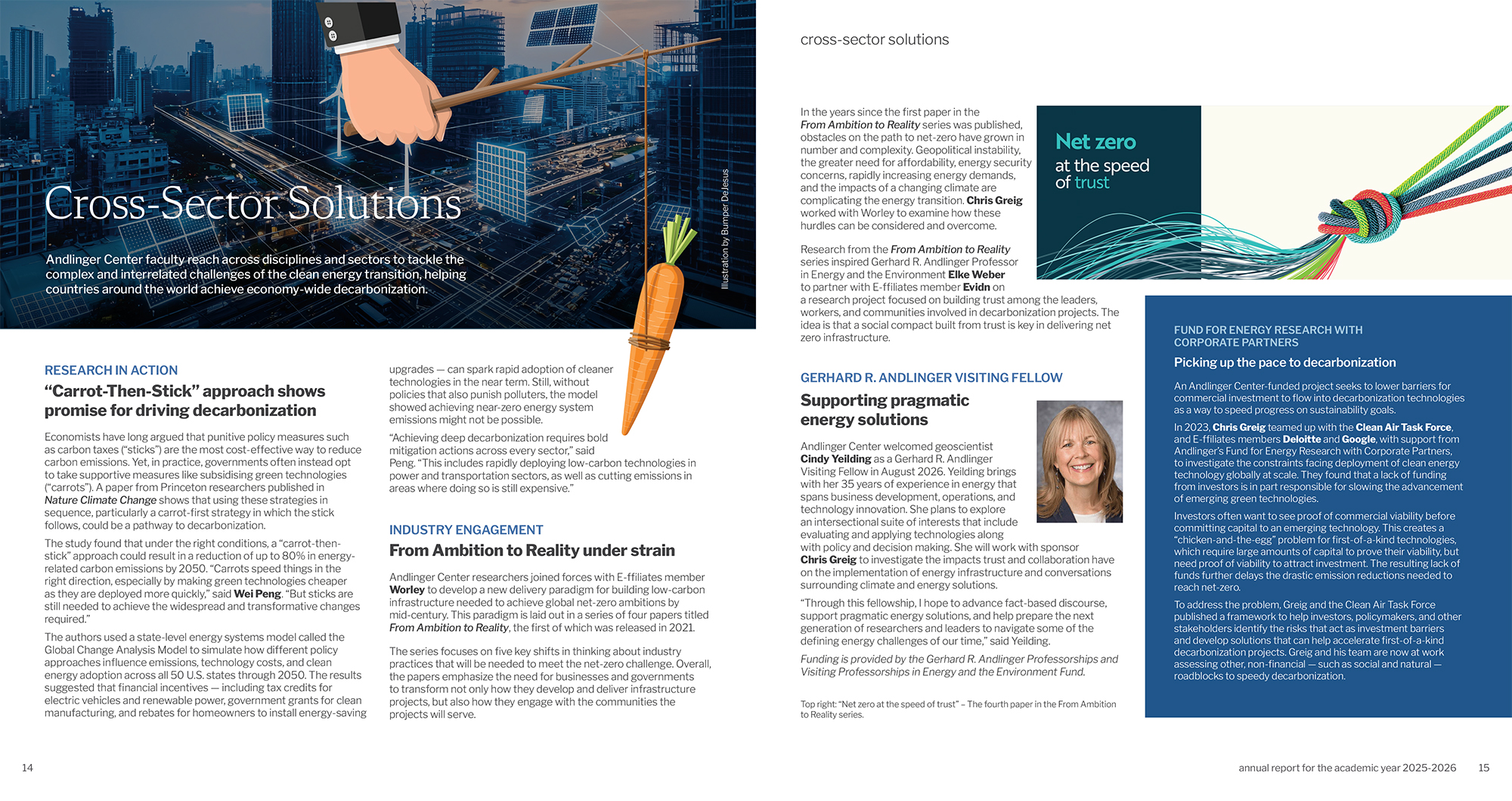
Cross-Sector Solutions
Andlinger Center faculty reach across disciplines and sectors to tackle the complex and interrelated challenges of the clean energy transition, helping countries around the world achieve economy-wide decarbonization
RESEARCH IN ACTION
“Carrot-Then-Stick” approach shows promise for driving decarbonization
Economists have long argued that punitive policy measures such as carbon taxes (“sticks”) are the most cost-effective way to reduce carbon emissions. Yet, in practice, governments often instead opt to take supportive measures like subsidising green technologies (“carrots”). A paper from Princeton researchers published in Nature Climate Change shows that using these strategies in sequence, particularly a carrot-first strategy in which the stick follows, could be a pathway to decarbonization.
The study found that under the right conditions, a “carrot-then-stick” approach could result in a reduction of up to 80% in energy-related carbon emissions by 2050. “Carrots speed things in the right direction, especially by making green technologies cheaper as they are deployed more quickly,” said Wei Peng. “But sticks are still needed to achieve the widespread and transformative changes required.”
The authors used a state-level energy systems model called the Global Change Analysis Model to simulate how different policy approaches influence emissions, technology costs, and clean energy adoption across all 50 U.S. states through 2050. The results suggested that financial incentives — including tax credits for electric vehicles and renewable power, government grants for clean manufacturing, and rebates for homeowners to install energy-saving upgrades — can spark rapid adoption of cleaner technologies in the near term. Still, without policies that also punish polluters, the model showed achieving near-zero energy system emissions might not be possible.
“Achieving deep decarbonization requires bold mitigation actions across every sector,” said Peng. “This includes rapidly deploying low-carbon technologies in power and transportation sectors, as well as cutting emissions in areas where doing so is still expensive.”
Captions: (Banner illustration by Bumper DeJesus)
RESEARCH IN ACTION
From Ambition to Reality Under Strain
 Andlinger Center researchers joined forces with E-ffiliates member Worley to develop a new delivery paradigm for building low-carbon infrastructure needed to achieve global net zero ambitions by mid-century. This paradigm is laid out in a series of four papers titled From Ambition to Reality, the first of which was released in 2021.
The series focuses on five key shifts in thinking about industry practices that will be needed to meet the net zero challenge. Overall, the papers emphasize the need for businesses and governments to transform not only how they develop and deliver infrastructure projects, but also how they engage with the communities the projects will serve.
In the years since the first paper in the From Ambition to Reality series was published, obstacles on the path to net-zero have grown in number and complexity. Geopolitical instability, the greater need for affordability, energy security concerns, rapidly increasing energy demands, and the impacts of a changing climate are complicating the energy transition. Chris Greig worked with Worley to examine how these hurdles can be considered and overcome.
Research from the From Ambition to Reality series inspired Gerhard R. Andlinger Professor in Energy and the Environment Elke Weber to partner with E-ffiliates member Evidn on a research project focused on building trust among the leaders, workers, and communities involved in decarbonization projects. The idea is that a social compact built from trust is key in delivering net zero infrastructure.
GERHARD R. ANDLINGER VISITING FELLOW
Supporting pragmatic energy solutions
 The Andlinger Center welcomed geoscientist Cindy Yeilding as a Gerhard R. Andlinger Visiting Fellow in August 2026. Yeilding brings with her 35 years of experience in energy that spans business development, operations, and technology innovation. She plans to explore an intersectional suite of interests that include evaluating and applying technologies along with policy and decision making. She will work with sponsor Chris Greig to investigate the impacts trust and collaboration have on the implementation of energy infrastructure and conversations surrounding climate and energy solutions.
“Through this fellowship, I hope to advance fact-based discourse, support pragmatic energy solutions, and help prepare the next generation of researchers and leaders to navigate some of the defining energy challenges of our time,” said Yeilding.
Funding is provided by the Gerhard R. Andlinger Professorships and Visiting Professorships in Energy and the Environment Fund
FUND FOR ENERGY RESEARCH WITH CORPORATE PARTNERS
Picking up the pace to decarbonization
An Andlinger Center-funded project seeks to lower barriers for commercial investment to flow into decarbonization technologies as a way to speed progress on sustainability goals.
In 2023, Chris Greig teamed up with the Clean Air Task Force, and E-ffiliates members Deloitte and Google, with support from Andlinger’s Fund for Energy Research with Corporate Partners, to investigate the constraints facing deployment of clean energy technology globally at scale. They found that a lack of funding from investors is in part responsible for slowing the advancement of emerging green technologies.
Investors often want to see proof of commercial viability before committing capital to an emerging technology. This creates a “chicken-and-the-egg” problem for first-of-a-kind technologies, which require large amounts of capital to prove their viability, but need proof of viability to attract investment. The resulting lack of funds further delays the drastic emission reductions needed to reach net-zero.
To address the problem, Greig and the Clean Air Task Force published a framework to help investors, policymakers, and other stakeholders identify the risks that act as investment barriers and develop solutions that can help accelerate first-of-a-kind decarbonization projects. Greig and his team are now at work assessing other, non-financial — such as social and natural — roadblocks to speedy decarbonization.